


The World Cup's growth in popularity could cost the US.
FIFA's executive committee still hasn't decided if it will stay with regional rotation of World Cup sites past 2014. The North and Central American and Caribbean region is due to get the World Cup in 2018 under the current system, and the US plans to bid.
But the World Cup has become such a big event -- in fan interest, television ratings and ticket sales -- that it no longer matters where it's played, FIFA president Sepp Blatter said on Sunday.
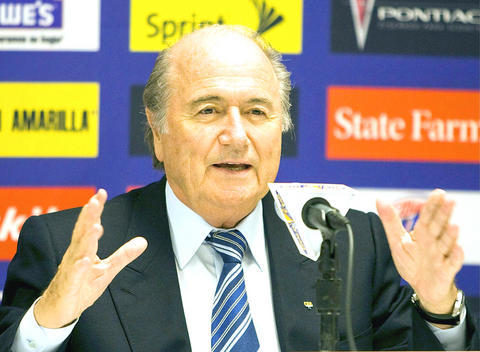
PHOTO: EPA
"Now the executive committee is confronted with the question: What will happen next?" Blatter said before the Gold Cup final. "If we go on with the rotation as it is, then the next one should go to the CONCACAF. On the other hand, you have people asking that every third time, the World Cup should come back to Europe. Why?"
not important
"We have realized it's not important where the World Cup is played concerning the impact of the World Cup," he said. "The product nowadays, for emotion, for passion, for bringing people together is such ... that it is not so important where you play."
The World Cup will be played in South Africa in 2010. Brazil is the sole candidate to host in 2014, and FIFA's executive committee is scheduled to vote in November.
Blatter also said that while South Africa needs to improve its transportation system, he was confident the country can put on a successful World Cup. He toured stadium sites and met with officials from the government and local organizing committee during a visit there last week.
Security won't be an issue, either, Blatter promised.
"In all big cities, there is a problem of security and there is a lot of crime. But when you know where the danger is, you can take the adequate measures," he said. "There is unity now in this country behind this competition. Let's trust South Africa and the African continent they will be able to receive all the visitors with open arms and open hearts."
ban furor
Blatter also defended FIFA's ban on high-altitude games, which has caused a furor in several South American countries. FIFA last month banned international tournaments and World Cup qualifying matches at any stadium above 2,500m. That rules out games in the capitals of Bolivia, Colombia, Ecuador and the stadiums of leading teams in Peru, Chile and Mexico.
The problem isn't the altitude, but the lack of time players have to adjust to it, Blatter said. The South America region continues to play its World Cup qualifiers on consecutive days, playing games Saturday and Sunday, and Tuesday and Wednesday.
"There is no possibility for acclimatization," Blatter said. "If you don't have time for this acclimatization, then your health can suffer."
"We have never said you can't play," he said. "This is only for the qualifications for the World Cup. Club competitions, national competitions, they can play wherever they want to play."
problems
CONCACAF president Jack Warner acknowledged there have been some problems with refereeing at the Gold Cup, but said none were deliberate. He also refused to single out any referees who had problems.
The US advanced to Sunday's final after the Canadians had a goal waved off in the final minute of injury time on a disputed offside call.
"Referees are human beings like anyone else. They can make mistakes at any level and I admit some mistakes have been made," Warner said. "But at no point and time has it been fixed for any country. It would be an absurd thing to do."
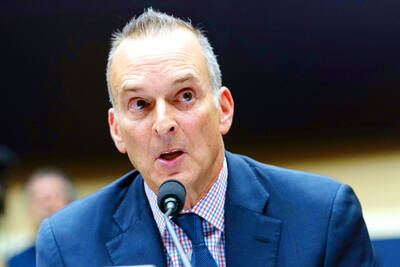
Revelations of positive doping tests for nearly two dozen Chinese swimmers that went unpunished sparked an intense flurry of accusations and legal threats between the World Anti-Doping Agency (WADA) and the head of the US drug-fighting organization, who has long been one of WADA’s fiercest critics. WADA on Saturday said it was turning to legal counsel to address a statement released by US Anti-Doping Agency (USADA) CEO Travis Tygart, who said WADA and anti-doping authorities in China swept positive tests “under the carpet by failing to fairly and evenly follow the global rules that apply to everyone else in the world.” The
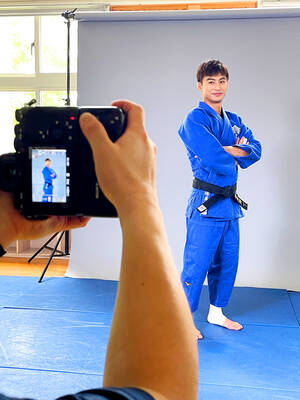
Taiwanese judoka Yang Yung-wei on Saturday won silver in the men’s under-60kg category at the Asian Judo Championships in Hong Kong. Nicknamed the “judo heartthrob” in Taiwan, the Olympic silver-medalist missed out on his first Asian Championships gold when he lost to Japanese judoka Taiki Nakamura in the finals. Yang defeated three opponents on Saturday to reach the final after receiving a bye through the round of 32. He first topped Laotian Soukphaxay Sithisane in the round of 16 with two seoi nage (over-the-shoulder throws), then ousted Indian Vijay Kumar Yadav in the quarter-finals with his signature ude hishigi sankaku gatame (triangular armlock). He

RALLY: It was only the second time the Taiwanese has partnered with Kudermetova, and the match seemed tight until they won seven points in a row to take the last set 10-2 Taiwan’s Chan Hao-ching and Russia’s Veronika Kudermetova on Sunday won the Porsche Tennis Grand Prix women’s doubles final in Stuttgart, Germany. The pair defeated Norway’s Ulrikke Eikeri and Estonia’s Ingrid Neel 4-6, 6-3, 10-2 in a tightly contested match at the WTA 500 tournament. Chan and Kudermetova fell 4-6 in the first set after having their serve broken three times, although they played increasingly well. They fought back in the second set and managed to break their opponents’ serve in the eighth game to triumph 6-3. In the tiebreaker, Chan and Kudermetova took a 3-0 lead before their opponents clawed back two points, but
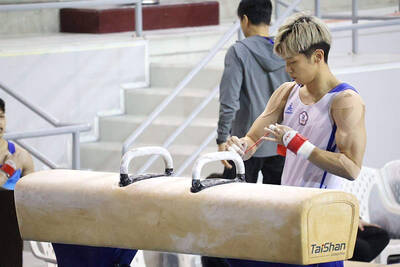
Taiwanese gymnast Lee Chih-kai failed to secure an Olympic berth in the pommel horse following a second-place finish at the last qualifier in Doha on Friday, a performance that Lee and his coach called “unconvincing.” The Tokyo Olympics silver medalist finished runner-up in the final after scoring 6.6 for degree of difficulty and 8.800 for execution for a combined score of 15.400. That was just 0.100 short of Jordan’s Ahmad Abu Al Soud, who had qualified for the event in Paris before the Apparatus World Cup series in Qatar’s capital. After missing the final rounds in the first two of four qualifier


 RSS
RSS