


Champion amputee sprinter Oscar Pistorius can compete against the world's best able-bodied athletes while researchers try to determine whether his prosthetics give him an unfair advantage, a spokesman for the international track authority said on Friday.
But Nick Davies, spokesman for the International Association of Athletics Federations (IAAF), said discussion of Pistorius competing in the Olympics was premature, noting the 20-year-old sprinter had not yet achieved the kind of times that would allow him to qualify.
"Oscar can compete. No one can stop him running," Davies said.

PHOTO: AP
In March, the IAAF introduced a new rule banning any runner deemed to benefit from artificial help from competing. That had widely been interpreted as scuttling Pistorius' hopes of being the first disabled runner to compete in the Olympic Games, with his sights set on Beijing next year.
"They have changed their stance," Van Zyl said. "This is a totally different stance from when they introduced the rule change."
Van Zyl said he now had to get Pistorius into "tiptop" shape for his international debut.
The 20-year-old Pistorius was born without fibula bones in his lower legs and was only 11 months old when the limbs were amputated from below the knee.
He has been dubbed "Blade Runner" because of the shape of the feet at the end of his carbon fiber legs and "the fastest man on no legs."
"I want to go forward and I can't if I have to compete only at a local level. The way to go forward is by running against people faster than me," Pistorius said in an interview on Thursday.
Davies said the March rule had been misinterpreted. It prohibits the "use of any technical device that incorporates springs, wheels or any other element that provides the user with an advantage over another athlete not using such a device." It was aimed at sophisticated gadgets manufacturers add to the shoes of top athletes.
Banning Pistorius "was never the purpose of the rule. It was never the intention. It would have been unfair," Davies said.
Davies said the new development was that the organization was going to take it upon itself to work with Pistorius to conduct scientific research and tests on the runner and his prosthetics. Davies said one of the aims was developing criteria on prosthetics and other aides.
"We need to establish the facts and we want to do this together. We have nothing against disabled athletes, on the contrary, but we need to be fair," Davies said, saying Pistorius's case was taking the federation into new and unfamiliar territory.
"This issue is so new. Oscar is an exceptional athlete, maybe unique. He is on the very edge of disabled and able-bodied sports. No one else has ever done that, that is why we are in the dark," Davies said.
Pistorius is adamant his blades give him no advantage or extra energy and that his stride is no longer than anyone else's.
"They are passive devices. If anything I am at more of a disadvantage. I have no ankles. There is less blood flowing through my body. I have no calf muscles so I have to use more muscles to do what they would," he said. "These exact feet have been used for 14 years and there has never been a paralympic sprinter to run my times."
Pistorius has clocked 10.91 seconds in the 100m, 21.58 seconds in the 200 and 46.56 seconds in the 400. Those are world records for disabled athletes, and he finished second in the 400m at the South African Championships -- the able-bodied meet -- in March.
Pistorius' times are still short of the 46.3 seconds in the 400m that he needs to qualify for the Olympics, but he hopes he can improve before next year's July deadline for meeting qualification requirements.
Davies said Pistorius might have a more realistic chance at qualifying in a relay event, which would only require him to be among his country's top six athletes.
That decision would be made by Athletics South Africa, "and it is a tough one for them," Davies said.
Linda Ferns, general manager of Athletics South Africa, would like to see a scientific resolution to Pistorius's case and said she was aware the IAAF was undertaking research.
Pistorius has played competitive rugby, water polo and tennis at school level. He only took up running in 2004 after a rugby injury.
When he's not wearing the prosthetics designed for sprinting, Pistorius has flesh-colored prosthetics with well-defined calves to fit his muscular frame.
"He is unique. Because he learnt to walk on prosthetics from a young age he has got balance," said renowned South African sports scientists Tim Noakes. "It is remarkable that he can maintain that balance at the speeds he reaches. He can use the equipment effectively. I have very high regard for what he has achieved."
Noakes believes that disabled athletes could be competing in the next Olympics. He is more concerned about the high amount of doping in sports and feels these aides don't give athletes as much, if any of an advantage, compared with taking steroids.
Pistorius's ambitions to make Beijing are not about winning or making any grand points about disability. He wants to take part because of the very spirit behind the Olympics.
"It would be as special for me as the next guy," he said.

US track and field athletes have about four dozen pieces to choose from when assembling their uniforms at the Olympics. The one grabbing the most attention is a high-cut leotard that barely covers the bikini line and has triggered debate between those who think it is sexist and others who say they do not need the Internet to make sure they have good uniforms. Among those critical or laughing at the uniforms included Paralympian Femita Ayanbeku, sprinter Britton Wilson and even athletes from other countries such as Britain’s Abigail Irozuru, who wrote on social media: “Was ANY female athlete consulted in

Four-time NBA all-star DeMarcus Cousins arrived in Taiwan with his family early yesterday to finish his renewed contract with the Taiwan Beer Leopards in the T1 League. Cousins initially played a four-game contract with the Leopards in January. On March 18, the Taoyuan-based team announced that Cousins had renewed his contract. “Hi what’s up Leopard fans, I’m back. I’m excited to be back and can’t wait to join the team,” Cousins said in a video posted on the Leopard’s Facebook page. “Most of all, can’t wait to see you guys, the fans, next weekend. So make sure you come out and support the Beer

Former US Masters champion Zach Johnson was left embarrassed after a foul-mouthed response to ironic cheers from spectators after a triple bogey at Augusta National on Friday. Johnson, the 2007 Masters winner, missed the cut after his three-over-par round of 75 left him on seven-over 151 for 36 holes, his six on the par-three 12th playing a big role in his downfall. Television footage showed Johnson reacting to sarcastic cheers and applause when he tapped in for the triple bogey by yelling: “Oh fuck off.” Such a response would be considered bad form in any golf tournament, but is particularly out of keeping
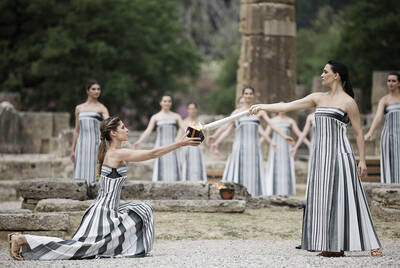
The sacred flame for the Paris Olympics was lit yesterday in Olympia, Greece, the birthplace of the ancient Games, in a ceremony inspired by antiquity and marked by messages of hope amid multiple global crises. “In ancient times, the Olympic Games brought together the Greek city states, even — and in particular — during times of war and conflict,” International Olympic Committee president Thomas Bach said. “Today, the Olympic Games are the only event that brings the entire world together in peaceful competition. Then as now, the Olympic athletes are sending this powerful message — yes, it is possible to compete fiercely


 RSS
RSS