


Floyd Landis' battle to retain his title in last year's Tour de France entered a new stage on Monday with the opening of his hearing before a panel of the American Arbitration Association.
The 31-year-old cyclist, whose dark suit set off a yellow tie that couldn't help but call to mind the yellow jersey he wore as Tour leader and champion last July, said he was looking forward to the hearing as a chance to clear his name.
"We have a very good team and we have an exceptional case," he said as he arrived at the School of Law at Pepperdine University, where the hearing is being held in a small courtroom.
The three arbitrators were panel chairman Patrice Brunet, US Anti-Doping Agency nominee Richard McLaren and Christopher Campbell, who was selected by Landis.
Landis is facing a two-year ban and could become the first Tour de France champion to be stripped of the title.
Maurice Suh, lead attorney for Landis' defense team, charged that the US doping agency's entire case is built on faulty scientific methods used by the Laboratoire National Depistage de Dopage in France.
"This case is an utter disaster," Suh said.
Over the course of the 10-day hearing, Suh said Landis' camp will outline eight violations of the International Standard for Laboratories, which governs procedures at laboratories sanctioned by the World Anti-Doping Agency.
"A disaster doesn't result from one or two things going wrong. It results from many things going wrong at the same time," Suh said.
In requesting a public hearing, Landis has said he hopes to shine a light on doping prosecutions that deny accused athletes due process.
"This is a historic case," Suh said. "It has to be done right."
However, US doping agency attorney Richard Young painted the case as just "one of dozens" of similar cases in which scientific data would show Landis had used synthetic testosterone.
"Despite all the attention this case has received, it's not particularly special ... this is just one of many similar cases," Young said.
"No matter how the data was processed, the results were still positive," Young said.
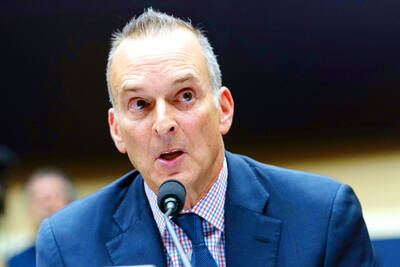
Revelations of positive doping tests for nearly two dozen Chinese swimmers that went unpunished sparked an intense flurry of accusations and legal threats between the World Anti-Doping Agency (WADA) and the head of the US drug-fighting organization, who has long been one of WADA’s fiercest critics. WADA on Saturday said it was turning to legal counsel to address a statement released by US Anti-Doping Agency (USADA) CEO Travis Tygart, who said WADA and anti-doping authorities in China swept positive tests “under the carpet by failing to fairly and evenly follow the global rules that apply to everyone else in the world.” The

Taiwanese judoka Yang Yung-wei on Saturday won silver in the men’s under-60kg category at the Asian Judo Championships in Hong Kong. Nicknamed the “judo heartthrob” in Taiwan, the Olympic silver-medalist missed out on his first Asian Championships gold when he lost to Japanese judoka Taiki Nakamura in the finals. Yang defeated three opponents on Saturday to reach the final after receiving a bye through the round of 32. He first topped Laotian Soukphaxay Sithisane in the round of 16 with two seoi nage (over-the-shoulder throws), then ousted Indian Vijay Kumar Yadav in the quarter-finals with his signature ude hishigi sankaku gatame (triangular armlock). He
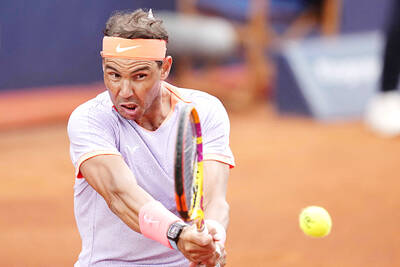
Rafael Nadal on Wednesday said the upcoming French Open would be the moment to “give everything and die” on the court after his comeback from injury in Barcelona was curtailed by Alex de Minaur. The 22-time Grand Slam title winner, back playing this week after three months on the sidelines, battled well, but eventually crumbled 7-5, 6-1 against the world No. 11 from Australia in the second round. Nadal, 37, who missed virtually all of last season, is hoping to compete at the French Open next month where he is the record 14-time champion. The Spaniard said the clash with De Minaur was

RALLY: It was only the second time the Taiwanese has partnered with Kudermetova, and the match seemed tight until they won seven points in a row to take the last set 10-2 Taiwan’s Chan Hao-ching and Russia’s Veronika Kudermetova on Sunday won the Porsche Tennis Grand Prix women’s doubles final in Stuttgart, Germany. The pair defeated Norway’s Ulrikke Eikeri and Estonia’s Ingrid Neel 4-6, 6-3, 10-2 in a tightly contested match at the WTA 500 tournament. Chan and Kudermetova fell 4-6 in the first set after having their serve broken three times, although they played increasingly well. They fought back in the second set and managed to break their opponents’ serve in the eighth game to triumph 6-3. In the tiebreaker, Chan and Kudermetova took a 3-0 lead before their opponents clawed back two points, but


 RSS
RSS