


England's 1966 World Cup winner Alan Ball has died from a heart attack while tackling a fire in his garden, police said on Wednesday. He was 61.
At 21, Ball was the youngest member of England's only World Cup-winning team. His tireless man-of-the-match performance in the 4-2 defeat of West Germany in the final typified his attitude to soccer.
The England legend collapsed and died outside his home after attempting to fight a blaze that had got out of control, police said, adding that his death was not being treated as suspicious.
Ball is the second member of the side to die. Captain Bobby Moore died of cancer in 1993.
Ball played 72 times for his country between 1965 and 1975, scoring eight goals and captaining the side six times.
The former Arsenal and Everton midfielder also forged a career in management, taking charge at Southampton, Manchester City and Portsmouth.
Ball's son Jimmy said his father had watched on television as Manchester United beat visitors AC Milan 3-2 in Tuesday's Champions League semi-final first leg.
"I was talking to him last night just after the football and he was in great form. We were talking about [Paul] Scholes' pass," he said from his father's home. "And then I got a phone call in the middle of the night. It's unbelievable and very, very sad."
"I would like him to be known as a nice man with a passion for football. He had a big heart and was very generous," he added.
Ball cut a distinctive figure with his diminutive stature, high-pitched voice and flame-red hair.
In the 1966 World Cup final, his cross set up striker Geoff Hurst's famously controversial goal that put England 3-2 ahead in extra time.
Hurst said fellow teammates were "all totally devastated" by Ball's death.
"He was the youngest member of the team and man of the match in the 1966 World Cup final," he said.
Born James Alan Ball on May 12, 1945 in Bolton, northwest England, he began his career with Blackpool, turning professional in May 1962 and making his league debut that year aged 17.
His tenacious performances caught the eye of England manager Alf Ramsey, who gave him his first cap in a 1-1 draw with Yugoslavia in Belgrade in May 1965.
He made it into Ramsey's World Cup squad and earned a ?110,000 (US$220,000) move to Everton in August 1966.
Ball made 208 league appearances for the Toffees, scoring 66 goals. Everton were 1968 FA Cup finalists and won the 1969-1970 English title.
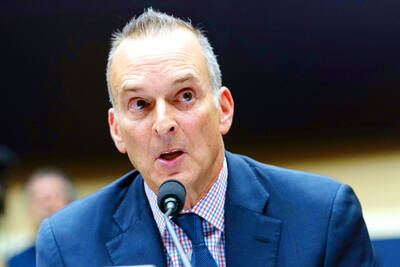
Revelations of positive doping tests for nearly two dozen Chinese swimmers that went unpunished sparked an intense flurry of accusations and legal threats between the World Anti-Doping Agency (WADA) and the head of the US drug-fighting organization, who has long been one of WADA’s fiercest critics. WADA on Saturday said it was turning to legal counsel to address a statement released by US Anti-Doping Agency (USADA) CEO Travis Tygart, who said WADA and anti-doping authorities in China swept positive tests “under the carpet by failing to fairly and evenly follow the global rules that apply to everyone else in the world.” The

Taiwanese judoka Yang Yung-wei on Saturday won silver in the men’s under-60kg category at the Asian Judo Championships in Hong Kong. Nicknamed the “judo heartthrob” in Taiwan, the Olympic silver-medalist missed out on his first Asian Championships gold when he lost to Japanese judoka Taiki Nakamura in the finals. Yang defeated three opponents on Saturday to reach the final after receiving a bye through the round of 32. He first topped Laotian Soukphaxay Sithisane in the round of 16 with two seoi nage (over-the-shoulder throws), then ousted Indian Vijay Kumar Yadav in the quarter-finals with his signature ude hishigi sankaku gatame (triangular armlock). He
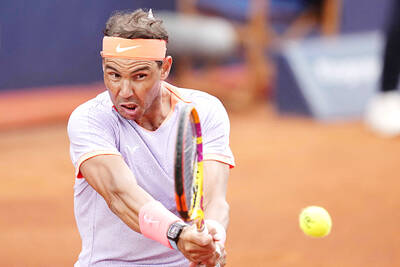
Rafael Nadal on Wednesday said the upcoming French Open would be the moment to “give everything and die” on the court after his comeback from injury in Barcelona was curtailed by Alex de Minaur. The 22-time Grand Slam title winner, back playing this week after three months on the sidelines, battled well, but eventually crumbled 7-5, 6-1 against the world No. 11 from Australia in the second round. Nadal, 37, who missed virtually all of last season, is hoping to compete at the French Open next month where he is the record 14-time champion. The Spaniard said the clash with De Minaur was

RALLY: It was only the second time the Taiwanese has partnered with Kudermetova, and the match seemed tight until they won seven points in a row to take the last set 10-2 Taiwan’s Chan Hao-ching and Russia’s Veronika Kudermetova on Sunday won the Porsche Tennis Grand Prix women’s doubles final in Stuttgart, Germany. The pair defeated Norway’s Ulrikke Eikeri and Estonia’s Ingrid Neel 4-6, 6-3, 10-2 in a tightly contested match at the WTA 500 tournament. Chan and Kudermetova fell 4-6 in the first set after having their serve broken three times, although they played increasingly well. They fought back in the second set and managed to break their opponents’ serve in the eighth game to triumph 6-3. In the tiebreaker, Chan and Kudermetova took a 3-0 lead before their opponents clawed back two points, but


 RSS
RSS