


Jarrod Washburn is reading a hunting magazine. Other Seattle Mariners are seated at a table in the middle of the clubhouse, working on a crossword puzzle a staffer has photocopied from the morning paper.
And Miguel Batista is seated alone and silent on a stool at his locker.
He's reading inside a three-ring binder with the title Human Cloning, researching for his second novel.

PHOTO: AP
Readings from Leo Tolstoy and the Bible are also handy.
Not quite the standard literary fare of a baseball clubhouse.
"Whenever they see me and what I am reading, they always shake their head and say, `Man...,'" Batista said on Friday.
He squeezed his dark eyes closed. He turned his head from side to side to imitate how his teammates have reacted to him for years, from Seattle to Arizona to Toronto to Montreal.
"Either they are -- or I am -- in the wrong place," he said, laughing.
"For them, it is shocking that a guy is actually interested in something other than the world of baseball," he said.
Batista, 36, is one of three new Mariners starters, an 11-game winner with the Diamondbacks last season who is 68-79 for seven teams since 1992.
While every other Seattle pitcher easily quotes his latest radar gun reading, Batista quotes The Da Vinci Code, Al Capone, Ted Bundy, Wayne Williams and Stephen King.
Batista is voracious reader because he is a writer -- the first Latin American professional player to publish a book of poetry.
"There is a lot more to him than meets the eye," Mariners manager Mike Hargrove said.
This month, he is researching his second novel, which is about scientists and specialists who have been called to Washington and to the UN to repair a secret government project. The project has gone horribly wrong and is threatening to "bring Armageddon to the world behind the scenes," Batista said.
His first novel was published last year. The Avenger of Blood details a 14-year-old serial killer and the US legal system's struggle in defining the concept of temporary insanity.
"Avenger of Blood? That's my kind of book," Seattle manager Mike Hargrove said.
Batista's goal in writing it?
"It was to find out, what exactly is an `insane' person? And, how can we quantify a criminal mind?" he said.
Batista said he learned how US law may actually make it "better" for a person to kill 200 people than just one, because the mass murderer can be classified as insane and not necessarily be sentenced to death.
"I had a defense lawyer tell me the temporary insanity definition changes every day," he said. "I mean I hear voices every day. My ex-wife, I hear her every day. Does that make me crazy?"
Batista went to extraordinary lengths to understand US law for someone with a day job as a US$25 million pitcher. He spent more than five years -- while playing for Montreal, Kansas City, Arizona, Toronto and Arizona again -- researching and writing on road trips, before and after games.
"Between batting practices, you have 45 minutes [before games]," the veteran of parts of 12 major league seasons said. "If you aren't pitching that day or the next day, you don't have much to do. You can take that time to relax, or whatever."
"I would take some of that time to write and then take it home to type," he said.
While his teammates partied late, Batista visited an Arizona prison to probe real criminal minds. He went to a psychiatric hospital.
He also interviewed judges, lawyers, policemen and detectives.
He even consulted with media members he has met around the league. He wanted insight on how to best depict scenes of the media covering the fictitious boy, Thomas Santiago, and his murders.
"A lot of us are protected under the bubble of the baseball life," Batista said of an industry where the minimum major league salary is US$380,000 and an average career pitcher like himself can earn an annual salary of more than US$8 million.
"A lot of people don't believe there is an outside world, another life. Baseball has been such a shield for some people that it doesn't let them see or feel the actual chaos in the world," he said.
"Sadness and catastrophe happen ... we are not as blessed as we thought we were," he said.
"Writing is like meditation. It's something you don't walk away from," Batista said. "The awakening of the mind is the course of being alive."

Revelations of positive doping tests for nearly two dozen Chinese swimmers that went unpunished sparked an intense flurry of accusations and legal threats between the World Anti-Doping Agency (WADA) and the head of the US drug-fighting organization, who has long been one of WADA’s fiercest critics. WADA on Saturday said it was turning to legal counsel to address a statement released by US Anti-Doping Agency (USADA) CEO Travis Tygart, who said WADA and anti-doping authorities in China swept positive tests “under the carpet by failing to fairly and evenly follow the global rules that apply to everyone else in the world.” The

Taiwanese judoka Yang Yung-wei on Saturday won silver in the men’s under-60kg category at the Asian Judo Championships in Hong Kong. Nicknamed the “judo heartthrob” in Taiwan, the Olympic silver-medalist missed out on his first Asian Championships gold when he lost to Japanese judoka Taiki Nakamura in the finals. Yang defeated three opponents on Saturday to reach the final after receiving a bye through the round of 32. He first topped Laotian Soukphaxay Sithisane in the round of 16 with two seoi nage (over-the-shoulder throws), then ousted Indian Vijay Kumar Yadav in the quarter-finals with his signature ude hishigi sankaku gatame (triangular armlock). He
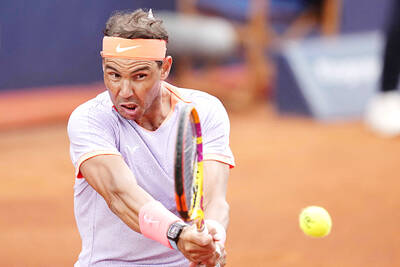
Rafael Nadal on Wednesday said the upcoming French Open would be the moment to “give everything and die” on the court after his comeback from injury in Barcelona was curtailed by Alex de Minaur. The 22-time Grand Slam title winner, back playing this week after three months on the sidelines, battled well, but eventually crumbled 7-5, 6-1 against the world No. 11 from Australia in the second round. Nadal, 37, who missed virtually all of last season, is hoping to compete at the French Open next month where he is the record 14-time champion. The Spaniard said the clash with De Minaur was

RALLY: It was only the second time the Taiwanese has partnered with Kudermetova, and the match seemed tight until they won seven points in a row to take the last set 10-2 Taiwan’s Chan Hao-ching and Russia’s Veronika Kudermetova on Sunday won the Porsche Tennis Grand Prix women’s doubles final in Stuttgart, Germany. The pair defeated Norway’s Ulrikke Eikeri and Estonia’s Ingrid Neel 4-6, 6-3, 10-2 in a tightly contested match at the WTA 500 tournament. Chan and Kudermetova fell 4-6 in the first set after having their serve broken three times, although they played increasingly well. They fought back in the second set and managed to break their opponents’ serve in the eighth game to triumph 6-3. In the tiebreaker, Chan and Kudermetova took a 3-0 lead before their opponents clawed back two points, but


 RSS
RSS