


Germany's patriotism debate has taken a new turn.
The latest squabble is over the national anthem, sung with gusto these days by huge crowds in stadiums and at World Cup fan festivals when the German team is playing. Is World Cup flag-waving a healthy show of a new national pride or a slide back to a darker "Deutschland ueber alles" mentality?
A regional teachers' union said on Friday that the 19th century verses are tainted by Germany's Nazi past and should be replaced by a new anthem. Walter Jens, a respected cultural commentator, told a German newspaper the current lyrics make little sense and that the country could do better.
Such talk prompted an outcry from some politicians.
"Bizarre and embarrassing," Wolfgang Bosbach, a senior legislator from the ruling Christian Democratic Party, said of the teachers' proposal, in a comment carried by the online Netzeitung.
Fans shrugged off the controversy, however.
"It's OK to sing the national anthem and wave flags," said 22-year-old soccer fan Ferdinand Hoppe of Neustrelitz in former East Germany. "All nations do it."
Most Germans seem to have trouble remembering their anthem's words beyond the first two lines: "Unity and justice and liberty for the German fatherland."
In recent days, German tabloids have reprinted the lyrics to support the soccer sing-alongs.
"Are you already singing, or are you still humming?" the Berliner Zeitung asked its readers.
The Deutschlandlied has had a choppy history. It was written by poet Heinrich Hoffmann von Fallersleben in 1841, and expressed a yearning for unity in a splintered nation.
The first verse, which begins with "Deutschland, Deutschland ueber alles" and outlines a rather oversized Germany, was popular under the Nazis.
After World War II, West Germany kept the anthem, despite some debate. Communist East Germany produced its own national song, Risen from the Ruins. In 1991, after the unification of East and West Germany, only the more mainstream third verse of the Deutschlandlied, with its emphasis on brotherhood, was declared the official national anthem.
CENTER STAGE
Unlike in other nations, in Germany the anthem never was a powerful presence. However, it moved center stage last week at the start of the World Cup when Germany's players stood in Munich's stadium, arms around each others' shoulders, as the hymn was played.
For many Germans it was a powerful moment, kicking off the biggest outburst of patriotism since World War II.
"This is the most positive kind of patriotism I've seen since unification. We haven't witnessed the whole country celebrating together," Germany 2006 vice president Wolfgang Niersbach said. "That's unusual."
The "patriotism debate" hasn't stopped since.
On Friday, a teachers' union in the state of Hesse called for a new national anthem after reissuing a 1990 brochure in which it argued against the Deutschlandlied.
"The current anthem is tainted and isn't appropriate for our country," union chief Jochen Nagel said. "We can't just close the lid and stop talking about the past."
Nagel added there was no such thing as "natural patriotism" in a country with Germany's history.
Jens, the cultural commentator, joined the chorus.
"If there's something to criticize in our country, it's this terrible national anthem with sometimes incomprehensible lyrics," he told the Sueddeutsche Zeitung.
Jens said that the anthem should be replaced by writer Berthold Brecht's Children's Hymn, a 1949 poem about a modest Germany, without expansionist ambitions and not feared by other nations.
However, the anthem found unlikely allies.
The swirl of patriotism around the World Cup "is not about `Deutschland, Deutschland ueber alles,'" Daniel Cohn-Bendit, head of the Green Party in the European Parliament, told the Sueddeutsche Zeitung. "It's all about, `Go, Germany, Go, score another goal.'"
Niersbach agreed.
"We're not going to let that spoil our fun -- it's positive patriotism, nobody is being excluded," he said. "It's an international party."

Four-time NBA all-star DeMarcus Cousins arrived in Taiwan with his family early yesterday to finish his renewed contract with the Taiwan Beer Leopards in the T1 League. Cousins initially played a four-game contract with the Leopards in January. On March 18, the Taoyuan-based team announced that Cousins had renewed his contract. “Hi what’s up Leopard fans, I’m back. I’m excited to be back and can’t wait to join the team,” Cousins said in a video posted on the Leopard’s Facebook page. “Most of all, can’t wait to see you guys, the fans, next weekend. So make sure you come out and support the Beer
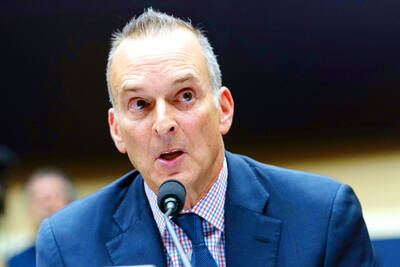
Revelations of positive doping tests for nearly two dozen Chinese swimmers that went unpunished sparked an intense flurry of accusations and legal threats between the World Anti-Doping Agency (WADA) and the head of the US drug-fighting organization, who has long been one of WADA’s fiercest critics. WADA on Saturday said it was turning to legal counsel to address a statement released by US Anti-Doping Agency (USADA) CEO Travis Tygart, who said WADA and anti-doping authorities in China swept positive tests “under the carpet by failing to fairly and evenly follow the global rules that apply to everyone else in the world.” The

Taiwanese judoka Yang Yung-wei on Saturday won silver in the men’s under-60kg category at the Asian Judo Championships in Hong Kong. Nicknamed the “judo heartthrob” in Taiwan, the Olympic silver-medalist missed out on his first Asian Championships gold when he lost to Japanese judoka Taiki Nakamura in the finals. Yang defeated three opponents on Saturday to reach the final after receiving a bye through the round of 32. He first topped Laotian Soukphaxay Sithisane in the round of 16 with two seoi nage (over-the-shoulder throws), then ousted Indian Vijay Kumar Yadav in the quarter-finals with his signature ude hishigi sankaku gatame (triangular armlock). He
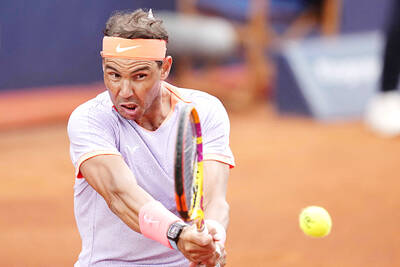
Rafael Nadal on Wednesday said the upcoming French Open would be the moment to “give everything and die” on the court after his comeback from injury in Barcelona was curtailed by Alex de Minaur. The 22-time Grand Slam title winner, back playing this week after three months on the sidelines, battled well, but eventually crumbled 7-5, 6-1 against the world No. 11 from Australia in the second round. Nadal, 37, who missed virtually all of last season, is hoping to compete at the French Open next month where he is the record 14-time champion. The Spaniard said the clash with De Minaur was


 RSS
RSS