


The booming drives that will be launched next week during the US PGA Championship have at least one thing in common with the hooks and slices that plague weekend hackers: They all start with the ball on a simple golf tee, invented just a few kilometers from where the world's best golfers will play the final major of the season.
The roots of the modern-day tee trace to New Jersey, where a dentist who didn't like using a mound of dirt as a tee tinkered in his garage until he found a better way to elevate a golf ball.
Dirt tees were the accepted method for several centuries. That didn't suit Dr. William Lowell, a member of the Maplewood Country Club, who disliked the process of mixing sand and water.
Maplewood is only a few miles from the Baltusrol Golf Club, site of this year's PGA Championship. Play begins on Thursday.
Although another dentist -- Dr. George F. Grant of Boston -- had patented the first wooden tee in 1899, it was not widely used since he did not market it, according to golf historians.
"This idea of a wooden golf tee sort of languished until you had Dr. William Lowell experimenting in his garage in the 1920s," said Rand Jerris, director of the museum and archives of the US Golf Association, in Far Hills.
While Grant's tee was a narrow cone topped with a concave rubber tip, Lowell's all-wood tee had a saucer-like platform atop the peg, similar to the shape in wide use today.
Lowell filed his application on May 5, 1922, and was granted patent No. 1,493,687 on May 13, 1924.
He also painted them red, formed the Reddy Tee Co, and hired two professional golfers, Walter Hagen and Joe Kirkwood, an Australian, to use his product in 1924 as the pair played exhibition matches.
"They were the perfect sort of showmen," Jerris said. "They did a great job of promoting the product."
The pros would leave the pegs in the ground after they hit, and spectators would scramble to retrieve them, he said. Other inventors and patents soon followed.
"The transformation happened very quickly," Jerris said. "Within a couple years the sand tee disappeared."
Reddy Tee has also faded into history, and USGA records indicate that Lowell eventually lost his patent after a long legal struggle.
Tees now come in many designs and materials, but the simple wooden tee remains the most popular. Some 288 patents for inventions with the words "golf tee" in the title have been granted since 1976, said Ruth Nyblod, a spokeswoman at the US Patent and Trademark Office.
The basic wooden tee is available for just a few pennies, making it the cheapest aspect of a game in which high-tech carbon-titanium drivers can cost hundreds of dollars.
On the Net:
USGA: http://www.usga.com

US track and field athletes have about four dozen pieces to choose from when assembling their uniforms at the Olympics. The one grabbing the most attention is a high-cut leotard that barely covers the bikini line and has triggered debate between those who think it is sexist and others who say they do not need the Internet to make sure they have good uniforms. Among those critical or laughing at the uniforms included Paralympian Femita Ayanbeku, sprinter Britton Wilson and even athletes from other countries such as Britain’s Abigail Irozuru, who wrote on social media: “Was ANY female athlete consulted in

Four-time NBA all-star DeMarcus Cousins arrived in Taiwan with his family early yesterday to finish his renewed contract with the Taiwan Beer Leopards in the T1 League. Cousins initially played a four-game contract with the Leopards in January. On March 18, the Taoyuan-based team announced that Cousins had renewed his contract. “Hi what’s up Leopard fans, I’m back. I’m excited to be back and can’t wait to join the team,” Cousins said in a video posted on the Leopard’s Facebook page. “Most of all, can’t wait to see you guys, the fans, next weekend. So make sure you come out and support the Beer

Former US Masters champion Zach Johnson was left embarrassed after a foul-mouthed response to ironic cheers from spectators after a triple bogey at Augusta National on Friday. Johnson, the 2007 Masters winner, missed the cut after his three-over-par round of 75 left him on seven-over 151 for 36 holes, his six on the par-three 12th playing a big role in his downfall. Television footage showed Johnson reacting to sarcastic cheers and applause when he tapped in for the triple bogey by yelling: “Oh fuck off.” Such a response would be considered bad form in any golf tournament, but is particularly out of keeping
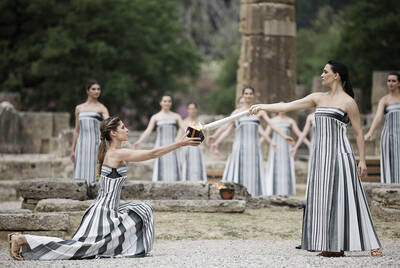
The sacred flame for the Paris Olympics was lit yesterday in Olympia, Greece, the birthplace of the ancient Games, in a ceremony inspired by antiquity and marked by messages of hope amid multiple global crises. “In ancient times, the Olympic Games brought together the Greek city states, even — and in particular — during times of war and conflict,” International Olympic Committee president Thomas Bach said. “Today, the Olympic Games are the only event that brings the entire world together in peaceful competition. Then as now, the Olympic athletes are sending this powerful message — yes, it is possible to compete fiercely


 RSS
RSS