


It's the never-ending season.
Summer used to mean a three-month break in European football. Now the hiatus is down to a few weeks. League seasons already have resumed in France and Scotland, ther German season starts Friday and the English Premier League begins Aug. 13.
Rich clubs like Real Madrid and Manchester United spent July on lucrative preseason tours of Asia. Chelsea and AC Milan played friendlies in the US.
The saturation has been blamed for a decline in television ratings and led to concerns about player fatigue, burnout and injuries. In Asia, fans complained about lackluster matches, high ticket prices and crass commercialism.
"There's a bit more football than there used to be," said Stefan Szymanski, a professor of sports economics at Tanaka Business School in London. "But there is a lot more meaningless football being played."
Deportivo La Coruna had the shortest summer of all. The Spanish club ended the league season on May 29, and was playing again 33 days later -- July 2 -- in the Intertoto Cup.
There's been little time off, too, for European champion Liverpool. The Reds won the Champions League title on May 25 -- stunning AC Milan on penalties -- and resumed 47 days later chasing a qualifying spot in the same tournament.
"Clubs used to prepare for the season in the twilight. You didn't know it was going on," said John Williams, director for the Centre for the Sociology of Sport at the University of Leicester. "Now with the proliferation of TV coverage -- even preseason coverage -- there is a sense that football never stops."
Next year's World Cup in Germany, which runs from June 9 to July 9, has added to the squeeze. Some domestic leagues are starting a bit earlier and ending earlier to give players four weeks' rest -- instead of three.
The idea came from England coach Sven-Goran Eriksson, who blamed player fatigue for his club's quarterfinal exits at the 2002 World Cup and 2004 European Championship.
"It might seem stupid but one week is like gold," Eriksson said.
On tours of Asia, players from Real Madrid, Manchester United, Barcelona and Bayern Munich griped about the travel and meaningless games.
"We have come to win the hearts of the Japanese, but it's not easy with so many journeys, flights, buses and promotional acts," Madrid's Ronaldo said.
Ronaldo and teammate Zinedine Zidane moaned about the Asian roadshow, reportedly worth about 21 million euros to the club. Coach Vanderlei Luxemburgo had little sympathy for the two, who both have annual incomes of about US$20 million.
"This is soccer," he said. "A club like Real Madrid must have a commercial side like this to earn money and exchange soccer experiences with other countries."
How many games can players sustain without risking injury?
"Nobody really knows what is the optimum or maximum games per year,'" said professor Jiri Dvorak, FIFA's chief medical officer. "I'd say about 50 to 60 games per year was OK, reasonable," he said. "But 70 to 80 is really the upper limit. I think it would be very difficult to increase the number of games much more."
Consider the top players at English champion Chelsea, owned by Russian billionaire Roman Abramovich. He has spent about 410 million euro on players since buying the club two years ago.
Last season, Chelsea played 38 league games, 12 in the Champions League, three more in the FA Cup, and six in the League Cup. In addition, top players were involved in 11 England national team games. Throw in six warmup matches, including Sunday's Charity Shield game against Arsenal, and the total is 76.
"It's pretty clear that over the past four or five years there have been more and more matches for the top players, for the top clubs," UEFA spokesman Rob Faulkner said.
"There's no doubt they are reaching a limit now, and we're sensitive to that."

US track and field athletes have about four dozen pieces to choose from when assembling their uniforms at the Olympics. The one grabbing the most attention is a high-cut leotard that barely covers the bikini line and has triggered debate between those who think it is sexist and others who say they do not need the Internet to make sure they have good uniforms. Among those critical or laughing at the uniforms included Paralympian Femita Ayanbeku, sprinter Britton Wilson and even athletes from other countries such as Britain’s Abigail Irozuru, who wrote on social media: “Was ANY female athlete consulted in

Four-time NBA all-star DeMarcus Cousins arrived in Taiwan with his family early yesterday to finish his renewed contract with the Taiwan Beer Leopards in the T1 League. Cousins initially played a four-game contract with the Leopards in January. On March 18, the Taoyuan-based team announced that Cousins had renewed his contract. “Hi what’s up Leopard fans, I’m back. I’m excited to be back and can’t wait to join the team,” Cousins said in a video posted on the Leopard’s Facebook page. “Most of all, can’t wait to see you guys, the fans, next weekend. So make sure you come out and support the Beer

Former US Masters champion Zach Johnson was left embarrassed after a foul-mouthed response to ironic cheers from spectators after a triple bogey at Augusta National on Friday. Johnson, the 2007 Masters winner, missed the cut after his three-over-par round of 75 left him on seven-over 151 for 36 holes, his six on the par-three 12th playing a big role in his downfall. Television footage showed Johnson reacting to sarcastic cheers and applause when he tapped in for the triple bogey by yelling: “Oh fuck off.” Such a response would be considered bad form in any golf tournament, but is particularly out of keeping
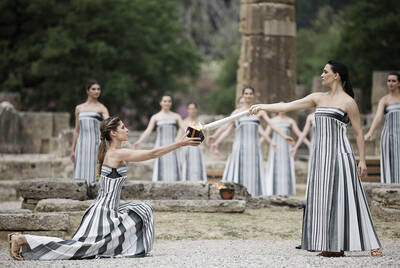
The sacred flame for the Paris Olympics was lit yesterday in Olympia, Greece, the birthplace of the ancient Games, in a ceremony inspired by antiquity and marked by messages of hope amid multiple global crises. “In ancient times, the Olympic Games brought together the Greek city states, even — and in particular — during times of war and conflict,” International Olympic Committee president Thomas Bach said. “Today, the Olympic Games are the only event that brings the entire world together in peaceful competition. Then as now, the Olympic athletes are sending this powerful message — yes, it is possible to compete fiercely


 RSS
RSS