


Michael Johnson and the rest of the US 1,600m relay team can keep their gold medals from the 2000 Sydney Olympics, sport's highest court ruled Thursday.
The Court of Arbitration for Sport upheld an appeal from the US Olympic Committee challenging moves to disqualify the entire squad for an earlier doping infraction by team member Jerome Young.
The court ruled that only Young should be stripped of the medal, meaning Johnson, Antonio Pettigrew, twins Alvin and Calvin Harrison and Angelo Taylor keep their golds.
Young ran in the opening and semifinal rounds in Sydney, but not in the final. Johnson ran the anchor leg in the final for the fifth and last Olympic gold medal of his career. Pettigrew and the Harrisons also ran in the final. Taylor ran in the earlier heats.
Young tested positive for the steroid nandrolone in 1999, but was exonerated by a US appeals panel in July 2000, avoiding a two-year ban.
USA Track & Field never gave the sport's world governing body specifics about the case, citing confidentiality rules in place at the time. Young's identity only became public in 2003.
The International Association of Athletics Federations ruled that the entire team should forfeit the victory because Young should have been ineligible to compete.
The arbitration court ruled yesterday that the IAAF's rules in place at the time of the Sydney Games did not call for an entire team to be disqualified.
"The panel decided that on the basis of the IAAF rules applicable at the time of the Sydney Games, the results of the men's 4x400m relay event at the Sydney Games should not be amended and that only Jerome Young in the US team should be stripped of his gold medal," CAS said in a statement.
The panel noted that the IAAF's current rules do call for an entire relay team to be disqualified in a similar event.
"The IAAF is extremely disappointed with this decision," IAAF spokesman Nick Davies said.
"Last July our council, in the best interest of our sport, decided that the results of the 4x400-meter final in Sydney should be changed because the USA fielded an ineligible athlete in the early rounds. This athlete, Jerome Young, was later suspended for life for a second serious doping offense. CAS, however, has decided that the council was wrong. We regret this but we accept also that CAS decisions are final and binding," Davies said.
Had the court rejected the USOC appeal, the International Olympic Committee would have been in position to upgrade Nigeria to the gold, Jamaica to silver and the Bahamas to bronze. Yesterday's ruling means there will be no change in the medals.
Young, the 2003 world champion in the 400 meters, was banned for life last year by the US Anti-Doping Agency following a second doping offense. He tested positive for EPO at a Paris meet in July last year.
Last October, Alvin Harrison was suspended for four years for doping violations uncovered in the Bay Area Laboratory Co-Operative investigation. Calvin Harrison is serving a two-year suspension for testing positive for drugs linked to BALCO.
It's now up to the IOC executive board to formally strip Young of the medal. The board's next full meeting is in October.
IOC president Jacques Rogge has repeatedly pressed for full disclosure in the case, and the committee had been prepared to take all the medals away.
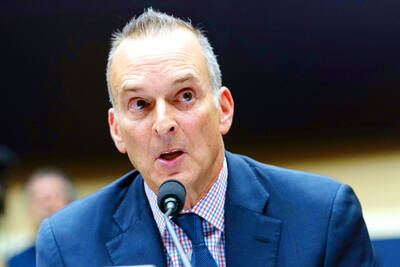
Revelations of positive doping tests for nearly two dozen Chinese swimmers that went unpunished sparked an intense flurry of accusations and legal threats between the World Anti-Doping Agency (WADA) and the head of the US drug-fighting organization, who has long been one of WADA’s fiercest critics. WADA on Saturday said it was turning to legal counsel to address a statement released by US Anti-Doping Agency (USADA) CEO Travis Tygart, who said WADA and anti-doping authorities in China swept positive tests “under the carpet by failing to fairly and evenly follow the global rules that apply to everyone else in the world.” The

Taiwanese judoka Yang Yung-wei on Saturday won silver in the men’s under-60kg category at the Asian Judo Championships in Hong Kong. Nicknamed the “judo heartthrob” in Taiwan, the Olympic silver-medalist missed out on his first Asian Championships gold when he lost to Japanese judoka Taiki Nakamura in the finals. Yang defeated three opponents on Saturday to reach the final after receiving a bye through the round of 32. He first topped Laotian Soukphaxay Sithisane in the round of 16 with two seoi nage (over-the-shoulder throws), then ousted Indian Vijay Kumar Yadav in the quarter-finals with his signature ude hishigi sankaku gatame (triangular armlock). He
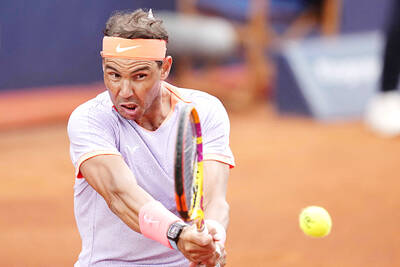
Rafael Nadal on Wednesday said the upcoming French Open would be the moment to “give everything and die” on the court after his comeback from injury in Barcelona was curtailed by Alex de Minaur. The 22-time Grand Slam title winner, back playing this week after three months on the sidelines, battled well, but eventually crumbled 7-5, 6-1 against the world No. 11 from Australia in the second round. Nadal, 37, who missed virtually all of last season, is hoping to compete at the French Open next month where he is the record 14-time champion. The Spaniard said the clash with De Minaur was

RALLY: It was only the second time the Taiwanese has partnered with Kudermetova, and the match seemed tight until they won seven points in a row to take the last set 10-2 Taiwan’s Chan Hao-ching and Russia’s Veronika Kudermetova on Sunday won the Porsche Tennis Grand Prix women’s doubles final in Stuttgart, Germany. The pair defeated Norway’s Ulrikke Eikeri and Estonia’s Ingrid Neel 4-6, 6-3, 10-2 in a tightly contested match at the WTA 500 tournament. Chan and Kudermetova fell 4-6 in the first set after having their serve broken three times, although they played increasingly well. They fought back in the second set and managed to break their opponents’ serve in the eighth game to triumph 6-3. In the tiebreaker, Chan and Kudermetova took a 3-0 lead before their opponents clawed back two points, but


 RSS
RSS