


The Heisman Trophy, which has been without an official home since the Downtown Athletic Club closed four years ago, will remain in Lower Manhattan as the centerpiece of the National Sports Museum being planned in a building on Broadway at Bowling Green.
The overseeing board of the Heisman Trophy Trust, which controls the trophy, entered into an agreement Tuesday with the National Sports Museum to house the trophy and create an exhibit using Heisman historical artifacts and memorabilia. Philip Schwalb, the chief executive and founder of the sports museum, said the museum hoped to become the site of the annual presentation of the Heisman Trophy, a nationally televised event in which the top college football player of the year is selected.
The 9,290m2 museum at 25 Broadway in the former Cunard Passenger Ship Line building is scheduled to be completed in November 2006. It is considered the first national museum to celebrate all sports under one roof.
"The Heisman deserves a permanent home," said Bill Dockery, president of the Heisman Trophy Trust. "We're had offers coming in from all over the country. But we're delighted that the trophy is staying in New York City and staying downtown where it was born, nurtured and grew to be the premier individual sports award in America."
The Heisman Trophy was first awarded in 1935 by the Downtown Athletic Club, which had erected a 35-story building at the southern tip of West Street and quickly became a mecca for Wall Street businessmen and sports enthusiasts.
In 1936, the trophy was named in honor of the club's late athletic director, John Heisman, a longtime college football coach. It has been given out every year since, recognizing some of the most notable athletes of the 20th century. The Downtown Athletic Club, only a few blocks from the World Trade Center, closed in the wake of the Sept. 11 attacks. Since then, the Heisman Trophy ceremony has taken place at other Manhattan locations, most recently at the New York Hilton in Midtown. The landmark Downtown Athletic Club building, no longer controlled by the club, is being converted into condominiums, Dockery said.
"It's exciting that the Heisman is coming home to help in the rebirth of Lower Manhattan," said Schwalb, whose sports museum will take shape with the help of US$52 million in Liberty redevelopment bonds. "From the back windows of the National Sports Museum you can see the old Downtown Athletic Club building. It's a historical touchstone, and I'm very enamored with the fact that you can see building to building."
The collection of former Heisman Trophy winners, many of whom attend the award's presentation annually, have been eager for the trophy to find a new home, even if they will reluctantly say goodbye to the Downtown Athletic Club's wood-paneled Heisman Room, where the trophy presentation was held for decades.
"We'll remember the Downtown Athletic Club as it was," John Cappelletti, the 1973 Heisman winner, said Tuesday. "There's nothing we can do about it now. More important than anything else is that the Heisman has found a place that hopefully will be its permanent home. I am glad it's going to a place of sports history. You don't want the Heisman on display in some hotel lobby."
Schwalb's concept for a national sports museum has been several years in the making. The design calls for a highly interactive site dedicated to the history, meaning and culture of sports.
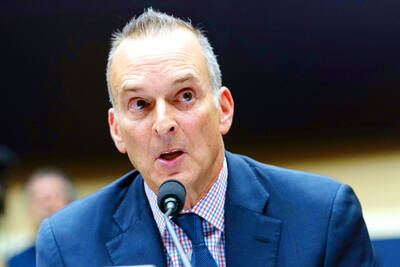
Revelations of positive doping tests for nearly two dozen Chinese swimmers that went unpunished sparked an intense flurry of accusations and legal threats between the World Anti-Doping Agency (WADA) and the head of the US drug-fighting organization, who has long been one of WADA’s fiercest critics. WADA on Saturday said it was turning to legal counsel to address a statement released by US Anti-Doping Agency (USADA) CEO Travis Tygart, who said WADA and anti-doping authorities in China swept positive tests “under the carpet by failing to fairly and evenly follow the global rules that apply to everyone else in the world.” The

Taiwanese judoka Yang Yung-wei on Saturday won silver in the men’s under-60kg category at the Asian Judo Championships in Hong Kong. Nicknamed the “judo heartthrob” in Taiwan, the Olympic silver-medalist missed out on his first Asian Championships gold when he lost to Japanese judoka Taiki Nakamura in the finals. Yang defeated three opponents on Saturday to reach the final after receiving a bye through the round of 32. He first topped Laotian Soukphaxay Sithisane in the round of 16 with two seoi nage (over-the-shoulder throws), then ousted Indian Vijay Kumar Yadav in the quarter-finals with his signature ude hishigi sankaku gatame (triangular armlock). He
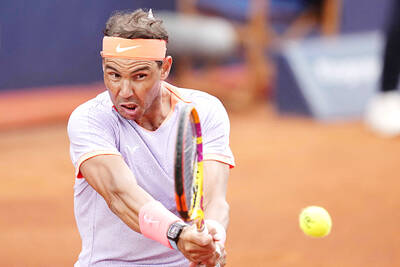
Rafael Nadal on Wednesday said the upcoming French Open would be the moment to “give everything and die” on the court after his comeback from injury in Barcelona was curtailed by Alex de Minaur. The 22-time Grand Slam title winner, back playing this week after three months on the sidelines, battled well, but eventually crumbled 7-5, 6-1 against the world No. 11 from Australia in the second round. Nadal, 37, who missed virtually all of last season, is hoping to compete at the French Open next month where he is the record 14-time champion. The Spaniard said the clash with De Minaur was

RALLY: It was only the second time the Taiwanese has partnered with Kudermetova, and the match seemed tight until they won seven points in a row to take the last set 10-2 Taiwan’s Chan Hao-ching and Russia’s Veronika Kudermetova on Sunday won the Porsche Tennis Grand Prix women’s doubles final in Stuttgart, Germany. The pair defeated Norway’s Ulrikke Eikeri and Estonia’s Ingrid Neel 4-6, 6-3, 10-2 in a tightly contested match at the WTA 500 tournament. Chan and Kudermetova fell 4-6 in the first set after having their serve broken three times, although they played increasingly well. They fought back in the second set and managed to break their opponents’ serve in the eighth game to triumph 6-3. In the tiebreaker, Chan and Kudermetova took a 3-0 lead before their opponents clawed back two points, but


 RSS
RSS