


Something strange happened the day after the US Open.
A black round cap about the size of a hockey puck mysteriously rose from the ground and started spraying water over Shinnecock Hills. In the golf industry, they call this a sprinkler.
Then a couple of players searched and found -- eureka! -- a pitch mark that needed to be repaired.
In other words, Shinnecock Hills returned to being a golf course, one of the finest in the country.
No one was sure what to call the links-styled course -- or the competition it held -- during a final round that identified the best players, humiliated the rest and set a US Open record for complaints.
There is no denying the US Golf Association, which treats par as its most precious commodity, went over the edge to make sure the toughest test in golf lived up to its reputation.
By continuing to double-cut the greens -- they were so dead, it's a wonder there was any grass left to mow -- and refusing to water them until certain holes became unplayable, the US Open more closely resembled a demolition derby than a national championship.
"Good shots are not staying in fairways. Good shots are not staying on greens," Tom Kite said. "You've got the best players in the world. If they can't shoot under par, then it's got to be out of control."
Robert Allenby had the best round at even-par 70.
Five players shot 79 and still moved up the leaderboard.
The 28 players who failed to break 80 included Ernie Els, the No. 2 player in the world.
"It's not the first time they've done this, and it won't be the last," Mark Calcavecchia said of the USGA, shortly after grinding out a 75. "On that note, I need a beer."
But for all the silliness Sunday, the lasting image is US Open champion Retief Goosen and runner-up Phil Mickelson playing a game unfamiliar to many others.
They were the only guys to beat par for the tournament.
They played the kind of golf that wins the US Open.
It's not about whether the golf course is fair. It's about shooting the lowest score.
Tee shots don't stay in the fairway? Mickelson only missed two of the last eight fairways. He played with such control that he used a variety of shots to keep the ball on the green and below the cup, giving himself a chance at birdie. His run of three birdies in four holes to briefly take the lead was sensational stuff.
After closing with 71, Lefty was asked if it was a fair test.
"I don't know what to say. I felt like I played some of the best golf of my life," he said. "I hit some of the best shots, I putted better than I probably ever have putted. And I still couldn't shoot par. So you tell me."
Then again, he would have shot 69 if not for that three-putt double bogey on the 17th that perhaps cost him the second leg of the Grand Slam.
Goosen showed incredible resiliency, if not poise. Almost as impressive as Mickelson's birdie run was the Goose saving par on No. 13, saving bogey on No. 14, and answering Mickelson with a birdie of his own on the 16th to regain a share of the lead. He took only 24 putts in the final round, and had no three-putts for the tournament.
"The way the course is set up, it's important to save pars," Goosen said. "I kept telling myself, `Keep playing for pars and you can win this event.' And it turned out that way."
One could argue that this is not how golf is meant to be played, but everyone played the same course.
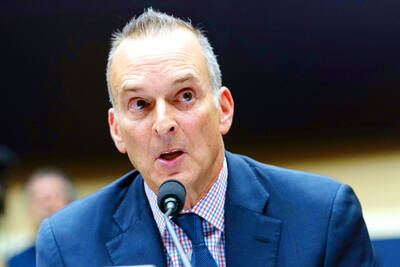
Revelations of positive doping tests for nearly two dozen Chinese swimmers that went unpunished sparked an intense flurry of accusations and legal threats between the World Anti-Doping Agency (WADA) and the head of the US drug-fighting organization, who has long been one of WADA’s fiercest critics. WADA on Saturday said it was turning to legal counsel to address a statement released by US Anti-Doping Agency (USADA) CEO Travis Tygart, who said WADA and anti-doping authorities in China swept positive tests “under the carpet by failing to fairly and evenly follow the global rules that apply to everyone else in the world.” The
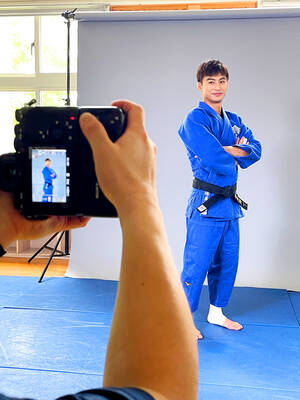
Taiwanese judoka Yang Yung-wei on Saturday won silver in the men’s under-60kg category at the Asian Judo Championships in Hong Kong. Nicknamed the “judo heartthrob” in Taiwan, the Olympic silver-medalist missed out on his first Asian Championships gold when he lost to Japanese judoka Taiki Nakamura in the finals. Yang defeated three opponents on Saturday to reach the final after receiving a bye through the round of 32. He first topped Laotian Soukphaxay Sithisane in the round of 16 with two seoi nage (over-the-shoulder throws), then ousted Indian Vijay Kumar Yadav in the quarter-finals with his signature ude hishigi sankaku gatame (triangular armlock). He
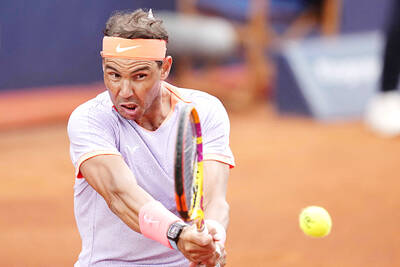
Rafael Nadal on Wednesday said the upcoming French Open would be the moment to “give everything and die” on the court after his comeback from injury in Barcelona was curtailed by Alex de Minaur. The 22-time Grand Slam title winner, back playing this week after three months on the sidelines, battled well, but eventually crumbled 7-5, 6-1 against the world No. 11 from Australia in the second round. Nadal, 37, who missed virtually all of last season, is hoping to compete at the French Open next month where he is the record 14-time champion. The Spaniard said the clash with De Minaur was

RALLY: It was only the second time the Taiwanese has partnered with Kudermetova, and the match seemed tight until they won seven points in a row to take the last set 10-2 Taiwan’s Chan Hao-ching and Russia’s Veronika Kudermetova on Sunday won the Porsche Tennis Grand Prix women’s doubles final in Stuttgart, Germany. The pair defeated Norway’s Ulrikke Eikeri and Estonia’s Ingrid Neel 4-6, 6-3, 10-2 in a tightly contested match at the WTA 500 tournament. Chan and Kudermetova fell 4-6 in the first set after having their serve broken three times, although they played increasingly well. They fought back in the second set and managed to break their opponents’ serve in the eighth game to triumph 6-3. In the tiebreaker, Chan and Kudermetova took a 3-0 lead before their opponents clawed back two points, but


 RSS
RSS