


Just a few days into the Major League season, baseball already has produced a startling statistic: The average salary dropped for the first time in nearly a decade.
Not that major leaguers will be sweating to make their mortgage payments. Despite the 3 percent drop from the start of last season, players on opening day rosters averaged US$2.49 million, according to a study by The Associated Press.
"Maybe that's going to be the trend. Maybe it's going to start going down," said Seattle designated hitter Edgar Martinez, whose base pay by was cut 25 percent to US$3 million.
The New York Yankees bucked the trend, pushing their payroll up to a record US$183 million, led by Alex Rodriguez, whose US$21.7 million salary topped the majors for the fourth straight year.
Boston, forever chasing New York in the standings and at the box office, was second at US$125 million.
And then came everyone else.
Anaheim was third at US$101 million, just ahead of the New York Mets. Philadelphia, fifth at US$93 million, has a payroll almost half that of the Yankees.
Milwaukee, the team controlled by the family of baseball commissioner Bud Selig, has the lowest payroll at US$27.5 million. Tampa Bay is 29th at US$29.5 million -- but that includes US$7 million the Devil Rays are getting reimbursed by St. Louis to pay nearly all of Tino Martinez's salary.
The average salary, which was US$2.56 million at the start of last season, hadn't dropped since 1995, immediately following the 7 1/2-month strike that wiped out the World Series for the first time in 90 years.
"There are a number of factors involved. Certainly, the economy is a big one," Selig said. "Teams had to tighten their belts because of debt."
Baseball's new labor contract, agreed to late in the 2002 season, had new debt regulations and also imposed a luxury tax. Last year, the Yankees were the only team that had to pay the tax.
"I think if you go back in history, the year following any type of a new labor agreement being put in place, there's always a market correction," said Yankees first baseman Tony Clark, a member of the union's negotiating committee.
Since the start of the free-agent era after the 1976 season, the only other times salaries dropped were 1987 -- when owners were found by an arbitrator to have conspired against free agents -- and 1995.

US track and field athletes have about four dozen pieces to choose from when assembling their uniforms at the Olympics. The one grabbing the most attention is a high-cut leotard that barely covers the bikini line and has triggered debate between those who think it is sexist and others who say they do not need the Internet to make sure they have good uniforms. Among those critical or laughing at the uniforms included Paralympian Femita Ayanbeku, sprinter Britton Wilson and even athletes from other countries such as Britain’s Abigail Irozuru, who wrote on social media: “Was ANY female athlete consulted in

Four-time NBA all-star DeMarcus Cousins arrived in Taiwan with his family early yesterday to finish his renewed contract with the Taiwan Beer Leopards in the T1 League. Cousins initially played a four-game contract with the Leopards in January. On March 18, the Taoyuan-based team announced that Cousins had renewed his contract. “Hi what’s up Leopard fans, I’m back. I’m excited to be back and can’t wait to join the team,” Cousins said in a video posted on the Leopard’s Facebook page. “Most of all, can’t wait to see you guys, the fans, next weekend. So make sure you come out and support the Beer

Former US Masters champion Zach Johnson was left embarrassed after a foul-mouthed response to ironic cheers from spectators after a triple bogey at Augusta National on Friday. Johnson, the 2007 Masters winner, missed the cut after his three-over-par round of 75 left him on seven-over 151 for 36 holes, his six on the par-three 12th playing a big role in his downfall. Television footage showed Johnson reacting to sarcastic cheers and applause when he tapped in for the triple bogey by yelling: “Oh fuck off.” Such a response would be considered bad form in any golf tournament, but is particularly out of keeping
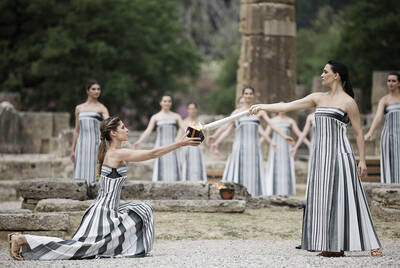
The sacred flame for the Paris Olympics was lit yesterday in Olympia, Greece, the birthplace of the ancient Games, in a ceremony inspired by antiquity and marked by messages of hope amid multiple global crises. “In ancient times, the Olympic Games brought together the Greek city states, even — and in particular — during times of war and conflict,” International Olympic Committee president Thomas Bach said. “Today, the Olympic Games are the only event that brings the entire world together in peaceful competition. Then as now, the Olympic athletes are sending this powerful message — yes, it is possible to compete fiercely


 RSS
RSS