


At first, they called him "Elefantino," or little elephant, because he had such big ears and a small frame.
Then, as he showed he could cycle through the Alps faster than anyone, Marco Pantani earned a more menacing nickname: "Pirate," for his hoop earring and the bandanna that covered his bald head.
On Sunday, Italy mourned the 34-year-old Pantani as a tragic "lost hero." Pantani -- the last cyclist other than American Lance Armstrong to win the Tour de France -- was found dead Saturday night in a hotel room in the Adriatic resort city of Rimini.
While several bottles of medicine and tranquilizers were found in the room, prosecutors ruled out suicide pending an autopsy scheduled for yesterday. The coroner who examined Pantani initially said cardiac arrest was the probable cause, news reports said.
Italy is essentially a single-sport nation, with soccer headlines dominating the country's mass circulation sports newspapers. Personable champions who emerge in other sports, however, often gain a mythical status.
Pantani was one such athlete. He became Italy's most popular cyclist, especially after he won cycling's two greatest races -- the Giro d'Italia and Tour de France -- in the same year, 1998. The last Italian to accomplish the feat was Fausto Coppi in 1952.
Pantani's popularity in Italy rivaled that of skier Alberto Tomba and Ferrari's Formula One team.
Moreover, in a country of weekend cycling warriors, Pantani plied a craft that millions of average athletes could try themselves.
And Pantani held onto that superstar status even after he was bedeviled by doping accusations and suspensions in recent seasons -- accusations he denied.
Armstrong, who began his run of five straight Tour de France victories in 1999 and battled Pantani in the 2000 edition, said in a statement Sunday he had deep respect for Pantani "regardless of our battles on/off the bike."
"Cycling has indeed lost a great champion and a great personality," Armstrong said.
After his magical 1998 wins, Pantani's entire Mercatone Uno team -- riders, trainers and masseuse -- shaved their heads to imitate him. A year later, in 1999, the Giro honored Pantani by arranging its route to pass through his hometown of Cesenatico.
On Sunday, the Italian Cycling Federation ordered a moment of silence at every cycling event in the country. Italian newspapers devoted their entire Sunday front pages to his death.
"He's gone," read the banner headline of the country's most respected sports newspaper, Gazzetta dello Sport. Former Gazzetta editor Candido Cannavo entitled his front-page editorial, "Lost hero: we adored you."
Short and slight in stature, Pantani scaled huge mountains faster than anyone and also excelled at increasing his lead or making up ground with daredevil descents.
In his heyday, fans would interrupt their workdays or beach vacations to find a television and watch the cyclist with the giant grin. Thousands of fans thronged the mountain passes where Pantani worked on his craft, whether at home or in the nearby French Alps.
His ascent up the 21 hairpin turns of the Tour de France's legendary L'Alpe d'Huez in 37 minutes, 35 seconds in 1997 stands as one of the sport's most respected records.
Like Coppi and other champions of the past, Pantani didn't wear a helmet for most of his career, giving fans an unobstructed view of the grimace that overcame his face whenever the road tilted uphill.
In recent years, however, his name was linked with doping accusations.
In 1999, he failed a random blood test and was kicked out of the Giro he was dominating. A syringe containing traces of insulin was found in his hotel room in a police raid during the 2001 Giro and he was suspended for six months.
In one of his best performances since his sparkling 1998 season, Pantani finished 14th in last year's Giro.
Last summer, he spent several weeks in a health clinic specializing in treatment for depression and drug addiction.
Pantani hadn't announced plans for this season, sparking rumors of his retirement.
His death shocked the cycling world. The RTBF TV network in cycling-crazy Belgium devoted more than 10 minutes to the story on its main lunchtime TV bulletin.
"He certainly made some errors. ... He fell in with a bad crowd, it's very sad," said Eddy Merckx, a Belgian who won the Tour de France five times from 1969 to 74.
"When the career is over, we can feel very alone. You're left to your own devices," he said.

US track and field athletes have about four dozen pieces to choose from when assembling their uniforms at the Olympics. The one grabbing the most attention is a high-cut leotard that barely covers the bikini line and has triggered debate between those who think it is sexist and others who say they do not need the Internet to make sure they have good uniforms. Among those critical or laughing at the uniforms included Paralympian Femita Ayanbeku, sprinter Britton Wilson and even athletes from other countries such as Britain’s Abigail Irozuru, who wrote on social media: “Was ANY female athlete consulted in

Four-time NBA all-star DeMarcus Cousins arrived in Taiwan with his family early yesterday to finish his renewed contract with the Taiwan Beer Leopards in the T1 League. Cousins initially played a four-game contract with the Leopards in January. On March 18, the Taoyuan-based team announced that Cousins had renewed his contract. “Hi what’s up Leopard fans, I’m back. I’m excited to be back and can’t wait to join the team,” Cousins said in a video posted on the Leopard’s Facebook page. “Most of all, can’t wait to see you guys, the fans, next weekend. So make sure you come out and support the Beer

Former US Masters champion Zach Johnson was left embarrassed after a foul-mouthed response to ironic cheers from spectators after a triple bogey at Augusta National on Friday. Johnson, the 2007 Masters winner, missed the cut after his three-over-par round of 75 left him on seven-over 151 for 36 holes, his six on the par-three 12th playing a big role in his downfall. Television footage showed Johnson reacting to sarcastic cheers and applause when he tapped in for the triple bogey by yelling: “Oh fuck off.” Such a response would be considered bad form in any golf tournament, but is particularly out of keeping
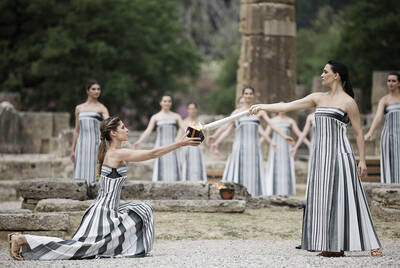
The sacred flame for the Paris Olympics was lit yesterday in Olympia, Greece, the birthplace of the ancient Games, in a ceremony inspired by antiquity and marked by messages of hope amid multiple global crises. “In ancient times, the Olympic Games brought together the Greek city states, even — and in particular — during times of war and conflict,” International Olympic Committee president Thomas Bach said. “Today, the Olympic Games are the only event that brings the entire world together in peaceful competition. Then as now, the Olympic athletes are sending this powerful message — yes, it is possible to compete fiercely


 RSS
RSS