


"You may be wondering," the smiling lady said, "just exactly what the NFL, Breathe-Right nasal strips and snoring all have in common."
To tell the truth, nobody really was wondering.
The 100 or so people at the publicity event more or less accepted the fact that the marriage between the three was legit. It is, after all, Super Bowl week, and snoring, nasal strips and American football didn't make any more, or less, sense being thrown together than chips, dip and an ice-cold can of beer.
In fact, no marketing play, publicity stunt or other show of excess surprises many people at the Super Bowl anymore. It is the nation's biggest "unofficial" holiday, an extravaganza of American revelry and indulgence that celebrates not so much football, as America's ability to celebrate.
"You take an event centered on TV, lubricated by beer and junk food, add the gambling element, drop it in a perfect spot on the calendar, and you've got the perfect American holiday," said Bob Thompson, professor of television and pop culture at Syracuse University.
Who's playing? Who cares?
Some 137 million people -- about half the nation's population -- are expected to watch at least six minutes of it on TV. About 86 million will watch in much bigger chunks.
Frito-Lay has increased corn and potato production by 4.5 million kilograms, about 33 percent more than they'd go through during an average week. Americans will spend about US$2.5 million on canned chili beans this week, double what they would usually spend.
In a somewhat fanciful estimate, one number-crunching company says corporate America will suffer an US$821 million loss in worker productivity due to people standing by the water cooler talking about the game.
But they don't just talk about the game. In fact, they may not talk about the game at all.
It's the Lingerie Bowl (on another network), the halftime show, the premiere of a new season of Survivor when the game is over, and the commercials that make the Super Bowl what it is.
The past decade has brought the proliferation of cable channels and the decline of the once-sacrosanct network television ratings. Not this Sunday, though.
"The rating is pretty much bulletproof," CBS Sports president Sean McManus said.
So when, exactly, did the Super Bowl turn into this?
When did a game that began as something of an exhibition between two rival leagues -- the first "AFL-NFL Championship Game" between Green Bay and Kansas City didn't even sell out -- turn into a cultural phenomenon that brings people together the same way Thanksgiving and Christmas do?
"The ratings for the Super Bowl have been pretty high for a long time," Thompson said. "But I don't know. I'd say somewhere around five or six years ago, the whole thing hit some new cultural plateau, and you can't really judge it by numbers."
Meanwhile, in Nevada last year, US$71 million was legally wagered on everything from who would win the opening coin toss to who would win the game. Hundreds of millions more will be illegally wagered in office pools, friendly bets at parties, through offshore Internet companies and illegal bookies in the US, making this the biggest single gambling day in America.
"Super Bowl Sunday to the compulsive gambler is like New Year's Eve to the alcoholic," said Arnie Wexler, a compulsive-gambling counselor who himself uses the game to drum up interest in his business.

US track and field athletes have about four dozen pieces to choose from when assembling their uniforms at the Olympics. The one grabbing the most attention is a high-cut leotard that barely covers the bikini line and has triggered debate between those who think it is sexist and others who say they do not need the Internet to make sure they have good uniforms. Among those critical or laughing at the uniforms included Paralympian Femita Ayanbeku, sprinter Britton Wilson and even athletes from other countries such as Britain’s Abigail Irozuru, who wrote on social media: “Was ANY female athlete consulted in

Four-time NBA all-star DeMarcus Cousins arrived in Taiwan with his family early yesterday to finish his renewed contract with the Taiwan Beer Leopards in the T1 League. Cousins initially played a four-game contract with the Leopards in January. On March 18, the Taoyuan-based team announced that Cousins had renewed his contract. “Hi what’s up Leopard fans, I’m back. I’m excited to be back and can’t wait to join the team,” Cousins said in a video posted on the Leopard’s Facebook page. “Most of all, can’t wait to see you guys, the fans, next weekend. So make sure you come out and support the Beer

Former US Masters champion Zach Johnson was left embarrassed after a foul-mouthed response to ironic cheers from spectators after a triple bogey at Augusta National on Friday. Johnson, the 2007 Masters winner, missed the cut after his three-over-par round of 75 left him on seven-over 151 for 36 holes, his six on the par-three 12th playing a big role in his downfall. Television footage showed Johnson reacting to sarcastic cheers and applause when he tapped in for the triple bogey by yelling: “Oh fuck off.” Such a response would be considered bad form in any golf tournament, but is particularly out of keeping
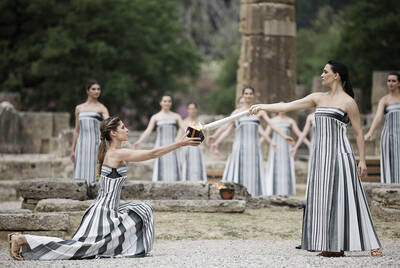
The sacred flame for the Paris Olympics was lit yesterday in Olympia, Greece, the birthplace of the ancient Games, in a ceremony inspired by antiquity and marked by messages of hope amid multiple global crises. “In ancient times, the Olympic Games brought together the Greek city states, even — and in particular — during times of war and conflict,” International Olympic Committee president Thomas Bach said. “Today, the Olympic Games are the only event that brings the entire world together in peaceful competition. Then as now, the Olympic athletes are sending this powerful message — yes, it is possible to compete fiercely


 RSS
RSS