


Al Burrows wore the same New York Black Yankees jersey he wore 49 years ago -- no high-priced throwback needed for this Negro League veteran.
On the table was a weathered glove worn for eight years by Satchel Paige, who eventually traded it to a friend for a pair of knee-high fishing boots.
Recently discovered artifacts nearly a century old were scattered throughout preserved unknowingly for decades in someone's suitcase: box scores, ledgers, photos and letters. They are the remnants of the less organized days of the so-called Colored Leagues, a period that even the old-timers couldn't remember.
Many of those memories will find a permanent home in the new Negro League Legends Hall of Fame, a shrine and museum to be built in Washington. Groundbreaking is scheduled for next year, with opening day set for 2006.
"We need this," said Sam Allen, who played for the Kansas City Monarchs, Raleigh Taggers and Memphis Red Sox in the late 1950s. "I've got grandchildren, and I can sit them down and tell them, but then they want to see the proof. With this museum coming up, they'll be able to come here and see my name and my picture. It's a long time coming."
There already is a Negro Leagues Baseball Museum in Kansas City, Missouri, and the history of black baseball is well documented in the Baseball Hall of Fame in Cooperstown, New York. The new Hall of Fame will supplement those, focusing more on individual players.
"It gives the average player a chance to be recognized," Allen said. "When you talk about Negro Leagues, black baseball, the first thing is Satchel Paige and Josh Gibson. But you had a lot of other good ball players. The Negro Leagues were loaded."
It was a discovery of some pre-Negro Leagues history that fascinated those gathered at Howard University on Wednesday. Detailed records that once belonged to Rutherford Hayes Jones, who owned a team called the Washington Giants in the early 20th century, had been found in a suitcase and turned over to Dwayne Sims, founder of the new Hall.
"He kept the box scores, how much he paid the umpires, the players, the receipts, everything," Sims said
Among the 300-plus items is a 1911 ledger noting US$2 paid to an umpire to work a game, numerous photos of athletes that Sims hopes to identify through research, and well-preserved correspondence from an era when white and black teams routinely played each other.
"Is your team white or colored?" is asked at the end of a letter organizing a series of games in 1906. "Kindly let me hear from you by return mail."
The Negro National League in 1920 was the first fully organized black league, followed by the Eastern Colored League in 1923. Even after Jackie Robinson broke the major league race barrier in 1947, some teams lasted into the 1950s and the 1960s. Sims estimates more than 300 Negro Leagues alumni are still living.
Their stories were ignored for years, but are now more popular than ever. A renaissance that started nearly a decade ago has them earning the acceptance -- and the perks -- they never received when they were playing.
"I can go out and make US$1,000 in one day," said Burrows, 71, recalling the fine food and hotel accommodations for a recent autograph session in Richmond, Virginia.
Not all are doing that well. Sims noted Negro League players are not getting any money from the sales of throwback Negro League hats and jerseys.

Four-time NBA all-star DeMarcus Cousins arrived in Taiwan with his family early yesterday to finish his renewed contract with the Taiwan Beer Leopards in the T1 League. Cousins initially played a four-game contract with the Leopards in January. On March 18, the Taoyuan-based team announced that Cousins had renewed his contract. “Hi what’s up Leopard fans, I’m back. I’m excited to be back and can’t wait to join the team,” Cousins said in a video posted on the Leopard’s Facebook page. “Most of all, can’t wait to see you guys, the fans, next weekend. So make sure you come out and support the Beer
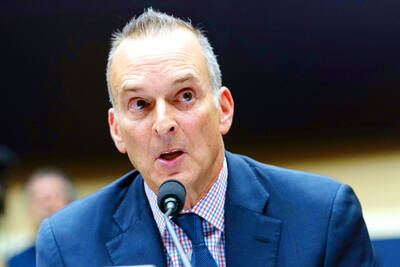
Revelations of positive doping tests for nearly two dozen Chinese swimmers that went unpunished sparked an intense flurry of accusations and legal threats between the World Anti-Doping Agency (WADA) and the head of the US drug-fighting organization, who has long been one of WADA’s fiercest critics. WADA on Saturday said it was turning to legal counsel to address a statement released by US Anti-Doping Agency (USADA) CEO Travis Tygart, who said WADA and anti-doping authorities in China swept positive tests “under the carpet by failing to fairly and evenly follow the global rules that apply to everyone else in the world.” The

Taiwanese judoka Yang Yung-wei on Saturday won silver in the men’s under-60kg category at the Asian Judo Championships in Hong Kong. Nicknamed the “judo heartthrob” in Taiwan, the Olympic silver-medalist missed out on his first Asian Championships gold when he lost to Japanese judoka Taiki Nakamura in the finals. Yang defeated three opponents on Saturday to reach the final after receiving a bye through the round of 32. He first topped Laotian Soukphaxay Sithisane in the round of 16 with two seoi nage (over-the-shoulder throws), then ousted Indian Vijay Kumar Yadav in the quarter-finals with his signature ude hishigi sankaku gatame (triangular armlock). He
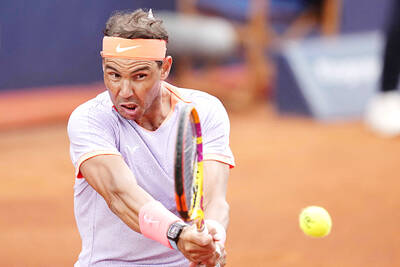
Rafael Nadal on Wednesday said the upcoming French Open would be the moment to “give everything and die” on the court after his comeback from injury in Barcelona was curtailed by Alex de Minaur. The 22-time Grand Slam title winner, back playing this week after three months on the sidelines, battled well, but eventually crumbled 7-5, 6-1 against the world No. 11 from Australia in the second round. Nadal, 37, who missed virtually all of last season, is hoping to compete at the French Open next month where he is the record 14-time champion. The Spaniard said the clash with De Minaur was


 RSS
RSS