


Its chemical components are similar to most banned steroids but with an insidious twist: This drug was synthesized so craftily it is undetectable by the standard test given to athletes.
The newly discovered designer steroid even foiled the skilled doping detectives who hunt for such drugs in urine samples, said Don Catlin of the Olympic Analytical Laboratory at UCLA.
What he and other scientists aren't so sure of is whether tetrahydrogestrinone -- THG -- was purposely designed to evade detection or if its creator got lucky.
"It could have been just a lucky shot," Catlin said. "But then I also tend not to underestimate the people who do this."
THG is at the heart of what one US anti-doping official called a widespread "conspiracy" involving chemists, coaches and athletes that was brought to the agency's attention by an anonymous tip.
Already, Europe's fastest man -- 100m champion Dwain Chambers of Britain -- has admitted taking THG. Other athletes -- including baseball sluggers Barry Bonds and Jason Giambi and boxer Shane Mosley -- have been subpoenaed to testify before a grand jury investigating the nutritional supplement company at the center of the unfolding case.
Because of the scandal, USA Track & Field, the sport's national governing body, proposed tougher drug rules on Wednesday that could include a lifetime ban for a first steroid offense. The organization also disclosed that four of its athletes tested positive for THG, and they could be barred from next year's Olympics.
The US Anti-Doping Agency, which monitors drug use by athletes in Olympic sports, turned to Catlin when it received a syringe of the stuff from an unidentified track coach this summer. After weeks of extensive tests, Catlin and his colleagues identified the substance as a "new chemical entity" with all the hallmarks of an anabolic steroid.
Anabolic steroids are synthetic versions of the male hormone testosterone. Doctors prescribe them to AIDS patients and other disease-stricken people who lose muscle mass. Athletes use them as shortcuts to bulk up, build endurance and recover better from training.
They can have dangerous side effects, including liver damage, heart disease, anxiety and rage.
There are at least a hundred known anabolic steroids, and professional doping sleuths such as Catlin have amassed a library of chemical fingerprints of these illegal substances that they match against athletes' urine samples.
To find steroid traces in urine, scientists use gas chromatography and mass spectrometry testing. The testing involves drying the sample, adding chemicals and then heating it. But THG disintegrates during this process and goes undetected, Catlin said.
Catlin, however, said he has developed a new process that keeps the signature of THG from disintegrating. He said he is making his recipe available to doping detection agencies.
The burgeoning scandal is the latest example of the cat-and-mouse game between makers of illicit drugs and the anti-doping officials who must constantly readjust their tests to detect ever-evolving substances.
Exactly who developed THG is unclear and is under investigation.
Victor Conte, owner of the Bay Area Laboratory Co-Operative recently raided by federal officials, has denied being the supplier of THG. He has not been charged with a crime, and his lawyers deny he has committed any wrongdoing.
Furthermore, Conte has said there is no proof THG is a steroid by the scientific definition. Catlin, however, said he is convinced it is.
Federal law makes possession of anabolic steroids illegal without a doctor's prescription. But some lawyers contend THG may not fit the legal definition of a steroid.
"It's apparently a newly created substance," said New York defense attorney Rick Collins, a former prosecutor who has defended clients accused of illegal steroid possession. "At this point we have no evidence, only speculation."
Collins said a stronger criminal case could be made that THG is an unapproved drug that violates Food and Drug Administration regulations for the marketing of pharmaceuticals.
Either way, sports governing bodies worldwide are moving to crack down on THG use. The NFL has said the league might retest its samples for THG. Swimming's world governing body said it would consider retesting drug samples from its world championships this summer.
Anti-doping scientists said Catlin's discovery may confirm what they have suspected for years: that there is a robust underground trade in performance-enhancers created specifically to evade detection.
"This is junior chemistry compared to what's coming," warned Gary Wadler, a member of the World Anti-Doping Agency.

Four-time NBA all-star DeMarcus Cousins arrived in Taiwan with his family early yesterday to finish his renewed contract with the Taiwan Beer Leopards in the T1 League. Cousins initially played a four-game contract with the Leopards in January. On March 18, the Taoyuan-based team announced that Cousins had renewed his contract. “Hi what’s up Leopard fans, I’m back. I’m excited to be back and can’t wait to join the team,” Cousins said in a video posted on the Leopard’s Facebook page. “Most of all, can’t wait to see you guys, the fans, next weekend. So make sure you come out and support the Beer
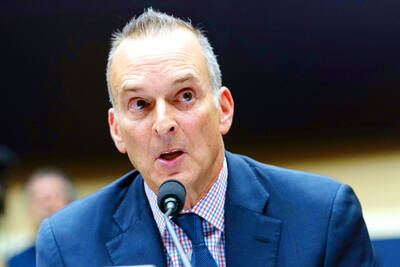
Revelations of positive doping tests for nearly two dozen Chinese swimmers that went unpunished sparked an intense flurry of accusations and legal threats between the World Anti-Doping Agency (WADA) and the head of the US drug-fighting organization, who has long been one of WADA’s fiercest critics. WADA on Saturday said it was turning to legal counsel to address a statement released by US Anti-Doping Agency (USADA) CEO Travis Tygart, who said WADA and anti-doping authorities in China swept positive tests “under the carpet by failing to fairly and evenly follow the global rules that apply to everyone else in the world.” The

Taiwanese judoka Yang Yung-wei on Saturday won silver in the men’s under-60kg category at the Asian Judo Championships in Hong Kong. Nicknamed the “judo heartthrob” in Taiwan, the Olympic silver-medalist missed out on his first Asian Championships gold when he lost to Japanese judoka Taiki Nakamura in the finals. Yang defeated three opponents on Saturday to reach the final after receiving a bye through the round of 32. He first topped Laotian Soukphaxay Sithisane in the round of 16 with two seoi nage (over-the-shoulder throws), then ousted Indian Vijay Kumar Yadav in the quarter-finals with his signature ude hishigi sankaku gatame (triangular armlock). He
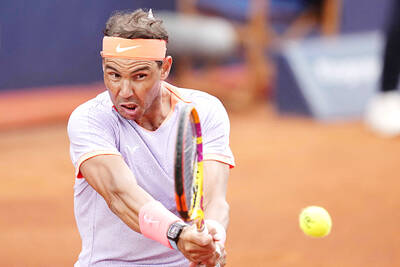
Rafael Nadal on Wednesday said the upcoming French Open would be the moment to “give everything and die” on the court after his comeback from injury in Barcelona was curtailed by Alex de Minaur. The 22-time Grand Slam title winner, back playing this week after three months on the sidelines, battled well, but eventually crumbled 7-5, 6-1 against the world No. 11 from Australia in the second round. Nadal, 37, who missed virtually all of last season, is hoping to compete at the French Open next month where he is the record 14-time champion. The Spaniard said the clash with De Minaur was


 RSS
RSS