


College football has begun, accompanied by the parallel season of moaning and groaning about the sad state of intercollegiate athletics. But when you go to stadiums around the US, there is not a lot of sadness. Quite the opposite.
Miami opened its season Thursday, trouncing Louisiana Tech, 48-9, before a record crowd of 43,279 in Shreveport. On Saturday night in Columbus, Ohio State began its defense of its national championship against Washington. What a marvelous atmosphere for college football: The usual 100,000 mostly Buckeyes fans flocking to Ohio Stadium in a poignant display of what makes this college sports enterprise so intriguing.
But Ohio State begins its season under a cloud: Its star running back, Maurice Clarett, who is being investigated for his academic performance, has been suspended for exaggerating the value of items that were stolen from a borrowed car. Washington begins the season with a new coach because his predecessor was fired for participating in a betting pool.
But this is not the face of intercollegiate athletics. For all the criticism, much of it deserved, the emotional pull of the enterprise is as strong as ever. The source of this attachment is an odd combination of loyalty, nostalgia and, in places like Columbus, civic pride.
College sports is not going away. And it should not. Intercollegiate athletics combines the best of what we are as a nation, testing body and mind. Mostly, it provides opportunity in the form of scholarships.
The great sin is that college presidents and educators have failed to meet the challenge of bringing intercollegiate athletics into the academic mainstream. They use high-profile programs as cash registers and on-campus entertainment, with no apparent concern for connecting this most public spectacle to the university.
This is the real academic fraud. Academia does not respect intercollegiate athletics as a viable field of study that deserves -- no, requires -- its own department. In this respect, athletics shares a bond with drama, art and music, which had to claw their way to respectability on liberal arts campuses.
Athletics currently exist in the academic bloodstream, but mostly as fragments. There are sports management courses and concentrations, as well as an array of offerings to physical education majors. There is the Center for the Study of Sport in Society at Northeastern University, but there is no comprehensive school, like that of drama, music or art, that embraces the totality of the sports industry: From history and communication to medicine, law and design.
This type of school or department would be made up of a number of parts of existing departments with its own emphasis on sports.
Critics make noise each new season about de-emphasizing athletics and about how "these kids" don't go to school for an education. The truth is that many are not finding the education they need because the school is too busy and too big to create an infrastructure that will accommodate the billion-dollar industry that sports has become.
There is an indisputable emotional connection in intercollegiate athletics; what's missing is the academic connection. Intercollegiate athletics should use the model of the long, hard journey schools of art, music and drama have had to endure to carve their niche on liberal arts campuses.
Otherwise we keep chasing our tails, beating the same old drum. Frankly, I'm tired of beating this old horse.
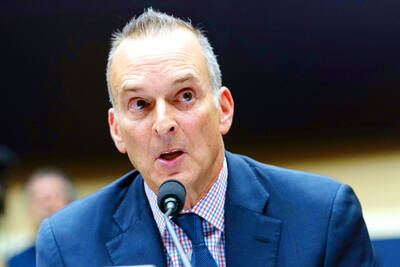
Revelations of positive doping tests for nearly two dozen Chinese swimmers that went unpunished sparked an intense flurry of accusations and legal threats between the World Anti-Doping Agency (WADA) and the head of the US drug-fighting organization, who has long been one of WADA’s fiercest critics. WADA on Saturday said it was turning to legal counsel to address a statement released by US Anti-Doping Agency (USADA) CEO Travis Tygart, who said WADA and anti-doping authorities in China swept positive tests “under the carpet by failing to fairly and evenly follow the global rules that apply to everyone else in the world.” The

Taiwanese judoka Yang Yung-wei on Saturday won silver in the men’s under-60kg category at the Asian Judo Championships in Hong Kong. Nicknamed the “judo heartthrob” in Taiwan, the Olympic silver-medalist missed out on his first Asian Championships gold when he lost to Japanese judoka Taiki Nakamura in the finals. Yang defeated three opponents on Saturday to reach the final after receiving a bye through the round of 32. He first topped Laotian Soukphaxay Sithisane in the round of 16 with two seoi nage (over-the-shoulder throws), then ousted Indian Vijay Kumar Yadav in the quarter-finals with his signature ude hishigi sankaku gatame (triangular armlock). He
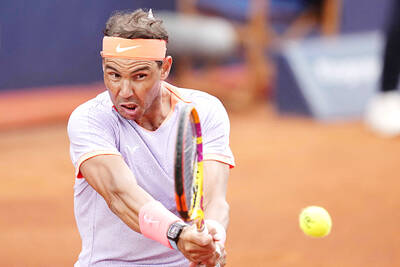
Rafael Nadal on Wednesday said the upcoming French Open would be the moment to “give everything and die” on the court after his comeback from injury in Barcelona was curtailed by Alex de Minaur. The 22-time Grand Slam title winner, back playing this week after three months on the sidelines, battled well, but eventually crumbled 7-5, 6-1 against the world No. 11 from Australia in the second round. Nadal, 37, who missed virtually all of last season, is hoping to compete at the French Open next month where he is the record 14-time champion. The Spaniard said the clash with De Minaur was

RALLY: It was only the second time the Taiwanese has partnered with Kudermetova, and the match seemed tight until they won seven points in a row to take the last set 10-2 Taiwan’s Chan Hao-ching and Russia’s Veronika Kudermetova on Sunday won the Porsche Tennis Grand Prix women’s doubles final in Stuttgart, Germany. The pair defeated Norway’s Ulrikke Eikeri and Estonia’s Ingrid Neel 4-6, 6-3, 10-2 in a tightly contested match at the WTA 500 tournament. Chan and Kudermetova fell 4-6 in the first set after having their serve broken three times, although they played increasingly well. They fought back in the second set and managed to break their opponents’ serve in the eighth game to triumph 6-3. In the tiebreaker, Chan and Kudermetova took a 3-0 lead before their opponents clawed back two points, but


 RSS
RSS