


Taipei Times: Despite a decade-long exile in the US, you have closely watched developments in China. Is China less totalitarian than 12 years ago?
Zhang Boli (
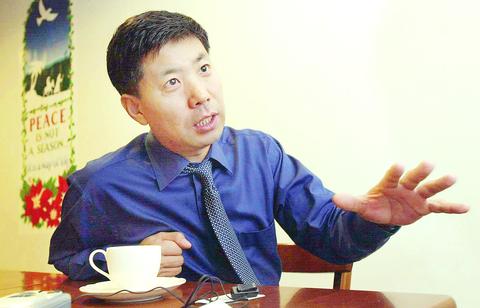
PHOTO: CHIANG YING-YING
Today, the government is still under control of a small group of conservatives who show no tolerance of dissenting voices.
Direct elections on the town and village levels border on a sham. Almost all candidates are handpicked by the Chinese Communist Party, which can, and often does, nullify the election outcome when its favored runners lose the race.
Democracy is more than adoption of certain political institutions. It is a way of life, the reflection of one's attitudes and values. Culturally, it may take Chinese people hundreds of years to truly assimilate Western philosophies, even in the absence of suppression. But that's no excuse for the Chinese authorities not to practice democracy, at odds with the global trend.
TT: Years after embarking on modernization, China now boasts an improved human rights record. To your knowledge, is that claim merited?
Zhang: Not in the least. In the past, China viewed human rights protection as a purely domestic matter, and any criticism from other countries is considered an improper intrusion. Now, Beijing is willing to discuss the issue with the international community, which I acknowledge is a sign of improvement.
The change, however, is cosmetic in that the Chinese government shows no relenting in its oppression to liberal intellectuals and religious groups. That explains why Falun Gong, Tibet and civil liberties remain taboos. Based on my personal experience, intellectuals enjoyed more freedom when Hu Yaobang (
TT: What do you think is the biggest obstacle to democratic reform in China?
Zhang: I concede that lack of organization and strategy caused the 1989 student movement to grow out of control later. Without a party-like apparatus, the protesters did not know when to retreat after successfully putting pressure on the government. The DPP in Taiwan did not experience a similar plight when staging street protests in the early 1990s.
The stark contrast bespoke the students' passion and naivety, but more importantly, it highlighted the importance of an opposition party. In light of the Chinese Communist Party's tight grip on power, I don't think China is anywhere ready to witness a power transfer in the foreseeable future such as Taiwan did in May last year -- peacefully.
Unlike most others, I'm not pessimistic, though. More and more Chinese students are studying abroad. I believe that after they graduate, they will help put the country in the right course, formidable as the mission may be.
TT: We haven't seen any massive student protest in China after the Tiananmen tragedy 12 years ago. How do you account for the calm?
Zhang: The bloody crackdown on June 4, 1989, has had a chilling effect on democracy fighters in China. I prophesied back then the massacre would bring about quiet for at least 20 years.
Also, students and intellectuals today tend to care less about the country's future. Over the years, Beijing has learned to play softball -- luring the intelligentsia with offers of material wealth and government posts -- to divert their energy. Many have succumbed to the temptation and muted their criticism of the regime. Some of my acquaintances, for instance, lead upper-class lives, no longer mindful of the pro-democracy crusade. I guess that is part of the price for embracing capitalism.
TT: How do you respond to allegations that students in the Tiananmen demonstration were pawns of a power struggle among the top brass in government?
Zhang: The student protest was spontaneous. As a frontline participant, I know that for sure. Certainly some politicians sought to use the movement to advance their own careers. Zhao, then China's president, intended to pressure more conservative elements within the party into liberal reforms. Former premier Li Peng (李鵬), on the other hand, seized on the turmoil to thwart Zhao's agenda. As Zhao was sympathetic with the students, we threw our weight behind him. We didn't mind being used in that manner. Unfortunately, the hardliners got the upper hand and Zhao was purged and put under house arrest. By failing to react positively to the student protests, China missed a great opportunity for political reform.
TT: Have you tried to return to China?
Zhang: Many times. But the Chinese authorities refuse to grant me a visa. They would arrest me on the spot if I were to set foot in the country. More than 200 people, up from 20, are on the so-called blacklist, including Gao Zhan (高瞻), the Chinese American scholar who has been detained since her trip back to China [in February]. Her arrest, which also enraged the White House, is linked to her former trips to Taiwan. Beijing tends to label anyone who visits Taiwan as a spy. That testifies to how far China has gone in improving its human rights record.
TT: Brought up with Chinese communist teaching that Taiwan is part of China and later studying cross-strait relations in the US, how do you view the standoff between Taipei and Beijing?
Zhang: It is a delicate issue that takes leaders on both sides great wisdom to handle. I would suggest an approach featuring more tolerance and less ideology. So be it if the people of Taiwan prefer the status quo. Let time have its way.
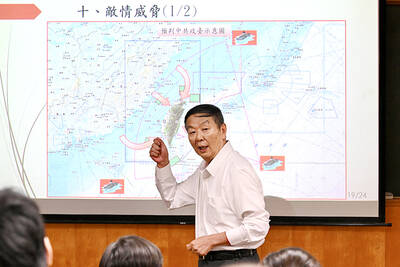
RETHINK? The defense ministry and Navy Command Headquarters could take over the indigenous submarine project and change its production timeline, a source said Admiral Huang Shu-kuang’s (黃曙光) resignation as head of the Indigenous Submarine Program and as a member of the National Security Council could affect the production of submarines, a source said yesterday. Huang in a statement last night said he had decided to resign due to national security concerns while expressing the hope that it would put a stop to political wrangling that only undermines the advancement of the nation’s defense capabilities. Taiwan People’s Party Legislator Vivian Huang (黃珊珊) yesterday said that the admiral, her older brother, felt it was time for him to step down and that he had completed what he
Taiwan has experienced its most significant improvement in the QS World University Rankings by Subject, data provided on Sunday by international higher education analyst Quacquarelli Symonds (QS) showed. Compared with last year’s edition of the rankings, which measure academic excellence and influence, Taiwanese universities made great improvements in the H Index metric, which evaluates research productivity and its impact, with a notable 30 percent increase overall, QS said. Taiwanese universities also made notable progress in the Citations per Paper metric, which measures the impact of research, achieving a 13 percent increase. Taiwanese universities gained 10 percent in Academic Reputation, but declined 18 percent

UNDER DISCUSSION: The combatant command would integrate fast attack boat and anti-ship missile groups to defend waters closest to the coastline, a source said The military could establish a new combatant command as early as 2026, which would be tasked with defending Taiwan’s territorial waters 24 nautical miles (44.4km) from the nation’s coastline, a source familiar with the matter said yesterday. The new command, which would fall under the Naval Command Headquarters, would be led by a vice admiral and integrate existing fast attack boat and anti-ship missile groups, along with the Naval Maritime Surveillance and Reconnaissance Command, said the source, who asked to remain anonymous. It could be launched by 2026, but details are being discussed and no final timetable has been announced, the source
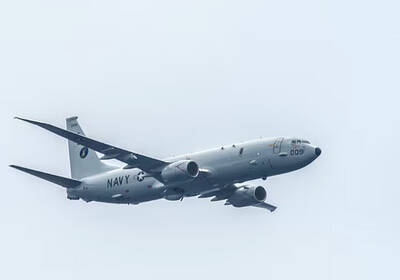
CHINA REACTS: The patrol and reconnaissance plane ‘transited the Taiwan Strait in international airspace,’ the 7th Fleet said, while Taipei said it saw nothing unusual The US 7th Fleet yesterday said that a US Navy P-8A Poseidon flew through the Taiwan Strait, a day after US and Chinese defense heads held their first talks since November 2022 in an effort to reduce regional tensions. The patrol and reconnaissance plane “transited the Taiwan Strait in international airspace,” the 7th Fleet said in a news release. “By operating within the Taiwan Strait in accordance with international law, the United States upholds the navigational rights and freedoms of all nations.” In a separate statement, the Ministry of National Defense said that it monitored nearby waters and airspace as the aircraft


 RSS
RSS