


Environmental activists once believed that the DPP's victory in the presidential election last year would lead to the establishment of a new paradigm -- a government that put environmental concerns at the heart of the administration.
On the eve of the anniversary of the DPP's taking the helm of national leadership, however, environmentalists bitterly criticized the DPP-led government, saying it has failed to address environmental problems in a new way.

FILE PHOTO
"The DPP did not use the handover of power to alter the former KMT-led government's old model -- that economic development takes precedence -- to a new way of thinking for years promoted by the DPP, which emphasizes the significance of sound environmental policy," said Lai Wei-chieh (賴偉傑), secretary-general of the Green Citizens' Action Alliance (GCAA, 綠色公民行動聯盟).
Taking the resumption of the construction of the Fourth Nuclear Power Plant (核四) as an example, Lai says that the government eventually gave in to opposition parties after a month-long political struggle without trying hard enough to win the public relations battle for the hearts and minds of the people. According to Lai, the government missed an opportunity to shape public opinion by introducing a new energy policy to Taiwan.
Although Lin Jun-yi (林俊義), a well-known anti-nuclear activist who has good relations with the DPP, took over as head of the Environmental Protection Administration (EPA) last May 20, his efforts to halt the construction of the Fourth Nuclear Power Plant failed to receive the necessary support from officials at higher levels.
The GCAA's Lai said that anti-nuclear activists are terribly disappointed that the DPP-led government has not even tried to review out-of-date energy policies.
"It's ironic that the DPP-led government has apparently forgotten the experts who wrote such an innovative environmental white paper for Chen Shui-bian (
Anti-nuclear activists complain that the type of thinking that drives the present DPP-led government is nearly identical to that of the former KMT regime.
To facilitate the construction of the Fourth Nuclear Power Plant, Taiwan Power Company (Taipower,
Environmentalists say that Taipower's strategy in Kungliao was exactly the one used by the former KMT-led government to compensate fishermen in Tamsui (
The project for creating the new town was designed to satisfy home-buyers in a hungry real-estate market. The ambitious project, however, turned out to be a failure because of the bad quality of the living environment and the lack of infrastructure. Surplus residential units still lie abandoned there and the government is continuing to pay off loans related to the project.
The failure of the Tamhai development plan resulted in the censure of several Cabinet agencies by the Control Yuan on May 1 for the unnecessary waste of money and the destruction of land. Activists believe that the damaged coastal environment in Tamsui might never recover and that the local fishing industry is damaged beyond repair.
"The huge Fourth Nuclear Power Plant project is exactly like the Tamhai case because both are impractical and both are inappropriate," Lai said.
"Does Taiwan have to walk down the same mistaken path again?" Lai said.
Environmentalists believe that the government has repeatedly failed to do the environmental footwork required to assure both long-term economic growth and a safe, secure environment for the country.
"From the Fourth Nuclear Power Plant to the Pinnan Industrial Complex Project, the government has unfortunately allowed short-term political concerns to outweigh the nation's long-term interests in environmental protection," said Lin Tze-luen (林子倫), a research associate at the Center for Energy and Environmental Policy at the University of Delaware in the US.
Last September, Lin and US experts from the Alton W. Jones Foundation held an international conference in Taipei on renewable energy.
In the same week, energy experts from Germany held another international conference on renewable energy in Taipei. At the opening ceremony, Chen promised to adopt more renewable energy sources in Taiwan, saying that the Presidential Office would be run on solar power. However, Chen has thus far failed to keep his word.
"The economic concerns of narrow sets of special interests continue to take precedence over the interests of the vast majority of the public," Lin said.
Environmentalists say that if the government had kept environmental concerns clearly in mind then a number of recent disasters could have been averted.
"Over the past year, the DPP-led government has experienced several crises, which actually resulted from perfunctory environmental impact assessments (EIA)," said Lin Sheng-chung (
Lin said that the recent fight between the National Science Council (NSC) and the Ministry of Transportation and Communications over vibration problems caused by a high-speed railroad passing by the Tainan Science-based Industrial Park could be attributed to the conditionally approved EIA for the industrial park. The EIA report lacked a precise limit for the intensity of vibrations produced by trains using the line.
The replacement of the NSC chairman in March was partly due to the agency's failure to prevent high-tech firms from pulling their projects out of the park.
Last July, Lin said, former vice premier Yu Shyi-kun's resignation in the wake of the Pachang Creek (
Lin argues that if the assessment had been done properly, a gravel excavation project would not have been permitted upstream of the creek. Poor land preservation in mountain areas caused the flood, which claimed the lives of four hapless workers killed while clinging to one another in the rising water.
Environmentalists charge that the DPP-led government has failed to come up with strategies to solve a number of existing problems, such as the illegal dumping of hazardous industrial waste.
In early July of last year, the illegal dumping of toxic chemical solvents upstream in the Kaoping River (高屏溪) caused serious water pollution, leaving millions of residents without tap water for days.
Twenty-two people from the Eternal Chemical Company (
New EPA head Hau Lung-bin (
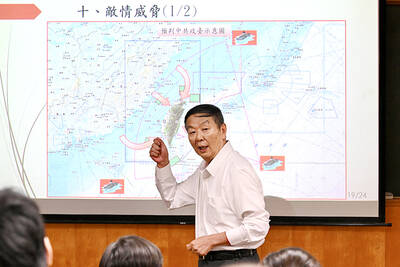
RETHINK? The defense ministry and Navy Command Headquarters could take over the indigenous submarine project and change its production timeline, a source said Admiral Huang Shu-kuang’s (黃曙光) resignation as head of the Indigenous Submarine Program and as a member of the National Security Council could affect the production of submarines, a source said yesterday. Huang in a statement last night said he had decided to resign due to national security concerns while expressing the hope that it would put a stop to political wrangling that only undermines the advancement of the nation’s defense capabilities. Taiwan People’s Party Legislator Vivian Huang (黃珊珊) yesterday said that the admiral, her older brother, felt it was time for him to step down and that he had completed what he
Taiwan has experienced its most significant improvement in the QS World University Rankings by Subject, data provided on Sunday by international higher education analyst Quacquarelli Symonds (QS) showed. Compared with last year’s edition of the rankings, which measure academic excellence and influence, Taiwanese universities made great improvements in the H Index metric, which evaluates research productivity and its impact, with a notable 30 percent increase overall, QS said. Taiwanese universities also made notable progress in the Citations per Paper metric, which measures the impact of research, achieving a 13 percent increase. Taiwanese universities gained 10 percent in Academic Reputation, but declined 18 percent
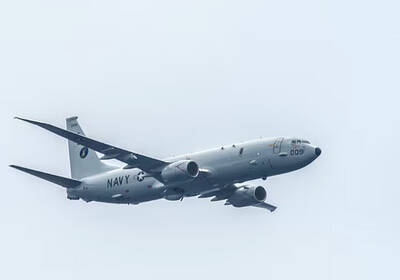
CHINA REACTS: The patrol and reconnaissance plane ‘transited the Taiwan Strait in international airspace,’ the 7th Fleet said, while Taipei said it saw nothing unusual The US 7th Fleet yesterday said that a US Navy P-8A Poseidon flew through the Taiwan Strait, a day after US and Chinese defense heads held their first talks since November 2022 in an effort to reduce regional tensions. The patrol and reconnaissance plane “transited the Taiwan Strait in international airspace,” the 7th Fleet said in a news release. “By operating within the Taiwan Strait in accordance with international law, the United States upholds the navigational rights and freedoms of all nations.” In a separate statement, the Ministry of National Defense said that it monitored nearby waters and airspace as the aircraft

UNDER DISCUSSION: The combatant command would integrate fast attack boat and anti-ship missile groups to defend waters closest to the coastline, a source said The military could establish a new combatant command as early as 2026, which would be tasked with defending Taiwan’s territorial waters 24 nautical miles (44.4km) from the nation’s coastline, a source familiar with the matter said yesterday. The new command, which would fall under the Naval Command Headquarters, would be led by a vice admiral and integrate existing fast attack boat and anti-ship missile groups, along with the Naval Maritime Surveillance and Reconnaissance Command, said the source, who asked to remain anonymous. It could be launched by 2026, but details are being discussed and no final timetable has been announced, the source


 RSS
RSS