


Kobayashi Yoshinori, author of the popular Japanese comic On Taiwan (
At a press conference yesterday, the Taipei Women's Rescue Foundation (婦女救援基金會), a non-governmental organization long dedicated to fact-finding on Taiwanese comfort women, lambasted Kobayshi's "twisted" presentation of the issue in interviews with two Taiwanese business leaders -- Hsu Wen-lung (許文龍) and Tsai Kuan-tsan (蔡焜燦).
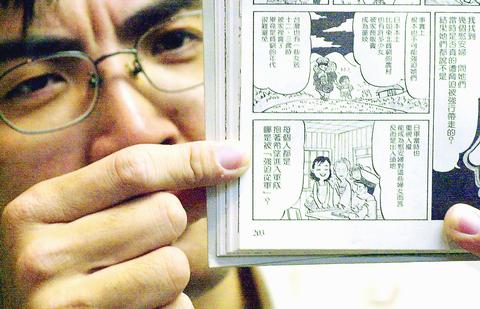
PHOTO: CHIANG YING-YING, TAIPEI TIMES
"It's nothing but an outrageous distortion of a painful history, which over 1,000 Taiwanese women had to go through at the cost of their youth and lives," said Lin Feng-hao (
"To ignore this kind of distortion today is like rubbing salt into old wounds. And to be silent about the author's male-chauvinistic views is to encourage the idea that women's bodies are a tradable commodity," Lin said.
In his comic On Taiwan, which has been available in Chinese in Taiwan since early February, Kobayashi cited Hsu, president of Chi Mei Electronics Corp (奇美電子) and senior advisor to the president, as saying that "All the comfort women were voluntary. It is impossible that they were forced to perform sex services for the [Japanese] army."
In contrast to accounts of the issue in Taiwan, Hsu was further quoted as saying that "The Japanese military was very concerned about human rights and it was an advancement for these women to be able to become comfort women."
Kobayashi also quoted the close friend of former president Lee Teng-hui (
Chu Te-lan (朱德蘭), an associate history research fellow at Academia Sinica, refuted Kobayashi's statements on the basis of her research on Taiwanese history during the Japanese colonial period from 1895 to 1945.
Chu indicated that while the recruited comfort women indeed included a few public prostitutes, the majority of them were recruited against their will, either by means of coercion, force or deception.
Kobayashi's previous book On War (
According to Avant Garde Publishing (
He will visit Taiwan in March to have face-to-face debates with the opponents of his accounts of colonial Taiwan.
The publisher also revealed the second edition of the book is now at the printers.
According to the Womens Rescue Foundation research, demand for sexual slaves increased dramatically after 1932 when Taiwan became a primary location for the recruitment of comfort women.
The files of the Taiwan Colonial Trade Corp (
Aside from the Taiwan Colonial Trade Corporation, the Japanese government also used prefectural officers and local police to recruit comfort women by forcible means. Moreover, many young women were recruited by deceptive means, being offered housemaid or laundry jobs.
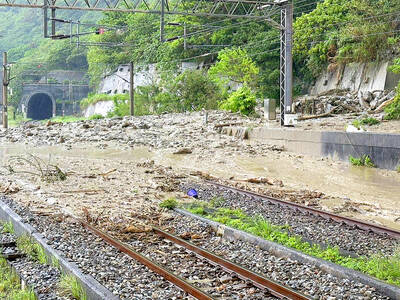
ROLLER-COASTER RIDE: More than five earthquakes ranging from magnitude 4.4 to 5.5 on the Richter scale shook eastern Taiwan in rapid succession yesterday afternoon Back-to-back weather fronts are forecast to hit Taiwan this week, resulting in rain across the nation in the coming days, the Central Weather Administration said yesterday, as it also warned residents in mountainous regions to be wary of landslides and rockfalls. As the first front approached, sporadic rainfall began in central and northern parts of Taiwan yesterday, the agency said, adding that rain is forecast to intensify in those regions today, while brief showers would also affect other parts of the nation. A second weather system is forecast to arrive on Thursday, bringing additional rain to the whole nation until Sunday, it

CONDITIONAL: The PRC imposes secret requirements that the funding it provides cannot be spent in states with diplomatic relations with Taiwan, Emma Reilly said China has been bribing UN officials to obtain “special benefits” and to block funding from countries that have diplomatic ties with Taiwan, a former UN employee told the British House of Commons on Tuesday. At a House of Commons Foreign Affairs Committee hearing into “international relations within the multilateral system,” former Office of the UN High Commissioner for Human Rights (OHCHR) employee Emma Reilly said in a written statement that “Beijing paid bribes to the two successive Presidents of the [UN] General Assembly” during the two-year negotiation of the Sustainable Development Goals. Another way China exercises influence within the UN Secretariat is
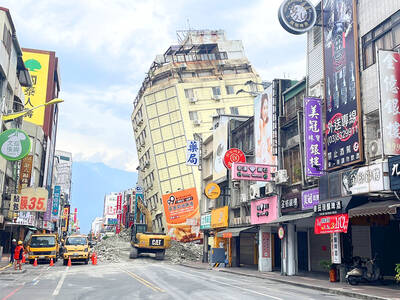
LANDSLIDES POSSIBLE: The agency advised the public to avoid visiting mountainous regions due to more expected aftershocks and rainfall from a series of weather fronts A series of earthquakes over the past few days were likely aftershocks of the April 3 earthquake in Hualien County, with further aftershocks to be expected for up to a year, the Central Weather Administration (CWA) said yesterday. Based on the nation’s experience after the quake on Sept. 21, 1999, more aftershocks are possible over the next six months to a year, the agency said. A total of 103 earthquakes of magnitude 4 on the local magnitude scale or higher hit Hualien County from 5:08pm on Monday to 10:27am yesterday, with 27 of them exceeding magnitude 5. They included two, of magnitude

Taiwan’s first drag queen to compete on the internationally acclaimed RuPaul’s Drag Race, Nymphia Wind (妮妃雅), was on Friday crowned the “Next Drag Superstar.” Dressed in a sparkling banana dress, Nymphia Wind swept onto the stage for the final, and stole the show. “Taiwan this is for you,” she said right after show host RuPaul announced her as the winner. “To those who feel like they don’t belong, just remember to live fearlessly and to live their truth,” she said on stage. One of the frontrunners for the past 15 episodes, the 28-year-old breezed through to the final after weeks of showcasing her unique


 RSS
RSS