


The Kaohsiung City Council passed regulations prohibiting the feeding of monkeys at the city's Takao Hill (打狗山) on Jan. 17. Any act of charity towards the monkeys is now punishable by an NT$6,000 fine. It has done little, though, to stop all the monkey business at Takao Hill, activists and animal conservationists say.
The Formosan rock macaque monkeys (
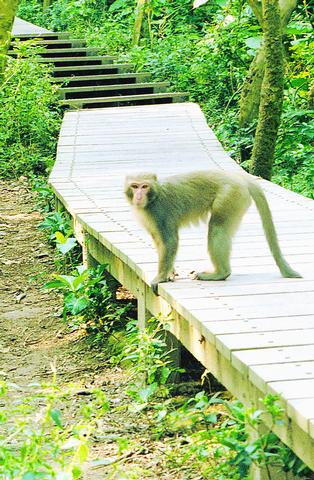
PHOTO: CHIU YU-TZU, TAIPEI TIMES
"Because the monkeys can get food so easily, they have become spoiled and have learned how to beg for food from mountain climbers ... they even aggressively snatch food away. It's unnatural," said Yang Ping-yu (楊娉育), the executive general of the Takao Hill Park Association (柴山自然公園促進會).
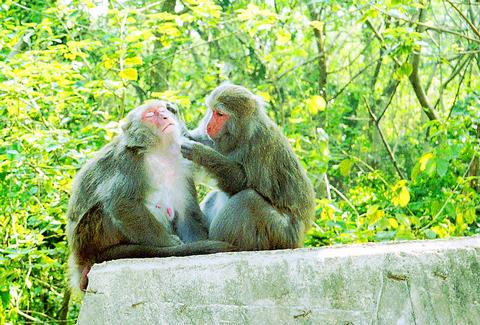
PHOTO: CHIU YU-TZU, TAIPEI TIMES
The 330m-high hill has long been home to the species. Their activities were first recorded in 1862 by English zoologist Robert Swinhoe, who named the endemic round-faced monkey Macaca cyclopis in his book Formosan Mammalians.
The species is known for its dark gray skin and cheek pouches, which it uses to carry food in while foraging.
The macaque consumes fruits, leaves, berries, seeds, insects and small vertebrate animals. It's tail, however, is medium length and not prehensile, making it impossible for it to assist the monkey when it climbs trees.
Swinhoe sent a pair of the Formosan rock macaques to a zoo in London and the exhibition reportedly drew a lot of attention from Western biologists.
Today, some 700 to 1,000 of the monkeys live on what foreigners once called Ape Hill.
However, Swinhoe probably never expected that over 130 years of attention from humans would threaten the species.
Mismanaged Park
While the Kaohsiung City government has mapped out 500 hectares of the hill as a protected area, the park has no designated entrance.
Traveling along an almost hidden cement path beside Lungchuan Temple (龍泉寺), in the Gushan district (鼓山區) of Kaohsiung city, mountain climbers who visit for the first time might have difficulty imagining the majestic scenery that's hidden behind the temple.
Dozens of families who live near the temple have complained that their quality of life has been ruined by thousands of day hikers forced to share limited parking space, as well as by hawkers who sell their wares at the base of the hill.
But even before the mountain opened to the public, residents complained about the monkeys, which invaded their backyards, scavenging for any available food.
"People have come now and the monkeys have retreated. A new battle is taking place on the mountain," one resident said.
Conservationists say the conflict could be attributed to the government's over-development of the area, which has added numerous pavilions, park benches and pathways to the mountain.
Walking on a wooden-plank footpath, visitors can tour the hill within the span of an hour -- provided they aren't distracted by monkeys along the way.
"We've found that monkeys seem to prefer walking on pathways to swinging in the woods," said Huang Li-ting (
In the mountain, it is common for visitors to have to make way for a group of monkeys running along the footpath.
While resting at one of the pavilions, visitors are often approached by monkeys begging and screaming for food. Many say they find the urge to feed the monkeys irresistible despite the law.
Based on their experience, monkeys have figured out that food is usually kept inside plastic bags. As a result, many of those who carry plastic bags are often attacked by aggressive monkeys, conservationists say.
"Some clever monkeys even know how to suck juice from cartons," said Huang, who has been observing the park's ecology for years.
But Huang is not totally against individuals coming to visit the mountain.
Some people come the hill to observe the monkeys' behavior, such as their grooming, she says. Monkeys groom to remove chips, salt particles and parasites from their hair.
"Observing is a good thing. But people get deeply involved in the monkeys' life by feeding them," Huang said.
`Never feed monkeys'
Feeding continues, regardless of the signs posted around the park.
"Never Feed Monkeys," is one of several "Nevers" ardently urged by the city government to remind visitors of the potential dangers of mischievous monkeys. However, notices advising to "Never bring pets" and "Never bring food" often go totally unheeded.
Pet owners holding their dogs and cats, which are scared by monkeys, are a common sight along the park's footpaths.
Other notices urge visitors to avoid feeding, attacking and staring at the monkeys. But few heed this advice as well. While visiting the mountain recently, a small group of teenagers in school uniforms walked by with popguns in hand ready to scare monkeys and take what they called "revenge" without adults' company.
"Some detestable monkey stole fruit and broke the antennae on my TV," said one teenager. Amazingly, not only teenagers but also adults use popguns to scare monkeys "just for fun."
Activists say that what the park needs most is comprehensive management, not more pavilions and park benches.
In addition to the famous native monkeys, there are other treasures within the park that equally deserve protection.
Visitors can easily find the fossils of sea urchins on the ground because the hill, formed between 80,000 and 120,000 years ago, was once coral reefs under the sea.
Additionally, several shell mounds (
City government no help
Environmentalists say that thoughtless management practices carried out by the government have accelerated the environmental deterioration within the park.
Last December, the city government, which has asked visitors not to bring food to the mountain, provided 55 sets of wooden tables and benches for picnickers that the monkeys now frequent themselves.
The benches and tables were provided following an overall cleanup of hundreds of tables and couches placed without permission by individuals last September.
Some 1,300 volunteer workers have also dismantled 19 buildings which were built without first obtaining a proper license. Some of the illegal villas were even owned by legislators.
The official cleanup was carried out following pressure from various environmental groups.
Last May, the "Rescuing Takao Hill" action was initiated by several local groups, including the Takao Hill Park Association, the Kaohsiung City Green Association (高雄市綠色協會), Kaohsiung City Teachers' Association (高雄市教師會) and the Chunghwa Telecom Workers' Union (中華電信工會).
Activists collected more than 10,000 signatures on a petition urging Kaohsiung City Mayor Frank Hsieh (謝長廷) to protect the area.
Environmentalists' aggressive action has caused a violent reaction among residents living in the area. When the government began razing illegal buildings last June, angry residents allegedly assaulted conservationists standing to the side, including Li Ken-cheng (
Officials with the Kaohsiung City government said that they have encountered difficulties for years in managing the park.
"We wanted to get land from Taiwan Cement Corporation (台灣水泥公司) to build an official gate in order to limit the amount of visitors, but failed," said an official of the city's Bureau of Reconstruction, who wished to remain anonymous.
One of Taiwan Cement's sites located by the mountain has mined limestone from the area for decades and more recently served as a blockade to visitors.
Officials with the Bureau of Reconstruction told the Taipei Times that all they could do now was to maintain old pavilions and build new footpaths for visitors.
An NT$12 million project was initiated last year; a new 500m-long footpath and four pavilions will be finished by October this year, the officials said.
Conservationists say that the over-exploited park will suffer further damage still if the government fails to either come up with a better scheme to manage the park or else educate the public.
Activists with the Takao Hill Park Association decided to rescue the mountain in their own way.
In recent years, they have trained dozens of volunteers to explain the local ecology to visitors. In April, they plan to target elementary students by holding workshops around the Kaohsiung area.
"Educated children might be more influential. They can spread ecological concepts to their teachers, parents, and friends," said the park association's Yang.
Taiwan has experienced its most significant improvement in the QS World University Rankings by Subject, data provided on Sunday by international higher education analyst Quacquarelli Symonds (QS) showed. Compared with last year’s edition of the rankings, which measure academic excellence and influence, Taiwanese universities made great improvements in the H Index metric, which evaluates research productivity and its impact, with a notable 30 percent increase overall, QS said. Taiwanese universities also made notable progress in the Citations per Paper metric, which measures the impact of research, achieving a 13 percent increase. Taiwanese universities gained 10 percent in Academic Reputation, but declined 18 percent

Chinese President Xi Jinping (習近平) yesterday met with former president Ma Ying-jeou (馬英九) at the Great Hall of the People in Beijing, with Xi’s opening statement once more emphasizing that people on both sides of the Taiwan Strait are Chinese and that foreign intervention cannot change their inevitable unification. Xi said that 5,000 years of history of zhonghua minzu (中華民族, ethnic Chinese group) have seen their ancestors move to Taiwan to establish new lives, while also documenting them fighting side-by-side against foreign forces and finally freeing Taiwan. “Both sides are Chinese,” and there are no issues that cannot be worked through, he
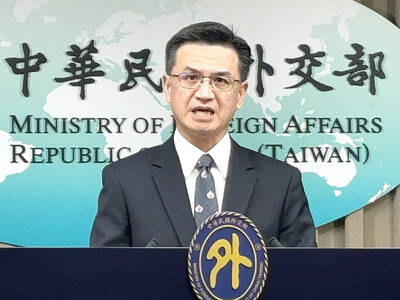
BULLY TACTICS: Beijing has continued its incursions into Taiwan’s airspace even as Xi Jinping talked about Taiwan being part of the Chinese family and nation China should stop its coercion of Taiwan and respect mainstream public opinion in Taiwan about sovereignty if its expression of goodwill is genuine, the Ministry of Foreign Affairs (MOFA) said yesterday. Ministry spokesman Jeff Liu (劉永健) made the comment in response to media queries about a meeting between former president Ma Ying-jeou (馬英九) and Chinese President Xi Jinping (習近平) the previous day. Ma voiced support for the so-called “1992 consensus,” while Xi said that although the two sides of the Taiwan Strait have “different systems,” this does not change the fact that they are “part of the same country,” and that “external

UNDER DISCUSSION: The combatant command would integrate fast attack boat and anti-ship missile groups to defend waters closest to the coastline, a source said The military could establish a new combatant command as early as 2026, which would be tasked with defending Taiwan’s territorial waters 24 nautical miles (44.4km) from the nation’s coastline, a source familiar with the matter said yesterday. The new command, which would fall under the Naval Command Headquarters, would be led by a vice admiral and integrate existing fast attack boat and anti-ship missile groups, along with the Naval Maritime Surveillance and Reconnaissance Command, said the source, who asked to remain anonymous. It could be launched by 2026, but details are being discussed and no final timetable has been announced, the source


 RSS
RSS