


To raise public awareness about preserving natural resources, Taipei's Bureau of Cultural Affairs (
Lung Ying-tai (
"They not only provide us with shelter, but are also living creatures just like you and I," Lung said. "We owe them an apology when we accidentally step on them or bump into them. They're older than our grandparents. They're the genuine indigenous people of this land."
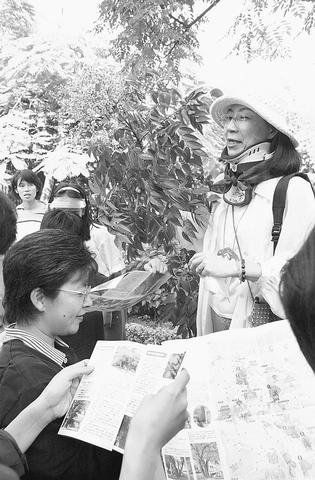
PHOTO: GEORGE TSORNG, TAIPEI TIMES
The tours, dubbed a "Historical Stroll of the Old Trees in Taipei City" (
The public is being encouraged to pick up literature on the tours, available at MRT stations, district offices, the bureau and the foundation, as a reference guide to visiting the old trees growing in the city's seven districts -- Chungshan, Shihlin, Peitou, Wenshan, Hsinyi, Neihu and Nankang.
The pamphlet, among other things, includes a map indicating where the trees are located in each district, as well as their history.
Yesterday's tour, which covered the Chungshan District, is part of a series of four tours. Tours of the Chungshan District will continue until January. The next of the series, which covers Shihlin and Peitou districts, is slated to begin in February and will also last for three months.
Yesterday's activity was part of the bureau's campaign to prepare for the passage of the Taipei City Tree Protection Autonomy Regulation (
The regulation protects trees that are more than 100 years old, taller than 15m and larger than 2.5m in diameter. Those who cut the protected trees without first obtaining approval from the bureau will face a fine of up to NT$100,000.
After the bureau kicked off a census of the city's trees on Sept. 25, at least 90 old trees have been recorded, most of them banyan trees.
Although yesterday's three-hour tour in Chungshan District seemed tiring, Alan Hwang, a 21-year-old exchange student from the University of California at Davis, said he learned something from the activity.
"The guide told us interesting stories about each tree and taught us useful things about trees," he said.
Hwang was on a field trip with his teacher and six other classmates from the language center at National Taiwan University.
Huang Pi-hua (黃碧華), who came with her two sons aged two and seven, said it was a meaningful and educational activity.
"I like my boys to see with their own eyes what kind of trees they are and how beautiful they are. After all, it's different from learning it in the classroom," she said.
Ko Chung-han (
"We don't usually go out to see the trees and sky because we have to study," Lee said.
Taiwan has experienced its most significant improvement in the QS World University Rankings by Subject, data provided on Sunday by international higher education analyst Quacquarelli Symonds (QS) showed. Compared with last year’s edition of the rankings, which measure academic excellence and influence, Taiwanese universities made great improvements in the H Index metric, which evaluates research productivity and its impact, with a notable 30 percent increase overall, QS said. Taiwanese universities also made notable progress in the Citations per Paper metric, which measures the impact of research, achieving a 13 percent increase. Taiwanese universities gained 10 percent in Academic Reputation, but declined 18 percent

Chinese President Xi Jinping (習近平) yesterday met with former president Ma Ying-jeou (馬英九) at the Great Hall of the People in Beijing, with Xi’s opening statement once more emphasizing that people on both sides of the Taiwan Strait are Chinese and that foreign intervention cannot change their inevitable unification. Xi said that 5,000 years of history of zhonghua minzu (中華民族, ethnic Chinese group) have seen their ancestors move to Taiwan to establish new lives, while also documenting them fighting side-by-side against foreign forces and finally freeing Taiwan. “Both sides are Chinese,” and there are no issues that cannot be worked through, he
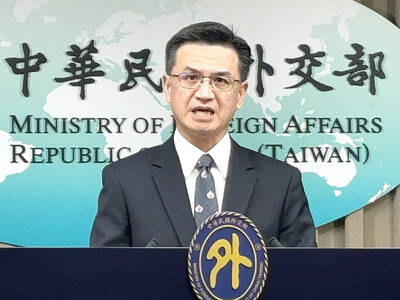
BULLY TACTICS: Beijing has continued its incursions into Taiwan’s airspace even as Xi Jinping talked about Taiwan being part of the Chinese family and nation China should stop its coercion of Taiwan and respect mainstream public opinion in Taiwan about sovereignty if its expression of goodwill is genuine, the Ministry of Foreign Affairs (MOFA) said yesterday. Ministry spokesman Jeff Liu (劉永健) made the comment in response to media queries about a meeting between former president Ma Ying-jeou (馬英九) and Chinese President Xi Jinping (習近平) the previous day. Ma voiced support for the so-called “1992 consensus,” while Xi said that although the two sides of the Taiwan Strait have “different systems,” this does not change the fact that they are “part of the same country,” and that “external

UNDER DISCUSSION: The combatant command would integrate fast attack boat and anti-ship missile groups to defend waters closest to the coastline, a source said The military could establish a new combatant command as early as 2026, which would be tasked with defending Taiwan’s territorial waters 24 nautical miles (44.4km) from the nation’s coastline, a source familiar with the matter said yesterday. The new command, which would fall under the Naval Command Headquarters, would be led by a vice admiral and integrate existing fast attack boat and anti-ship missile groups, along with the Naval Maritime Surveillance and Reconnaissance Command, said the source, who asked to remain anonymous. It could be launched by 2026, but details are being discussed and no final timetable has been announced, the source


 RSS
RSS