


The Taipei city government is to hold Taiwan's first chemical accident reaction drill on Thursday, as part of efforts to smooth rescue operations in the event of contamination of the city's mass rapid transit (MRT) system.
"The purpose of the drill is to find out any potential problems that might arise concerning the use of chemical hazard rescue equipment in the MRT system, and to prepare the city's medical staff for a quick reaction to any such possible mishaps," said Yeh Ching-chuan (
Possible sources of chemical contamination of underground portions of the MRT system could come from gas main leaks or deliberate sabotage.
In 1995, members of Japan's Aum Shinrikyo doomsday cult, led by its founder, Shoko Asahara, launched a deadly nerve-gas attack on the Tokyo subway system, killing 12 people and injuring thousands of others. It was an event analysts said hammered home the vulnerability of underground transit systems.
Thursday's drill, ordered by Taipei Mayor Ma Ying-jeou (
No traffic regulations will be imposed, but the west entrance and the fifth and sixth exits of the stop will be closed. The public is welcome to view the 40-minute drill, according to city officials.
Around 400 people have been recruited from 12 city government departments, including the health bureau, fire department, environmental protection bureau, police headquarters, and Taipei Rapid Transit Co, Ltd, in addition to Chung Hsiao municipal hospital.
According to Tyrone Wang (
"Two features of the drill will be that some of the scenes will be broadcast live, and a clear zoning of handling areas will be set up," he said.
The zones are classified as "contaminated," "control" and "safe" areas.
Victims rescued from the contaminated area must be removed of contaminants in the control area before they are sent to the safe area for medical assistance.
During the drill, medical staff will not be permitted to enter the contaminated area to give medical assistance.
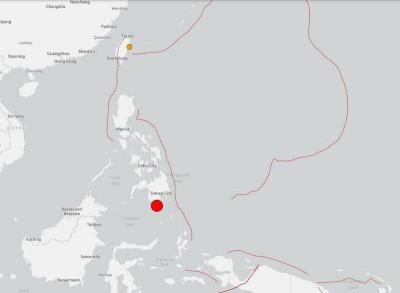
A magnitude 7.8 earthquake struck off the southern coast of Mindanao in the Philippines at 7:38am today, prompting the US Tsunami Warning System to issue an alert for neighboring countries, including Taiwan. The system issued a purple alert indicating a "tsunami threat." The potential threat zone includes Taiwan, the Philippines, Papua New Guinea, Yap and Palau. Philippine authorities were assessing the damage from the quake, with the office of civil defense seeking to verifying initial reports that 15 people had been killed and 129 injured in the region, mostly from falling debris. Arlene Hollero, disaster chief of Maasim town in the Philippines' Sarangani Province,
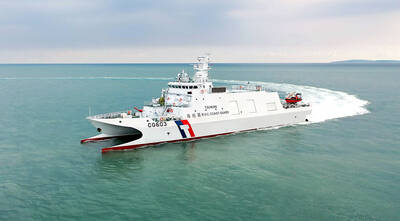
‘GRAY ZONE’ PRESSURE: Beijing’s activities are intended to create the deceitful impression that China has jurisdiction over the area around Taiwan, the CGA said Taiwan’s rights over its territorial waters and exclusive economic zone must not be violated by any country, the Mainland Affairs Council said yesterday, adding that it will not accept any unprovoked actions. The council issued the remarks in response to the China Coast Guard conducting maritime enforcement drills near eastern Taiwan and claiming to fully exercise China’s maritime administrative law enforcement authority. The Coast Guard Administration (CGA) has been closely monitoring the situation and is taking concrete steps to defend the nation’s sovereignty and secure its waters, the council said. China has no sovereign rights over the waters off eastern
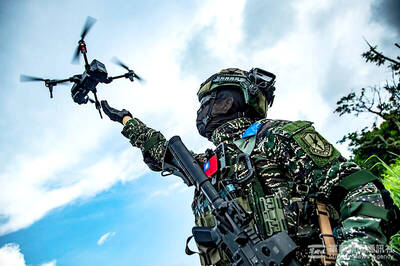
RESILIENCE: Taiwan plays a key role in semiconductors, energy, information infrastructure and advanced manufacturing, AIT Director Raymond Greene said Taiwan’s continued investment in deterrence and resilience remains vital, especially in uncrewed systems and other emerging technologies, American Institute in Taiwan (AIT) Director Raymond Greene said yesterday. Greene made the remarks at the annual National Strategic Summit on Supply Chain Resilience held by the Research Institute for Democracy, Society and Emerging Technology (DSET), a government-backed think tank. As Taiwan last year became the US’ fourth-largest trading partner and supply chain security is becoming more important, cooperation in emerging technologies continues to deepen between the two countries, he said. The US is committed to accelerating innovation, building key infrastructure, strengthening cooperation

RIGHT DIRECTION: Taiwan’s efforts to prevent forced labor include a proposal to ‘fully prohibit’ employers from withholding workers’ documents, an official said Taiwan is to establish a mechanism to restrict imports of goods linked to forced labor, the Executive Yuan said yesterday, after the US proposed imposing additional tariffs on Taiwanese goods over labor concerns. “The Ministry of Labor and the Ministry of Economic Affairs are to establish an interministerial review procedure,” Executive Yuan spokesperson Michelle Lee (李慧芝) said at a news briefing in Taipei. “The government is to use the Foreign Trade Act [貿易法] as the legal basis to restrict imports of goods produced with forced labor” and bring its supply chain governance more in line with international standards on human rights, resilience


 RSS
RSS