


A year after the waste contractor for the Formosa Plastics Group (台塑關係企業) was found to have dumped thousands of tonnes of mercury-tainted waste in Cambodia, Taiwan is still struggling with its global environmental reputation.
In the aftermath of the accusations made against the company, which include several deaths attributed to the disposal of 3,000 tonnes of waste, harsh criticism has been aimed at the environmental policies of Taiwan, labeled the "Island of Poison" by environmentalists.
"It's been almost a year since the scandal broke, but we haven't seen any kind of redemptive action on the part of either the company or the government," said Joyce Fu (

PHOTO: STEPHEN O'CONNELL
Wandering waste
Under international pressure last December, Formosa Plastics was forced to move the Cambodian waste -- identified on customs documents as cement cakes -- and several tonnes of contaminated soil back to Taiwan after protesters prevented it from being shipped to the US.
Over the disapproval of Taiwan's Environmental Protection Administration (EPA), 4,600 tonnes of the refuse was put in temporary storage in Kaohsiung Harbor in April on the condition that it be shipped out of the country again.

PHOTO: STEPHEN O'CONNELL
Seven months later, it's still there. Efforts to send the waste to France and the US have failed, mostly as the result of pressure from foreign environmentalists.
In July, export to Seattle, Washington, was blocked by activists from the Basel Action Network (BAN) and the Tacoma Longshoremen's Union. In November, Formosa Plastics was turned down by the French government, which relented to pressure by the Centre National D'information Independante sur les Dechets (CNIID).
In its most recent bid to rid Taiwan of the waste -- this time to Germany -- the company has run into opposition from no less than Greenpeace.
Local reaction
It hasn't gone much better for Formosa Plastics at home. The company tried earlier this year to solve the Cambodian problem by importing the waste to its own facilities at Mailiao (
Local environmentalists like Yang Ping-yu (
Other environmentalists said that a similar situation exists at another site in Chihshanyen (赤?s巖), Kaohsinug County, where at least 4,800 tonnes of mercury-contaminated waste dumped by FPG contractors had to be dug out.
Where has all the toxic waste gone?
The problems experienced by Formosa Plastics have illuminated a larger industrial waste problem facing the Taiwanese government, which has begun to examine the dumping practices of other companies.
In January the government traced waste handlers used by local chemical companies and dug at several sites in southern Taiwan. They found thousands of barrels of buried waste similar to Formosa Plastics', which had been improperly stored or exposed to the environment.
While official statistics from the EPA and the Industrial Development Bureau (?u業局) appear to be inconsistent, activists have claimed that some of the waste has been dumped secretly or has been turned into construction materials such as road base.
Additionally, a June EPA report announced that five of 160 illegal dump sites discovered -- mostly in southern Taiwan -- were classified as being "an immediate danger" (立即|M害) to the health of nearby residents. EPA officials said they suspect soil and groundwater at these sites were contaminated with dangerous toxic chemicals.
According to a report released in January by the Environmental Quality Protection Foundation (
Amid these revelations, the Legislative Yuan revised the Waste Disposal Act in July to hopefully make life tougher for industrial polluters. In the event of injury or death caused by illegal dumping, industrial manufacturers and waste handlers can now be punished with life imprisonment or up to NT$5 million in fines.
Critics not so sure
Still, environmental policy experts say the legislature needs to improve laws covering the efficiency of hazardous waste cleanup programs.
"The revised Waste Disposal Act lacks considerations for long-term environmental effects," said Tsai Huay-jiun (
Tsai also pointed out that current environmental laws do not force polluters to restore the damaged environment, something Formosa Plastics didn't have to do in Cambodia.
"Recovering and restoring the environment is usually regarded as part of settling one's industrial conscience," he said.
"Taiwan was denounced in the international community due to FPG's behavior."
The idea of seeking legal redress is an intimidating one for residents of Sihanoukville who claim to be suffering from poor health after being exposed to waste dumped there by the Formosa Plastics Group. Undoubtedly, the biggest obstacle to their pursuing legal action has been conflicting and inconclusive medical evidence of possible long-term health defects caused by the waste.
But there is hope. George Cooper, a legal consultant with Legal Aid in Cambodia (LAC), a non-governmental organization, says action is being taken to bring researchers from an unnamed US university to Sihanoukville to perform sophisticated testing on residents exposed to the waste.
"There's real serious culpability somewhere [for the toxic waste's importation]," Cooper said of LAC's continuing interest in the case. "But exactly where we don't yet know."
If the proposed testing does indicate the existence of long-term illness from waste exposure, Cooper says LAC believes it will be possible to launch a civil compensation claim in a Taiwan court against the Formosa Plastics Group.
"We've checked with Taiwan to see whether we could sue on [proof of illness due to exposure], and the answer is yes," Cooper told the Taipei Times. "But we still don't know if there's a case ... it depends on how far down the causation chain [in terms of death and damage caused by the dumping] Taiwan law allows us to go."
High Court Judge Tsai Jeong-duen (蔗??幸?breve>[), confirmed Cooper's contention, saying a civil lawsuit would stand in Taiwan -- as long as the affected Sihanoukville residents are able to prove their illnesses were actually caused by exposure to the waste dumped by the Formosa Plastics Group. But the sticking point comes in convincing the Taiwan court of the strength of the "causation chain" by providing firm evidence that associates the illnesses with being exposed to the waste. The onus of providing this proof lies without doubt on the residents, he said.
Tsai also said that in the case of a wrongful act in which the injured party is entitled to compensation, civil litigation can be based on the laws in the country where the incident occurred.
However, to instigate a suit here, the alleged wrongdoing must also be considered unlawful in Taiwan. This would include personal injury and general property damage.
Tsai said that regardless of what Cambodian law stipulates, the compensation sought against Formosa Plastics must fall within the scope of what is allowed by Taiwan law.
"It's not only about proof of damages. The most difficult part is that the victims have to prove the damage was caused by the waste. This is the most crucial factor if they have any hope of winning the case," Tsai said.
-- Phelim Kyne, Chea Sotheacheath and Irene Lin
Taiwan has experienced its most significant improvement in the QS World University Rankings by Subject, data provided on Sunday by international higher education analyst Quacquarelli Symonds (QS) showed. Compared with last year’s edition of the rankings, which measure academic excellence and influence, Taiwanese universities made great improvements in the H Index metric, which evaluates research productivity and its impact, with a notable 30 percent increase overall, QS said. Taiwanese universities also made notable progress in the Citations per Paper metric, which measures the impact of research, achieving a 13 percent increase. Taiwanese universities gained 10 percent in Academic Reputation, but declined 18 percent
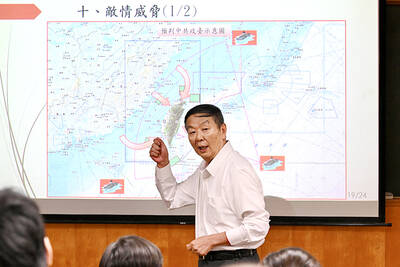
RETHINK? The defense ministry and Navy Command Headquarters could take over the indigenous submarine project and change its production timeline, a source said Admiral Huang Shu-kuang’s (黃曙光) resignation as head of the Indigenous Submarine Program and as a member of the National Security Council could affect the production of submarines, a source said yesterday. Huang in a statement last night said he had decided to resign due to national security concerns while expressing the hope that it would put a stop to political wrangling that only undermines the advancement of the nation’s defense capabilities. Taiwan People’s Party Legislator Vivian Huang (黃珊珊) yesterday said that the admiral, her older brother, felt it was time for him to step down and that he had completed what he
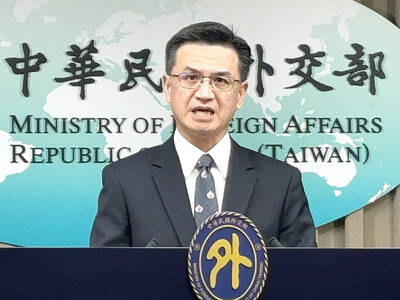
BULLY TACTICS: Beijing has continued its incursions into Taiwan’s airspace even as Xi Jinping talked about Taiwan being part of the Chinese family and nation China should stop its coercion of Taiwan and respect mainstream public opinion in Taiwan about sovereignty if its expression of goodwill is genuine, the Ministry of Foreign Affairs (MOFA) said yesterday. Ministry spokesman Jeff Liu (劉永健) made the comment in response to media queries about a meeting between former president Ma Ying-jeou (馬英九) and Chinese President Xi Jinping (習近平) the previous day. Ma voiced support for the so-called “1992 consensus,” while Xi said that although the two sides of the Taiwan Strait have “different systems,” this does not change the fact that they are “part of the same country,” and that “external

UNDER DISCUSSION: The combatant command would integrate fast attack boat and anti-ship missile groups to defend waters closest to the coastline, a source said The military could establish a new combatant command as early as 2026, which would be tasked with defending Taiwan’s territorial waters 24 nautical miles (44.4km) from the nation’s coastline, a source familiar with the matter said yesterday. The new command, which would fall under the Naval Command Headquarters, would be led by a vice admiral and integrate existing fast attack boat and anti-ship missile groups, along with the Naval Maritime Surveillance and Reconnaissance Command, said the source, who asked to remain anonymous. It could be launched by 2026, but details are being discussed and no final timetable has been announced, the source


 RSS
RSS