


Paleontologists from Argentina and Brazil earlier this month unveiled a new giant dinosaur species that lived 88 million years ago in the Patagonia region of Argentina, where they found its fossils.
"It is one of the three largest dinosaur fossils ever discovered in the world and the most complete because we found 70 percent of its skeleton," said Argentina's Comahue National University Paleontology Center Director Jorge Calvo.
Belonging to the Titanosaur family, the newly discovered dinosaur measured 32 - 34m in length and lived exclusively in Patagonia.
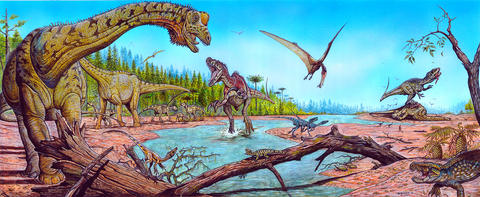
PHOTO: AP
It has been named Futalognkosaurus dukei, with the first name from the Mapuche language meaning "giant chief of dinosaurs," and the second in honor of the Duke Energy Argentina company that largely financed the digs.
The new dinosaur was found at the start of the excavation, in February 2000, alongside other animal and plant fossils in a 400m2 area.
The fossils allowed experts to "reconstruct an ecosystem of the upper Cretaceous period (from 97 to 66 million years ago) with unprecedented exactitude," Calvo said.

PHOTO: AP
"The fact that most of the fossils were found in a limited area under a 0.5m rock layer makes us deduce that all those animals lived in the same epoch," he added.
The paleontologists also found fossils of fish, shellfish, at least two types of crocodile-like creatures and several dinosaurs, including the flying Pterosaur and carnivores like Megaraptor, with its 40cm claws.
They also found plant fossils of leaves showing the dominance of flowering plants at the time. (AFP)
阿根廷與巴西的古生物學家在本月初公佈了一個新發現的大型恐龍物種。這種恐龍八千八百萬年前生活在阿根廷的巴塔哥尼亞地區,這也是古生物學家發現恐龍化石的地方。
「這是現今全世界發現最大的三具恐龍化石之一,也是歷來保存得最完善的一具,因為我們找到牠百分之七十的骨骸,」阿根廷科瑪烏埃大學古生物中心主任喬治.卡佛說。
和雷龍同科的這種新發現的恐龍有三十二到三十四公尺長,僅出沒在巴塔哥尼亞地區。
這種恐龍被命名為「Futalognkosaurus dukei」,這是當地馬普切語。Futalognkosaurus的意思是「恐龍的大頭目」,dukei則是為了向大量資助挖掘工作經費的阿根廷杜克能源公司表達謝意。
這個新種恐龍化石是在二OOO年二月份開挖初期出土的。在此四百平方公尺的範圍附近,也挖掘到了其他動植物的化石。
這次出土的化石讓專家們可以「空前精準的重建白堊紀後期(九千七百萬到六千六百萬年前)的生態系統」,卡佛說。
「事實上,這次出土的化石絕大多數是在一個半公尺厚的岩石層下方的特定範圍內發現的,因此我們推論這些生物都是生存在同一個時期,」卡佛接著說明。
這些古生物學家們也發現了魚類化石、貝類化石、兩種以上類似鱷魚的生物化石,和其他好幾種恐龍化石,包括會飛的翼龍和肉食性恐龍如:暴龍,還有其四十公分長的爪子。
他們也挖掘到植物葉片的化石,顯示開花植物當時已經出現。 (法新社/翻譯:袁星塵)
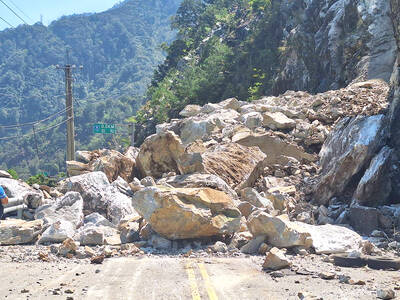
The strongest earthquake to hit Taiwan in 25 years killed at least 16 people and damaged dozens of buildings, but the destruction was largely contained thanks to decades of preparedness work. Taiwan sits on the “Ring of Fire,” an arc of intense seismic activity along the Pacific Rim, and — much like neighboring Japan — has a long history of catastrophic quakes. How does April 3 compare with other recent quakes? The April 3 earthquake, which measured 7.4 on the moment magnitude scale, was felt across Taiwan. It was the most severe since a 7.6 magnitude quake in 1999 killed

A: Artificial intelligence technology has been causing controversy lately: a student was caught cheating with AI to win the grand prize in an art contest. B: That’s so absurd. Does this mean that AI paints better than humans? A: Maybe. Luckily, the student was later disqualified. B: And more absurdly, it’s becoming more and more popular to use AI technology to “resurrect” people. A: Yeah, some netizens even posted videos featuring the late singer CoCo Lee, who was “resurrected” by them with AI software. A: 人工智慧的爭議不斷,有學生違規使用AI參加美術展,甚至贏得首獎。 B: 真誇張,這是不是代表AI比人類還強大? A: 或許吧,幸好得獎資格被取消。 B: 還有更誇張的︰讓死者重現的「AI復活」技術越來越熱門。 A: 對啊,還有網友製作已故歌后李玟「復活」的影片呢! (By Eddy Chang, Taipei Times/台北時報張聖恩)

Around the time of the Dragon Boat Festival in June, the streets of Taiwan are filled with the delightful aroma of zongzi, a traditional snack made of sticky rice wrapped in leaves. The leaves are folded into a cone and then filled with sticky rice and other ingredients such as braised pork belly, peanuts and salted duck egg yolks. The filled leaves are then tightly tied with kitchen twine and ready for cooking. 每到六月端午時節,街頭巷尾就會飄出粽子的香氣。粽子是將糯米包進粽葉的傳統美食,先將粽葉折成圓錐狀塞入糯米,以及紅燒肉、花生、鹹鴨蛋黃等配料,用棉線綁緊後即可烹煮。 Dragon Boat Festival (n. phr.) 端午節 aroma

Everyone has seen a piece of fruit turn brown after being cut. Have you ever wondered why that happens? It is a common phenomenon that occurs due to a chemical reaction called enzymatic browning. The appearance, flavor and nutritional value of the fruit are all affected by this reaction. Some fruits, such as apples, pears, bananas, avocados and peaches, are more prone to enzymatic browning than others. These fruits contain high levels of an enzyme called polyphenol oxidase, or PPO for short. __1__ This causes a chain of chemical reactions that ultimately transforms the phenolic compounds into


 RSS
RSS