


Paleontologists have discovered the fossilized remains of a fearsome new species of penguin that lived on the southern coast of Peru about 36 million years ago.
The ancient bird, Icadyptes salasi, stood 1.5m tall and had a pointed 18cm beak which it probably used to spear its prey.
The now extinct penguin species is one of the largest ever reported and was recovered from the coastal desert of Peru.

PHOTO: EPA
Paleontologists also discovered the skull and partial skeleton of a second extinct penguin species, called Perudyptes devriesi, in the same region.
The penguin fossils are among the most complete ever recovered. Paleontologists and students of the penguin lineage had assumed that penguins evolved in colder climates in the Antarctic and in New Zealand and had only moved closer to the equator about 10 million years ago - long after significant global cooling about 34 million years ago.
"We tend to think of penguins as being cold-adapted species," said Julia Clarke, a paleontologist and assistant professor of marine, Earth and atmospheric sciences at North Carolina State University, in Raleigh.
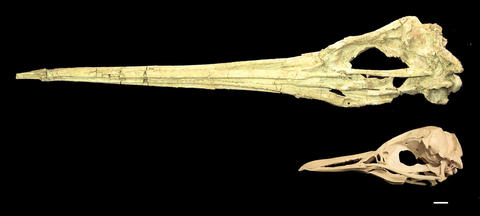
PHOTO: AP
But the new fossils date back to one of the warmest periods in 65 million years of Earth's history. What's more, paleontologists generally assume that species moving from cold to warm climates become smaller as the animals do not need to conserve heat.
It's all the more surprising, then, to find giant penguin fossils close to the Earth's equator, especially during the waning days of a greenhouse Earth, the authors of the study noted.
一群古生物學家發現了三千六百萬年前生活在祕魯南海岸的新品種企鵝化石遺跡。
這種名為「Icadyptes salasi」的古代企鵝高達一點五公尺,十八公分長的尖喙可能是啄食獵物用的。
現今已絕種的這種企鵝是全球體型最大、也是在祕魯海岸沙漠出土的企鵝品種之一。
古生物學家也在同一個地區,發現了另一種已絕跡的「Perudyptes devriesi」企鵝頭顱與部分遺骸。
這些化石可說是迄今已出土的最完整企鵝化石。古生物學家與專門研究企鵝的學生都認為,企鵝是從南極與紐西蘭等較冷的氣候環境進化,約一千萬年前才遷徙到更靠近赤道的地方,遠較三千四百萬年前全球氣溫大幅降低的時代晚。
北卡羅萊納大學羅雷校區的古生物學家暨海洋、地球與大氣科學系助理教授茱莉亞.克拉克說︰「我們傾向認為,企鵝是適應寒帶的生物。」
不過,這些新的化石卻可追溯到地球六千五百年歷史的某一個最溫暖時期。此外,古生物學家普遍認為,從寒帶遷徙到溫暖氣候的物種由於不需貯存熱能,體型會變小。
這份研究的作者群指出,最驚人的要屬在靠近赤道的地方發現了這些巨型企鵝化石,尤其當時屬地球溫暖時期即將結束的年代。(翻譯︰賴美君)
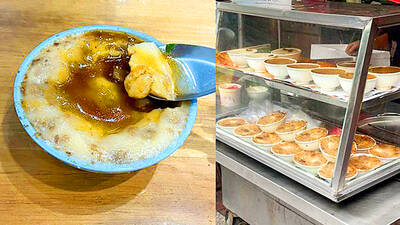
Rice is an essential ingredient in Taiwanese cuisine. Many foods are made of rice, adding more variety to our cooking, such as rice cake, or “gui.” Wagui is made by steaming rice flour batter in a bowl. The term “gui” refers to a type of food made from rice, while “wa” refers to a bowl. The pronunciation of “gui” in Taiwanese Hokkien is similar to the word for “nobility” in Chinese, so it is common for people to prepare various types of gui, including wagui, as offerings to the gods or ancestors,. 米是台灣重要的主食,用米製成的食品十分多元,豐富我們的飲食,如米做成的「粿」。粿的意思是米做成的糕點,碗粿是將在來米漿倒入碗中蒸熟,因而得名。粿因為音同「貴」,因此碗粿等粿食常用作供品祭拜神明和祖先。 nobility (n.) 高貴,高尚;貴族 offering (n.) 供品 While Taiwan may not be
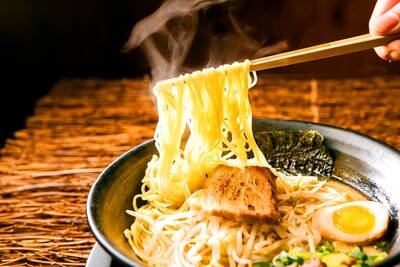
It’s no secret that Japanese people have a deep affection for noodles. Like in the rest of East Asia, noodles are an important staple food, second only to rice. Japanese people have enjoyed noodles for over 1,000 years. The first noodles came from China and were introduced around 800 CE. As time passed, noodles in Japan not only became widespread but also developed some unique Japanese characteristics. The three most popular types of noodles in Japan are ramen, soba, and udon. Ramen, typically made from wheat flour, is usually thin and firm. The dough is kneaded and left to

On Tuesday last week, the flame for this summer’s Paris Olympics was lit at the birthplace of the ancient Olympic Games in southern Greece in a meticulously choreographed ceremony. It will then be carried through Greece for more than 5,000km before being handed over to French organizers at the Athens venue used for the first modern Olympics in 1896. The pageantry at Olympia has been an essential part of every Olympics for nearly 90 years since the Games in Berlin. It’s meant to provide an ineluctable link between the modern event and the ancient Greek original on which it was initially modelled. Once

Drive-through (or drive-thru) restaurants provide people with the immense convenience of being able to purchase and pick up meals without needing to leave their vehicles. These restaurants have been around for decades, and their success has spawned a number of equally handy services. The drive-through concept originated with the drive-in restaurant, the first of which was established in the US in 1921. Patrons would order and eat the food that was delivered to their cars by workers called “carhops.” Ten years later, a drive-through service was introduced, but it was not until 1947 that the first exclusively drive-through restaurant opened its


 RSS
RSS