


You probably get lots of advice on how to eat healthily. But it seems the simplest advice may also turn out to be some of the most important — eat less salt.
Two studies started in the 1990s among 3,000 adults aged 30-54. These people showed signs of developing high blood pressure at the time.
Some volunteers cut down the amount of salt they ate by just 25-30 percent. A control group did not cut down on salt.

PHOTO: NY TIMES NEWS SERVICE
Ten to 15 years later, salt-cutters were 25 percent less likely to have heart problems and 20 percent less likely to have died.
This shows that cutting back on salt not only helps with blood pressure, but with all kinds of heart problems.
Doctors suggested eating less than 2.5g of salt a day, or about a teaspoon.
Heart disease is the leading cause of death in Western countries and a growing problem elsewhere. (Jason Cox, Staff Writer with AFP)
你大概聽過諸多健康飲食的建議。不過,最簡單的或許也是最重要的—少吃點鹽巴。
有兩項自一九九○年代起進行的研究,對象為三千位年齡介於三十到五十四歲的成年人。當時他們都有高血壓症狀。
部分自願者降低百分之二十五到三十的鹽攝取量。另一對照組則未減少鹽攝取。
十到十五年之後,少吃鹽的人罹患心臟病的比率降低了百分之二十五,死亡率則降低了百分之二十。
這顯示出,減少鹽攝取量不只對高血壓有幫助,對心臟病也有益。
醫師建議民眾每日減少二點五公克(約一茶匙)的鹽。
心臟病是西方國家的第一死因,在世界各地都有成長跡象。
(翻譯︰賴美君)

A: Muslims around the world are celebrating Eid al-Fitr this week. B: Wiil there be any celebrations in Taipei? A: Sure, the “2024 Eid al-Fitr in Taipei” is set for this Sunday. B: Where will the event be held? A: It’s going to take place from 11am to 5pm at Daan Park in Taipei. We can go together if you’d like. A: 全球的穆斯林本週正在慶祝「開齋節」! B: 台北市也有慶祝活動嗎? A: 當然啦,「2024尋味台北 齊賀開齋」即將在週日登場。 B: 要去哪裡參加活動啊? A: 活動將從上午11點到下午5點,在大安森林公園舉行,我們一起去吧。 (By Eddy Chang, Taipei Times/台北時報張聖恩)
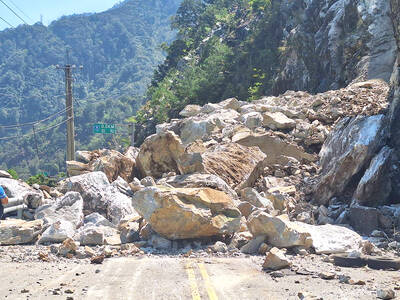
The strongest earthquake to hit Taiwan in 25 years killed at least 16 people and damaged dozens of buildings, but the destruction was largely contained thanks to decades of preparedness work. Taiwan sits on the “Ring of Fire,” an arc of intense seismic activity along the Pacific Rim, and — much like neighboring Japan — has a long history of catastrophic quakes. How does April 3 compare with other recent quakes? The April 3 earthquake, which measured 7.4 on the moment magnitude scale, was felt across Taiwan. It was the most severe since a 7.6 magnitude quake in 1999 killed

Everyone has seen a piece of fruit turn brown after being cut. Have you ever wondered why that happens? It is a common phenomenon that occurs due to a chemical reaction called enzymatic browning. The appearance, flavor and nutritional value of the fruit are all affected by this reaction. Some fruits, such as apples, pears, bananas, avocados and peaches, are more prone to enzymatic browning than others. These fruits contain high levels of an enzyme called polyphenol oxidase, or PPO for short. __1__ This causes a chain of chemical reactions that ultimately transforms the phenolic compounds into

Around the time of the Dragon Boat Festival in June, the streets of Taiwan are filled with the delightful aroma of zongzi, a traditional snack made of sticky rice wrapped in leaves. The leaves are folded into a cone and then filled with sticky rice and other ingredients such as braised pork belly, peanuts and salted duck egg yolks. The filled leaves are then tightly tied with kitchen twine and ready for cooking. 每到六月端午時節,街頭巷尾就會飄出粽子的香氣。粽子是將糯米包進粽葉的傳統美食,先將粽葉折成圓錐狀塞入糯米,以及紅燒肉、花生、鹹鴨蛋黃等配料,用棉線綁緊後即可烹煮。 Dragon Boat Festival (n. phr.) 端午節 aroma


 RSS
RSS