


Former US senator John Kerry was sworn in on Friday as US secretary of state, less than two hours after former US secretary of state Hillary Rodham Clinton swept out of office on a day marred by yet another attack on a US diplomatic post.
US Supreme Court judge Elena Kagan administered the oath of office to Kerry during a private ceremony on Capitol Hill. He was joined by his wife, Teresa, daughter, Vanessa, brother, Cameron and his Senate staff.
However, a pall was cast over the historic events by an attack on the US embassy in Ankara that killed a Turkish security guard.
It came less than five months after the attack in September last year on the US embassy in Benghazi, Libya, in which late US ambassador Chris Stevens and three other Americans died, and two weeks after the militant hostage crisis in Algeria.
“I am very proud of the work we have done together,” Clinton, 65, told hundreds of cheering staff just before she left the US State Department, having tendered her letter of resignation to US President Barack Obama.
“Of course, we live in very complex and even dangerous times, as we saw again just today at our embassy in Ankara, where we were attacked and lost one of our foreign service nationals, and others injured. I know that the world we are trying to help bring into being in the 21st century will have many difficult days,” she added.
However, the former first lady and US senator said she was “more optimistic today than I was when I stood here four years ago” because of the agency’s work to help ensure “peace, progress and prosperity” around the world.
US officials said they were probing the Ankara attack, when a bomber wearing a suicide vest blew himself up at the first checkpoint on the perimeter of the embassy compound. In addition to killing the guard, three people were hurt, one seriously.
The bombing once again exposes the vulnerability of the army of 70,000 US diplomats — many of whom operate in the world’s hotspots.
The suicide bomber who struck the US Embassy in Ankara spent five years in prison on terrorism charges, but was released after being diagnosed with a hunger strike-related brain disorder, Turkish officials said yesterday.
The bomber was identified as 40-year-old leftist militant Ecevit Sanli. Sanli was armed with TNT and also detonated a hand grenade, officials said.
The US flag at the embassy flew at half-staff and already tight security was increased. Police sealed off a street in front of the security checkpoint where the explosion knocked a door off its hinges and littered the road with debris. Police vehicles were parked in streets surrounding the building.
Sanli’s motives were still unclear. He had been a member of the outlawed Revolutionary People’s Liberation Party-Front, or DHKP-C, which has claimed responsibility for assassinations and bombings since the 1970s, but has been relatively quiet in recent years. Compared with al-Qaeda, it has not been seen as a strong terrorist threat.
Officials said Sanil was arrested in 1997 for alleged involvement in attacks on police headquarters and a military guesthouse in Istanbul and jailed on charges of membership in the group.
While in prison awaiting trial, he took part in a major hunger strike that led to the deaths of dozens of inmates, according to a statement from the Ankara governor’s office. The protesters opposed a maximum-security system in which prisoners were held in small cells instead of large wards.
Sanli was released in 2002 after being diagnosed with Wernicke-Korsakoff syndrome, a malnutrition-related brain illness that affects vision, muscle coordination and memory and that can cause hallucinations. Sanli fled Turkey after his release and was wanted by Turkish authorities, the statement said. He was convicted in absentia in 2002.
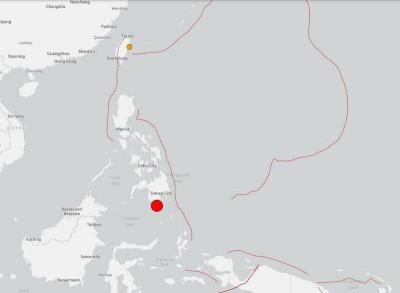
A magnitude 7.8 earthquake struck off the southern coast of Mindanao in the Philippines at 7:38am today, prompting the US Tsunami Warning System to issue an alert for neighboring countries, including Taiwan. The system issued a purple alert indicating a "tsunami threat." The potential threat zone includes Taiwan, the Philippines, Papua New Guinea, Yap and Palau. Philippine authorities were assessing the damage from the quake, with the office of civil defense seeking to verifying initial reports that 15 people had been killed and 129 injured in the region, mostly from falling debris. Arlene Hollero, disaster chief of Maasim town in the Philippines' Sarangani Province,
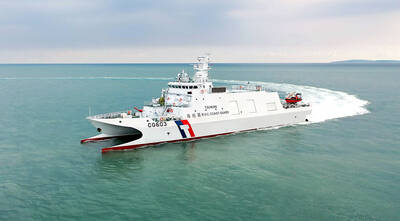
‘GRAY ZONE’ PRESSURE: Beijing’s activities are intended to create the deceitful impression that China has jurisdiction over the area around Taiwan, the CGA said Taiwan’s rights over its territorial waters and exclusive economic zone must not be violated by any country, the Mainland Affairs Council said yesterday, adding that it will not accept any unprovoked actions. The council issued the remarks in response to the China Coast Guard conducting maritime enforcement drills near eastern Taiwan and claiming to fully exercise China’s maritime administrative law enforcement authority. The Coast Guard Administration (CGA) has been closely monitoring the situation and is taking concrete steps to defend the nation’s sovereignty and secure its waters, the council said. China has no sovereign rights over the waters off eastern
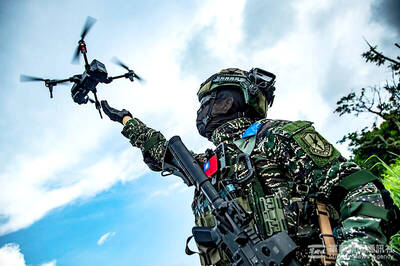
RESILIENCE: Taiwan plays a key role in semiconductors, energy, information infrastructure and advanced manufacturing, AIT Director Raymond Greene said Taiwan’s continued investment in deterrence and resilience remains vital, especially in uncrewed systems and other emerging technologies, American Institute in Taiwan (AIT) Director Raymond Greene said yesterday. Greene made the remarks at the annual National Strategic Summit on Supply Chain Resilience held by the Research Institute for Democracy, Society and Emerging Technology (DSET), a government-backed think tank. As Taiwan last year became the US’ fourth-largest trading partner and supply chain security is becoming more important, cooperation in emerging technologies continues to deepen between the two countries, he said. The US is committed to accelerating innovation, building key infrastructure, strengthening cooperation

RIGHT DIRECTION: Taiwan’s efforts to prevent forced labor include a proposal to ‘fully prohibit’ employers from withholding workers’ documents, an official said Taiwan is to establish a mechanism to restrict imports of goods linked to forced labor, the Executive Yuan said yesterday, after the US proposed imposing additional tariffs on Taiwanese goods over labor concerns. “The Ministry of Labor and the Ministry of Economic Affairs are to establish an interministerial review procedure,” Executive Yuan spokesperson Michelle Lee (李慧芝) said at a news briefing in Taipei. “The government is to use the Foreign Trade Act [貿易法] as the legal basis to restrict imports of goods produced with forced labor” and bring its supply chain governance more in line with international standards on human rights, resilience


 RSS
RSS