


Hong Kong conservationists yesterday expressed outrage after images of a factory rooftop covered in thousands of freshly sliced shark fins emerged, as they called for curbs on the “barbaric” trade.
The Chinese territory is one of the world’s biggest markets for shark fins, which are used to make soup that is an expensive staple at Chinese banquets and viewed by many Asians as a rare delicacy.
Activist Gary Stokes, who has visited the site, estimated there were 15,000 to 20,000 fins being laid to dry on the rooftop in Hong Kong ahead of an anticipated surge in demand over Lunar New Year next month.
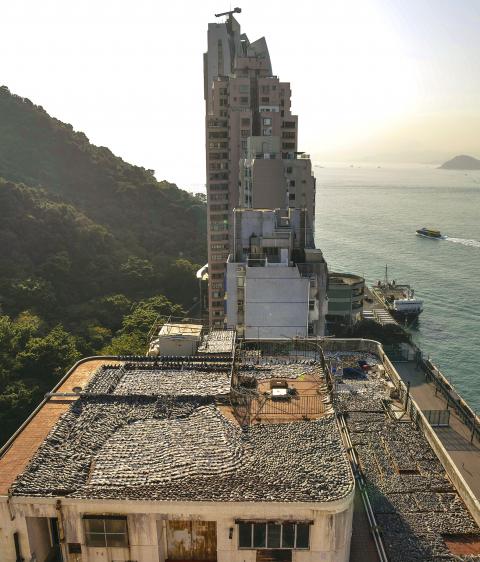
Photo: AFP
“This is shocking,” said Stokes, the Hong Kong coordinator for conservation group Sea Shepherd, adding that it was the first time he had spotted such a massive hoarding of shark fins in one place in the Asian financial hub.
“This is the most graphic, brutal and barbaric part of the industry — the element of chopping a shark’s fin off and throwing it back into the water is horrific and inhumane,” he said.
Stokes believed the large amount of shark fins were destined for China, and that traders moved to dry the shark fins on secluded rooftops instead of sidewalks — as they had done in the past — to avoid public anger.
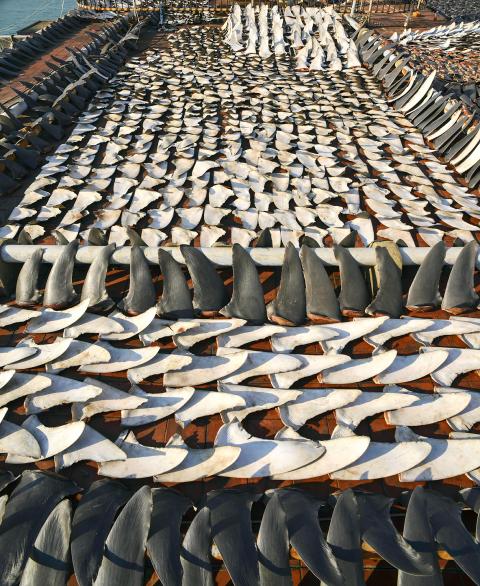
Photo: AFP
Campaigns against consuming shark fins have gained ground in Hong Kong in recent years, after major hotel chains decided to drop the soup from menus, and home carrier Cathay Pacific said in September it would stop carrying unsustainable sourced shark products on its cargo flights.
“The demand in Hong Kong is definitely decreasing, but unfortunately the demand in China is growing,” Stokes said.
“As long as there is no protection for the sharks, the [demand] will just keep going on and on,” he added, urging Hong Kong authorities to ban the trade.
Environmentalists say the sustainable shark fin industry is tiny and most of the products are harvested in a way that threatens scores of shark species deemed vital for healthy oceans.
About 73 million sharks are killed every year, with Hong Kong importing about 10,000 tonnes annually for the past decade, the environmental group WWF said. Most of those fins are then exported to mainland China.
The number of threatened shark species has soared from 15 in 1996 to more than 180 in 2010, mainly due to the growing Chinese demand for fins.
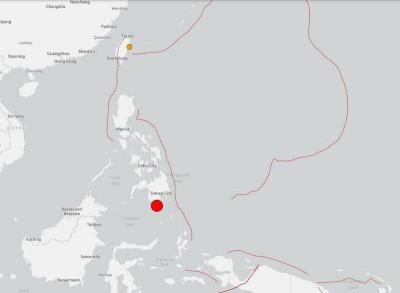
A magnitude 7.8 earthquake struck off the southern coast of Mindanao in the Philippines at 7:38am today, prompting the US Tsunami Warning System to issue an alert for neighboring countries, including Taiwan. The system issued a purple alert indicating a "tsunami threat." The potential threat zone includes Taiwan, the Philippines, Papua New Guinea, Yap and Palau. Philippine authorities were assessing the damage from the quake, with the office of civil defense seeking to verifying initial reports that 15 people had been killed and 129 injured in the region, mostly from falling debris. Arlene Hollero, disaster chief of Maasim town in the Philippines' Sarangani Province,

‘GRAY ZONE’ PRESSURE: Beijing’s activities are intended to create the deceitful impression that China has jurisdiction over the area around Taiwan, the CGA said Taiwan’s rights over its territorial waters and exclusive economic zone must not be violated by any country, the Mainland Affairs Council said yesterday, adding that it will not accept any unprovoked actions. The council issued the remarks in response to the China Coast Guard conducting maritime enforcement drills near eastern Taiwan and claiming to fully exercise China’s maritime administrative law enforcement authority. The Coast Guard Administration (CGA) has been closely monitoring the situation and is taking concrete steps to defend the nation’s sovereignty and secure its waters, the council said. China has no sovereign rights over the waters off eastern

RESILIENCE: Taiwan plays a key role in semiconductors, energy, information infrastructure and advanced manufacturing, AIT Director Raymond Greene said Taiwan’s continued investment in deterrence and resilience remains vital, especially in uncrewed systems and other emerging technologies, American Institute in Taiwan (AIT) Director Raymond Greene said yesterday. Greene made the remarks at the annual National Strategic Summit on Supply Chain Resilience held by the Research Institute for Democracy, Society and Emerging Technology (DSET), a government-backed think tank. As Taiwan last year became the US’ fourth-largest trading partner and supply chain security is becoming more important, cooperation in emerging technologies continues to deepen between the two countries, he said. The US is committed to accelerating innovation, building key infrastructure, strengthening cooperation

RIGHT DIRECTION: Taiwan’s efforts to prevent forced labor include a proposal to ‘fully prohibit’ employers from withholding workers’ documents, an official said Taiwan is to establish a mechanism to restrict imports of goods linked to forced labor, the Executive Yuan said yesterday, after the US proposed imposing additional tariffs on Taiwanese goods over labor concerns. “The Ministry of Labor and the Ministry of Economic Affairs are to establish an interministerial review procedure,” Executive Yuan spokesperson Michelle Lee (李慧芝) said at a news briefing in Taipei. “The government is to use the Foreign Trade Act [貿易法] as the legal basis to restrict imports of goods produced with forced labor” and bring its supply chain governance more in line with international standards on human rights, resilience


 RSS
RSS