


Controversy arose yesterday after it was revealed that the first young Taiwanese to be appointed as a representative at the UN Framework Convention on Climate Change (UNFCCC) is listed as being from “Taiwan (Province of China).”
Chang Liang-yi (張良伊), born in 1988, was elected as a focal point for UNFCCC youth nongovernmental organizations during the 18th Session of the Conference of the Parties (COP18) to the UNFCCC, held in the Qatari capital, Doha, from Nov. 26 through Friday last week.
As the focal point representing developing countries in YOUNGO — the official youth constituency of the UNFCCC — Chang will be in charge of communicating with the Secretariat of the UNFCCC and attend UN activities concerning climate change on behalf of young people next year.
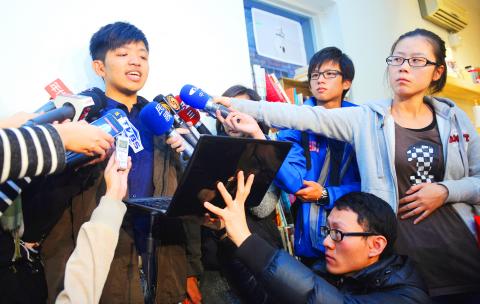
Photo: Lo Pei-der, Taipei Times
However, the nationality printed on his candidate registration form — “Taiwan (Province of China)” — has stirred up debate in Taiwan, and a report in the Chinese-language Apple Daily on the matter published yesterday drew additional public attention.
At the legislature, Minister of Foreign Affairs David Lin (林永樂) expressed his regret.
“It’s the duty of every citizen to safeguard the nation’s sovereignty, status and dignity. I feel extremely saddened by the choice [Chang] made,” Lin said at a meeting of the Foreign Affairs and National Defense Committee in Taipei.
Although it has been an aim of Taiwan’s to participate in international organizations, the nation’s status and sovereignty must not be compromised in the process, he said.
In response to questions from lawmakers, Liang Guang-chung (梁光中), deputy director-general of the ministry’s Department of Treaty and Legal Affairs, distanced the government from the matter, saying Chang enrolled in the institution “as an individual, not as a representative of Taiwan.”
“[The whole matter] was his personal preference,” Liang said.
Chang is the founder and chairman of the Taiwan Youth Climate Coalition (TWYCC) and the organization was one of many civil groups which, along with some government officials, and representatives from the industrial and academic sectors, comprised the nation’s COP18 delegation, which was present as a non-governmental organization (NGO) observer.
Liang said that Chang attended COP18 “as a member of the Green Club,” a Vancouver-based organization established in 1994 by a group of people from Taiwan, China and Hong Kong.
However, the registration documents, which can be downloaded from the UNFCCC’s Web site, suggest otherwise.
In the documents, Chang introduced himself as the TWYCC’s founder and described the endeavors he had engaged in over the past few years to pursue the stated goals of the UNFCCC.
“As the chairman of first youth climate NGO in Taiwan and stakeholder in a youth hotel, I have a lot of experience and stories to share with YOUNGO,” Chang wrote, in response to a question on the application asking what made him a good candidate to be a focal point.
Liang, who was in the nation’s delegation to COP18, said the ministry had no prior knowledge that Chang had his nationality listed as “Taiwan (Province of China)” on his registration form.
Before the COP18 meeting began, the ministry held a briefing, which Chang Liang-yi attended for members of the delegation to remind them to be careful about issues regarding China during activities and events, Liang said.
Liang said the delegation in Doha did not know about Chang’s registered nationality until it was informed by other local NGO participants after the voting was over.
“He [Chang] experienced interference from mainland [China] when he participated in the UNFCCC in 2009. By declaring his nationality as ‘Taiwan, (Province of China)’ this time, he was aiming to win support from mainland representatives,” Liang said.
UNFCCC rules stipulate that there were two constituencies voting for focal points, which each commanded 50 percent of the vote.
The first constituency consists of organizations active in YOUNGO and the UNFCCC, while the second consists of individuals committed to climate change and interested in the UNFCCC process.
Lawmakers across party lines have expressed their disapproval of Chang’s choice.
Since 1995, Taiwan has participated in COP meetings of the UNFCCC as an observer through the Industrial Technology Research Institute (ITRI), which in official UNFCCC documents is identified as an NGO located in “Hsinchu, China.”
While the vote was ongoing, the issue of Chang’s nationality had already been debated among Taiwanese activists who were also participating in COP18.
The TWYCC posted a message on its Facebook page on Dec. 3 to solicit votes for Chang.
In response, Facebook user Wayne Chiu said he was not sure if he should vote for Chang or not “because his nationality “is listed as ‘Taiwan (Province of China).’”
Liao Ting-yi (廖婷儀), who administers the Facebook page, responded: “We didn’t want ‘Province of China’ either. However, we would not have had a chance to be in the election if we had not accepted this.”
Mainland Affairs Council Minister Wang Yu-chi (王郁琦) expressed regret over the incident and said the council would continue to clarify the nation’s efforts to expand its international presence with Beijing.
“We understand young people’s passion for international activities, but we regret the incident,” he said during a question-and-answer session at the legislature.
Wang said it was the norm for the nation to participate in international activities under the title “Taiwan,” “Republic of China” or “Chinese Taipei.”
“Participating under the titles of ‘Province of China’ is unacceptable,” he said.
The incident has sparked concern among lawmakers across party lines about China’s suppression of Taiwan’s international participation.
Wang promised that the council would express these concerns to China, urging it to value Taiwan’s efforts to increase the nation’s international participation.
At a press conference in Taipei yesterday, Chang said he had insisted on participating as a “youth from Taiwan” and wrote only his name and “Taiwan” on the registration form.
“I wrote my name and ‘Taiwan’ on the form,” Chang said. “The next day [after registration], I delivered a speech to introduce myself where I introduced myself as a young man from Taiwan.”
However, when asked if the “Taiwan, (Province of China)” was added afterward, Chang said he did not know.
When asked to confirm if he wrote “Taiwan” on the form, Chang said he could not explain in too much detail, but insisted that he was there as a young Taiwanese.
Chang would not comment directly on the Ministry of Foreign Affairs’ remarks that he had accepted running as representative from “Taiwan, (Province of China)” and said he saw himself as taking part as a “young man from Taiwan.”
What is most important is to undertake active participation, not the political issues in the background, he said.
Additional reporting by Mo Yan-chih and Loa Iok-sin
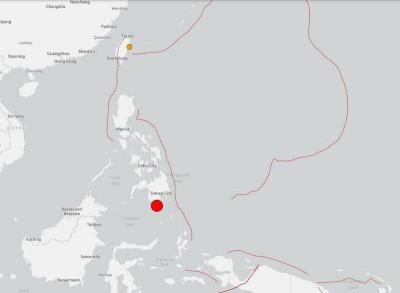
A magnitude 7.8 earthquake struck off the southern coast of Mindanao in the Philippines at 7:38am today, prompting the US Tsunami Warning System to issue an alert for neighboring countries, including Taiwan. The system issued a purple alert indicating a "tsunami threat." The potential threat zone includes Taiwan, the Philippines, Papua New Guinea, Yap and Palau. Philippine authorities were assessing the damage from the quake, with the office of civil defense seeking to verifying initial reports that 15 people had been killed and 129 injured in the region, mostly from falling debris. Arlene Hollero, disaster chief of Maasim town in the Philippines' Sarangani Province,
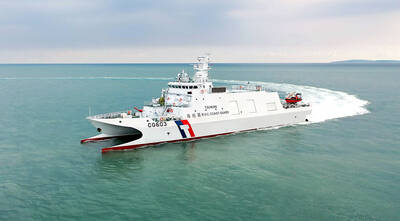
‘GRAY ZONE’ PRESSURE: Beijing’s activities are intended to create the deceitful impression that China has jurisdiction over the area around Taiwan, the CGA said Taiwan’s rights over its territorial waters and exclusive economic zone must not be violated by any country, the Mainland Affairs Council said yesterday, adding that it will not accept any unprovoked actions. The council issued the remarks in response to the China Coast Guard conducting maritime enforcement drills near eastern Taiwan and claiming to fully exercise China’s maritime administrative law enforcement authority. The Coast Guard Administration (CGA) has been closely monitoring the situation and is taking concrete steps to defend the nation’s sovereignty and secure its waters, the council said. China has no sovereign rights over the waters off eastern

RESILIENCE: Taiwan plays a key role in semiconductors, energy, information infrastructure and advanced manufacturing, AIT Director Raymond Greene said Taiwan’s continued investment in deterrence and resilience remains vital, especially in uncrewed systems and other emerging technologies, American Institute in Taiwan (AIT) Director Raymond Greene said yesterday. Greene made the remarks at the annual National Strategic Summit on Supply Chain Resilience held by the Research Institute for Democracy, Society and Emerging Technology (DSET), a government-backed think tank. As Taiwan last year became the US’ fourth-largest trading partner and supply chain security is becoming more important, cooperation in emerging technologies continues to deepen between the two countries, he said. The US is committed to accelerating innovation, building key infrastructure, strengthening cooperation

RIGHT DIRECTION: Taiwan’s efforts to prevent forced labor include a proposal to ‘fully prohibit’ employers from withholding workers’ documents, an official said Taiwan is to establish a mechanism to restrict imports of goods linked to forced labor, the Executive Yuan said yesterday, after the US proposed imposing additional tariffs on Taiwanese goods over labor concerns. “The Ministry of Labor and the Ministry of Economic Affairs are to establish an interministerial review procedure,” Executive Yuan spokesperson Michelle Lee (李慧芝) said at a news briefing in Taipei. “The government is to use the Foreign Trade Act [貿易法] as the legal basis to restrict imports of goods produced with forced labor” and bring its supply chain governance more in line with international standards on human rights, resilience


 RSS
RSS