


The Mainland Affairs Council yesterday reiterated President Ma Ying-jeou’s (馬英九) “three noes” policy — no unification, no independence and no use of force — in response to China’s call for both sides of the Taiwan Strait to negotiate and sign a peace agreement.
Speaking at the opening of the Chinese Communist Party’s (CCP) 18th National Congress in Beijing yesterday, Chinese President Hu Jintao (胡錦濤) also warned Taiwan against any moves toward independence and said that China would stick to the principle of “peaceful unification” with Taiwan under the “one country, two systems” model.
“We resolutely oppose any separatist attempt for Taiwan independence. The Chinese people will never allow anyone or any force to separate Taiwan from the motherland by any means,” he said.
“We will agree to interact with, conduct dialogue with and cooperate with any political parties in Taiwan, as long as they do not advocate Taiwan independence and as long as they identify with the ‘one China’ principle,” Hu said, adding that peaceful and stable development across the Taiwan Strait is a must if China is to achieve peaceful unification with Taiwan.
The council’s response said Taiwan’s government, under the Republic of China Constitution framework, would maintain the cross-strait “status quo” by upholding the “three noes” policy and the so-called “1992 consensus” — which stipulates that there is “one China, with each side having its own interpretation” — as the basis for peaceful and stable cross-strait development.
Meanwhile, the Presidential Office publicized the content of President Ma Ying-jeou’s (馬英九) interview with Asia Week magazine that was conducted on Friday last week, in which the president was asked whether he has considered signing a peace agreement with China. According to the press release, Ma said that last year, he floated the idea of a cross-strait peace agreement when he laid out his vision of a “golden decade” for the country, but many in Taiwan expressed doubt about it, which means that there is ample room for discussion on whether such a formality is needed.
In response to Hu’s speech, Democratic Progressive Party (DPP) Chairman Su Tseng-chang (蘇貞昌) said that his comments relating to Taiwan were “basically the same” as those in the past.
“Taiwan is a sovereign and independent country. The differences between Taiwan and China, as well as mainstream public opinion in Taiwan, are a political reality that Beijing cannot evade,” Su said on the sidelines of a Rotary Club event.
“The DPP intends to engage the CCP with confidence and enthusiasm,” Su said.
“However, it would also encourage Chinese leaders to broaden their perspective and embrace Taiwanese public opinion,” he said.
While some DPP members and supporters are calling on the party to adjust its China policy, Su reiterated that there is “no rush” to implement such proposals, including the establishment of a China affairs committee and holding an intraparty debate on the party’s China policy.
The DPP’s China policy, Su said, should be formulated under the framework of regional security and global politics and after Chinese Vice President Xi Jinping (習近平), Hu’s anointed successor, has consolidated his power and unveiled his policy on Taiwan.
Taiwan Solidarity Union Legislator Hsu Chung-hsin (許忠信) told a press conference that Taiwanese should closely monitor Xi, who is widely perceived as the most knowledgeable Chinese politician on Taiwanese affairs and the first to suggest the “unification by trade” (以經促統) strategy.
“It’s worth watching if Xi continues Hu’s Taiwan policy by yielding more benefits and promoting more market opening before applying more political pressure on President Ma to sign a cross-strait peace agreement,” Hsu said.
Hsu also expected Xi to make use of “soft power,” trying to appeal to Taiwanese sympathies by promoting Chinese culture and establishing a communication platform between the CCP and the DPP to force Ma to accelerate his cross-strait political agenda.
Additionally, Xi could attempt to incorporate Taiwan by signing a wide range of bilateral agreements, including cross-strait cooperation on culture, media, religion and banking, which would become a “web” to advance a “natural unification process,” he said.
Chinese premier-designate Lee Keqiang (李克強) and Chinese People’s Political Consultative Conference Chairman Wang Qishan (王岐山) are expected to take charge of the economic policies related to Taiwan, given their background in economic affairs, Hsu said.
In terms of Taiwan Affairs Office Director Wang Yi (王毅), who is expected to be promoted to the CCP politburo, Hsu said Wang had successfully enforced a “united front” tactic by arranging visits by hundreds of provincial officials and delegations to Taiwan.
Wang is also expected to play a pivotal role in Beijing’s Taiwan policy in the future as well, Hsu added.
Additional reporting by Huang Wei-chu and agencies
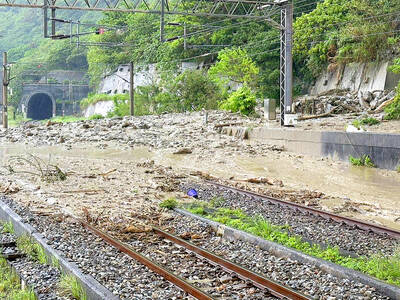
ROLLER-COASTER RIDE: More than five earthquakes ranging from magnitude 4.4 to 5.5 on the Richter scale shook eastern Taiwan in rapid succession yesterday afternoon Back-to-back weather fronts are forecast to hit Taiwan this week, resulting in rain across the nation in the coming days, the Central Weather Administration said yesterday, as it also warned residents in mountainous regions to be wary of landslides and rockfalls. As the first front approached, sporadic rainfall began in central and northern parts of Taiwan yesterday, the agency said, adding that rain is forecast to intensify in those regions today, while brief showers would also affect other parts of the nation. A second weather system is forecast to arrive on Thursday, bringing additional rain to the whole nation until Sunday, it
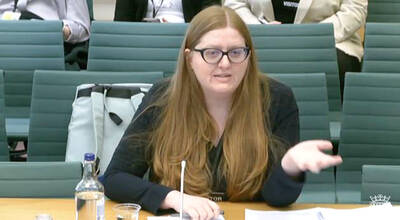
CONDITIONAL: The PRC imposes secret requirements that the funding it provides cannot be spent in states with diplomatic relations with Taiwan, Emma Reilly said China has been bribing UN officials to obtain “special benefits” and to block funding from countries that have diplomatic ties with Taiwan, a former UN employee told the British House of Commons on Tuesday. At a House of Commons Foreign Affairs Committee hearing into “international relations within the multilateral system,” former Office of the UN High Commissioner for Human Rights (OHCHR) employee Emma Reilly said in a written statement that “Beijing paid bribes to the two successive Presidents of the [UN] General Assembly” during the two-year negotiation of the Sustainable Development Goals. Another way China exercises influence within the UN Secretariat is
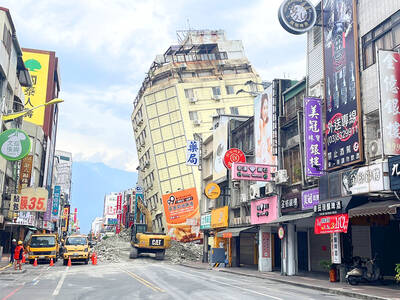
LANDSLIDES POSSIBLE: The agency advised the public to avoid visiting mountainous regions due to more expected aftershocks and rainfall from a series of weather fronts A series of earthquakes over the past few days were likely aftershocks of the April 3 earthquake in Hualien County, with further aftershocks to be expected for up to a year, the Central Weather Administration (CWA) said yesterday. Based on the nation’s experience after the quake on Sept. 21, 1999, more aftershocks are possible over the next six months to a year, the agency said. A total of 103 earthquakes of magnitude 4 on the local magnitude scale or higher hit Hualien County from 5:08pm on Monday to 10:27am yesterday, with 27 of them exceeding magnitude 5. They included two, of magnitude
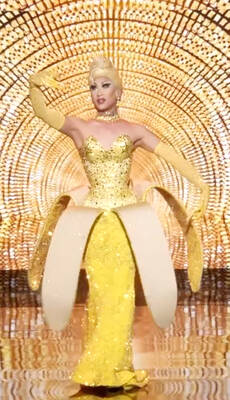
Taiwan’s first drag queen to compete on the internationally acclaimed RuPaul’s Drag Race, Nymphia Wind (妮妃雅), was on Friday crowned the “Next Drag Superstar.” Dressed in a sparkling banana dress, Nymphia Wind swept onto the stage for the final, and stole the show. “Taiwan this is for you,” she said right after show host RuPaul announced her as the winner. “To those who feel like they don’t belong, just remember to live fearlessly and to live their truth,” she said on stage. One of the frontrunners for the past 15 episodes, the 28-year-old breezed through to the final after weeks of showcasing her unique


 RSS
RSS