


Former premier Frank Hsieh (謝長廷) met China’s State Councilor Dai Bingguo (戴秉國) and Association for Relations Across the Taiwan Straits Chairman Chen Yunlin (陳雲林) in Beijing yesterday in what appeared to be the climax of his landmark five-day visit to China.
Hsieh became the most senior member of the former Democratic Progressive Party (DPP) administration to meet with high-ranking Chinese officials.
The 66-year-old met with Dai, who also serves as the director of the general office of foreign affairs leadership group of the Chinese Communist Party’s (CCP) Central Committee, yesterday afternoon.
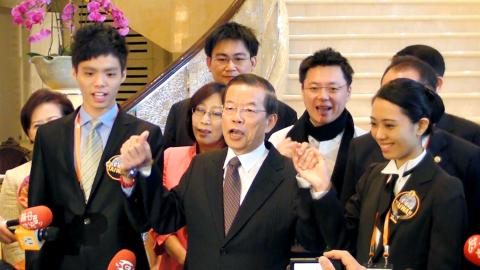
Photo: CNA
Hsieh then met with Chen, who oversaw and participated in the signing of 18 cross-strait agreements over the past four years and had frequently been criticized by the DPP, at a dinner banquet, Hsieh told a press conference in Beijing last night.
Hsieh, who was regarded as a moderate on China policy, also attended an international bartending competition yesterday morning where he cheered on the Taiwanese team. The event was the main purpose of his trip, which began in Xiamen in China’s Fujian Province on Thursday.
Although Hsieh, who supported the “constitutional one China (憲法一中)” and “constitutional consensus (憲法共識)” formulas, reiterated that the only goal of his “apolitical” trip would be initiating the DPP’s active engagement with Beijing, all eyes were still focused on his meetings with CCP officials.
After meeting with prominent Chinese think tanks in Xiamen and Beijing, Hsieh met China’s Taiwan Affairs Office (TAO) Director Wang Yi (王毅) on Saturday night for a two-hour closed door meeting.
Hsieh told reporters yesterday that he told Wang the DPP “did not think the so-called ‘1992 consensus’ existed” and said there alternative options existed that could replace the policy, such as "constitutions with different interpretations (憲法各表)" — Hsieh’s brainchild.
Hsieh said the two exchanged opinions on comments he had made earlier in Xiamen calling for both sides of the Taiwan Strait to “transcend their differences” because “shelving differences alone was not enough to conduct bilateral engagements.”
“Seeking common ground while shelving differences” (求同存異) has been the approach adopted by the CCP and the Chinese Nationalist Party (KMT) on cross-strait exchanges.
Wang then explained to Hsieh how the so-called “1992 consensus” was reached, Hsieh said, adding that while both sides fail to agree with each other at the moment, “with wisdom a solution would come up over time.”
Wang understood the DPP’s ideology very well, Hsieh said.
TAO spokesperson Yang Yi (楊毅) said the meeting “was healthy for both sides,” but played down its significance, adding that Wang received Hsieh out of hospitality.
Hsieh’s trip has been closely watched by DPP and KMT politicians, and international media despite his insistence that the visit was made in a private capacity in his role as chairman of the Taiwan Reform Foundation.
DPP Chairman Su Tseng-chang (蘇貞昌), who has a rocky relationship with Hsieh, said yesterday in Yilan County that the visit was “Hsieh’s private trip regardless of who he met and what he said” and that Hsieh’s comments did not represented the DPP’s position.
“No communication platform between the DPP and the CCP is being established,” he added.
DPP members remained split over Hsieh’s “constitutional one China” and “constitutional consensus” initiatives, and on his visit.
Most of the international media that reported on Hsieh’s trip recognized his visit as an attempt by the DPP to improve bilateral relations.
Hsieh is scheduled to return to return to Taipei today.
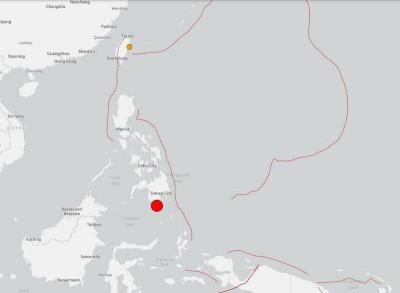
A magnitude 7.8 earthquake struck off the southern coast of Mindanao in the Philippines at 7:38am today, prompting the US Tsunami Warning System to issue an alert for neighboring countries, including Taiwan. The system issued a purple alert indicating a "tsunami threat." The potential threat zone includes Taiwan, the Philippines, Papua New Guinea, Yap and Palau. Philippine authorities were assessing the damage from the quake, with the office of civil defense seeking to verifying initial reports that 15 people had been killed and 129 injured in the region, mostly from falling debris. Arlene Hollero, disaster chief of Maasim town in the Philippines' Sarangani Province,

‘GRAY ZONE’ PRESSURE: Beijing’s activities are intended to create the deceitful impression that China has jurisdiction over the area around Taiwan, the CGA said Taiwan’s rights over its territorial waters and exclusive economic zone must not be violated by any country, the Mainland Affairs Council said yesterday, adding that it will not accept any unprovoked actions. The council issued the remarks in response to the China Coast Guard conducting maritime enforcement drills near eastern Taiwan and claiming to fully exercise China’s maritime administrative law enforcement authority. The Coast Guard Administration (CGA) has been closely monitoring the situation and is taking concrete steps to defend the nation’s sovereignty and secure its waters, the council said. China has no sovereign rights over the waters off eastern

RESILIENCE: Taiwan plays a key role in semiconductors, energy, information infrastructure and advanced manufacturing, AIT Director Raymond Greene said Taiwan’s continued investment in deterrence and resilience remains vital, especially in uncrewed systems and other emerging technologies, American Institute in Taiwan (AIT) Director Raymond Greene said yesterday. Greene made the remarks at the annual National Strategic Summit on Supply Chain Resilience held by the Research Institute for Democracy, Society and Emerging Technology (DSET), a government-backed think tank. As Taiwan last year became the US’ fourth-largest trading partner and supply chain security is becoming more important, cooperation in emerging technologies continues to deepen between the two countries, he said. The US is committed to accelerating innovation, building key infrastructure, strengthening cooperation

RIGHT DIRECTION: Taiwan’s efforts to prevent forced labor include a proposal to ‘fully prohibit’ employers from withholding workers’ documents, an official said Taiwan is to establish a mechanism to restrict imports of goods linked to forced labor, the Executive Yuan said yesterday, after the US proposed imposing additional tariffs on Taiwanese goods over labor concerns. “The Ministry of Labor and the Ministry of Economic Affairs are to establish an interministerial review procedure,” Executive Yuan spokesperson Michelle Lee (李慧芝) said at a news briefing in Taipei. “The government is to use the Foreign Trade Act [貿易法] as the legal basis to restrict imports of goods produced with forced labor” and bring its supply chain governance more in line with international standards on human rights, resilience


 RSS
RSS