


North Korea’s inexperienced young leader, Kim Jong-un, has taken his first big step on the international stage by doing a deal with the US little more than two months after the death of his father in a move that will help establish his credibility.
The reclusive state agreed to suspend nuclear tests, halt long-range missile launches and enrichment of uranium at a nuclear facility and allow back nuclear inspectors, completing a key piece of business left unfinished by the death in December last year of Kim Jong-il, who ruled the impoverished state for 17 years.
Wednesday’s announcement by Washington and Pyongyang will likely see aid for disarmament talks resume. However, few believe Kim Jong-un, believed to be in his late 20s, has any intention of abandoning the nuclear aspirations that came to define his father’s rule and were the one bit of leverage he had with the outside world, in particular the US.
“In the long run, they hope to make a deal about arms restriction, as opposed to disarmament,” Andrei Lankov of Kookmin University in Seoul said.
“They are willing to freeze their nuclear program, if they are paid a hefty fee, and explicitly or implicitly allowed to keep some stockpiles of plutonium and/or nuclear devices,” Lankov said.
US Secretary of State Hillary Rodham Clinton dubbed the decision to a “modest first step.”
The deal with Washington, that also involved consultations with China, the North’s main backer, and Russia, continues a pattern by Pyongyang of playing off regional powers and a policy of seeking to isolate South Korea from its ally in Washington.
The deal came at the height of joint military drills by US and South Korean forces aimed at deterring aggression by the North, a regular occasion for Pyongyang to unleash vitriolic rhetoric against Washington.
South Korean media said that Seoul appeared to have become alienated from its close ally and questioned how committed Washington still was to a demand that relations between the two Koreas, who remain technically at war, improve before broader regional talks can resume.
“The diplomatic loser here is of course [South Korean] President Lee Myung-bak,” John Delury of Yonsei University in Seoul said. “Inter-Korean issues have been cleanly separated from nuclear negotiations.”
Although the agreement between Pyongyang and Washington included some food aid, the driving factor was North Korea’s long-standing goal to “normalize” relations with the US and to establish Kim Jong-un’s credibility as head of the family dynasty that has led North Korea since it was founded.
“I don’t think the need for food aid is driving this. In fact, I suspect food aid is a decoy,” Delury said.
The North has suffered chronic food shortages for two decades.
The agreement calls for the US shipment of 240,000 tonnes of “nutritional assistance” to the North, which excludes rice or other staples that Washington and Seoul believe could be diverted away from needy civilians and stored for troops.
Meanwhile, as Associated Press report said that in another sign of warming relations between two wartime foes, North Korean Vice Foreign Minister Ri Yong Ho would attend a security conference in the US.
Ri, who is also the North’s envoy to nuclear disarmament negotiations, has been cleared to travel to the US to attend the forum at Syracuse University, according to the person with knowledge of the arrangement.
A second person with information about Ri’s itinerary also said the envoy would be attending the Syracuse forum.
Both spoke on condition of anonymity because Ri’s travel plans have not been formally announced.
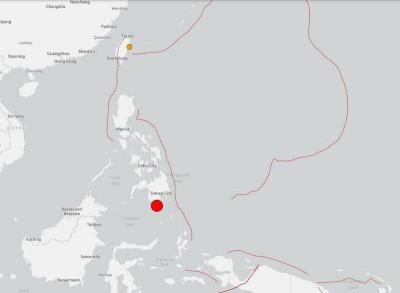
A magnitude 7.8 earthquake struck off the southern coast of Mindanao in the Philippines at 7:38am today, prompting the US Tsunami Warning System to issue an alert for neighboring countries, including Taiwan. The system issued a purple alert indicating a "tsunami threat." The potential threat zone includes Taiwan, the Philippines, Papua New Guinea, Yap and Palau. Philippine authorities were assessing the damage from the quake, with the office of civil defense seeking to verifying initial reports that 15 people had been killed and 129 injured in the region, mostly from falling debris. Arlene Hollero, disaster chief of Maasim town in the Philippines' Sarangani Province,

‘GRAY ZONE’ PRESSURE: Beijing’s activities are intended to create the deceitful impression that China has jurisdiction over the area around Taiwan, the CGA said Taiwan’s rights over its territorial waters and exclusive economic zone must not be violated by any country, the Mainland Affairs Council said yesterday, adding that it will not accept any unprovoked actions. The council issued the remarks in response to the China Coast Guard conducting maritime enforcement drills near eastern Taiwan and claiming to fully exercise China’s maritime administrative law enforcement authority. The Coast Guard Administration (CGA) has been closely monitoring the situation and is taking concrete steps to defend the nation’s sovereignty and secure its waters, the council said. China has no sovereign rights over the waters off eastern
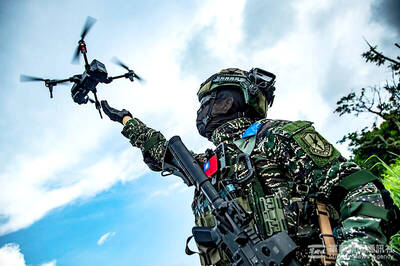
RESILIENCE: Taiwan plays a key role in semiconductors, energy, information infrastructure and advanced manufacturing, AIT Director Raymond Greene said Taiwan’s continued investment in deterrence and resilience remains vital, especially in uncrewed systems and other emerging technologies, American Institute in Taiwan (AIT) Director Raymond Greene said yesterday. Greene made the remarks at the annual National Strategic Summit on Supply Chain Resilience held by the Research Institute for Democracy, Society and Emerging Technology (DSET), a government-backed think tank. As Taiwan last year became the US’ fourth-largest trading partner and supply chain security is becoming more important, cooperation in emerging technologies continues to deepen between the two countries, he said. The US is committed to accelerating innovation, building key infrastructure, strengthening cooperation

RIGHT DIRECTION: Taiwan’s efforts to prevent forced labor include a proposal to ‘fully prohibit’ employers from withholding workers’ documents, an official said Taiwan is to establish a mechanism to restrict imports of goods linked to forced labor, the Executive Yuan said yesterday, after the US proposed imposing additional tariffs on Taiwanese goods over labor concerns. “The Ministry of Labor and the Ministry of Economic Affairs are to establish an interministerial review procedure,” Executive Yuan spokesperson Michelle Lee (李慧芝) said at a news briefing in Taipei. “The government is to use the Foreign Trade Act [貿易法] as the legal basis to restrict imports of goods produced with forced labor” and bring its supply chain governance more in line with international standards on human rights, resilience


 RSS
RSS