


An ozone hole five times the size of California opened over the Arctic this spring, matching ozone loss over Antarctica for the first time on record, scientists said on Sunday.
Formed by a deep chill over the North Pole, the unprecedented hole at one point shifted over eastern Europe, Russia and Mongolia, exposing populations to higher, but unsustained, levels of ultraviolet light.
Ozone, a molecule of oxygen, forms in the stratosphere, filtering out ultraviolet rays that damage vegetation and can cause skin cancer and cataracts.
The shield comes under seasonal attack in both polar regions in the local winter-to-spring.
Part of the source comes from manmade chlorine-based compounds, once widely used in refrigerants and consumer aerosols, that are being phased out under the UN’s Montreal Protocol.
However, the loss itself is driven by deep cold, which causes water vapor and molecules of nitric acid to condense into clouds in the lower stratosphere.
These clouds in turn become a “bed” where atmospheric chlorine molecules convert into reactive compounds that gobble up ozone.
Ozone loss over the Antarctic is traditionally much bigger than over the Arctic because of the far colder temperatures there.
In the Arctic, records have — until now — suggested that the loss, while variable, is far more limited.
Satellite measurements conducted in the Arctic winter-to-spring from last year until this year found ozone badly depleted at a height of between 15km and 23km.
The biggest loss — of more than 80 percent — occurred between 18km and 20km.
“For the first time, sufficient loss occurred to be reasonably described as an Arctic ozone hole,” says the study, appearing in the British science journal Nature.
The trigger was the polar vortex, a large-scale cyclone that forms every winter in the Arctic stratosphere, but which last winter was born in extremely cold conditions, Gloria Manney, of the Jet Propulsion Laboratory in California, said in an e-mail.
“Especially low total column ozone values [below 250 Dobson Units] were observed for about 27 days in March and early April,” Manney said. “The maximum area with values below 250 Dobson Units was about 2 million km2, roughly five times the area of Germany or California.”
This was similar in size to ozone loss in Antarctica in the mid-1980s.
In April, the vortex shifted over more densely populated parts of Russia, Mongolia and eastern Europe for about two weeks.
Measurements on the ground showed “unusually high values” of ultraviolet, although human exposure was not constant as the vortex shifted location daily before eventually fading, Manney said.
The study challenges conventional thinking about the Arctic’s susceptibility to ozone holes. This thinking is based on only a few decades of satellite observations.
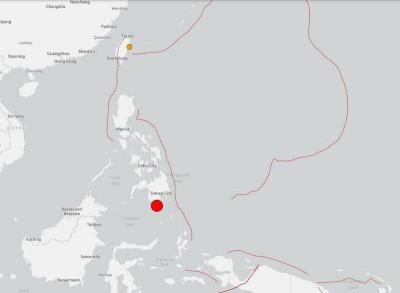
A magnitude 7.8 earthquake struck off the southern coast of Mindanao in the Philippines at 7:38am today, prompting the US Tsunami Warning System to issue an alert for neighboring countries, including Taiwan. The system issued a purple alert indicating a "tsunami threat." The potential threat zone includes Taiwan, the Philippines, Papua New Guinea, Yap and Palau. Philippine authorities were assessing the damage from the quake, with the office of civil defense seeking to verifying initial reports that 15 people had been killed and 129 injured in the region, mostly from falling debris. Arlene Hollero, disaster chief of Maasim town in the Philippines' Sarangani Province,
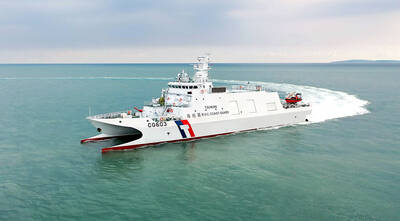
‘GRAY ZONE’ PRESSURE: Beijing’s activities are intended to create the deceitful impression that China has jurisdiction over the area around Taiwan, the CGA said Taiwan’s rights over its territorial waters and exclusive economic zone must not be violated by any country, the Mainland Affairs Council said yesterday, adding that it will not accept any unprovoked actions. The council issued the remarks in response to the China Coast Guard conducting maritime enforcement drills near eastern Taiwan and claiming to fully exercise China’s maritime administrative law enforcement authority. The Coast Guard Administration (CGA) has been closely monitoring the situation and is taking concrete steps to defend the nation’s sovereignty and secure its waters, the council said. China has no sovereign rights over the waters off eastern

RESILIENCE: Taiwan plays a key role in semiconductors, energy, information infrastructure and advanced manufacturing, AIT Director Raymond Greene said Taiwan’s continued investment in deterrence and resilience remains vital, especially in uncrewed systems and other emerging technologies, American Institute in Taiwan (AIT) Director Raymond Greene said yesterday. Greene made the remarks at the annual National Strategic Summit on Supply Chain Resilience held by the Research Institute for Democracy, Society and Emerging Technology (DSET), a government-backed think tank. As Taiwan last year became the US’ fourth-largest trading partner and supply chain security is becoming more important, cooperation in emerging technologies continues to deepen between the two countries, he said. The US is committed to accelerating innovation, building key infrastructure, strengthening cooperation

RIGHT DIRECTION: Taiwan’s efforts to prevent forced labor include a proposal to ‘fully prohibit’ employers from withholding workers’ documents, an official said Taiwan is to establish a mechanism to restrict imports of goods linked to forced labor, the Executive Yuan said yesterday, after the US proposed imposing additional tariffs on Taiwanese goods over labor concerns. “The Ministry of Labor and the Ministry of Economic Affairs are to establish an interministerial review procedure,” Executive Yuan spokesperson Michelle Lee (李慧芝) said at a news briefing in Taipei. “The government is to use the Foreign Trade Act [貿易法] as the legal basis to restrict imports of goods produced with forced labor” and bring its supply chain governance more in line with international standards on human rights, resilience


 RSS
RSS