


Democratic Progressive Party (DPP) Chairperson Tsai Ing-wen (蔡英文) was grabbed by a Chinese woman who managed to get on the stage at an event in Greater Taichung yesterday.
Tsai, the DPP’s presidential candidate in January’s presidential election, had just finished her speech at a meeting celebrating Lawyer’s Day when a woman rushed onto the stage and grabbed Tsai by the arm.
Tsai seemed a bit embarrassed and was later escorted off the stage, while the woman was asked to leave after venting her anger over what she said was an unfair ruling regarding a suit she had filed over a medical dispute.
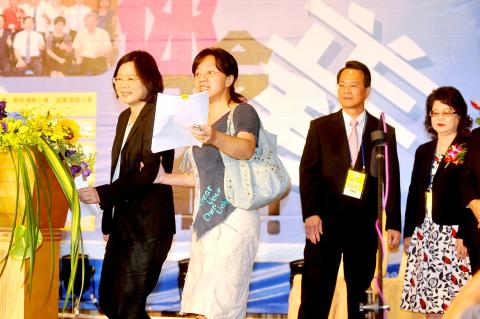
Photo: Liao Yau-tung, Taipei Times
The woman, surnamed Tsui (崔), is from China and is married to a Taiwanese man.
However, the relevant “agencies should review their security measures to see if there were any loopholes,” Tsai said, adding that the woman had been able to get direct access to the stage without any security checks.
The National Police Agency (NPA), which is in charge of security, later said it would review the incident to see whether it was a matter of negligence.
It was the second time in two weeks that a presidential candidate has been approached by a member of the public seeking to make a personal appeal.
On Aug. 23, a man suddenly appeared on stage behind President Ma Ying-jeou (馬英九), who is seeking re-election, at an event at Fokuangshan Monastery in Greater Kaohsiung. The man was taken away by security personnel.
In another case, on the eve of the special municipality elections last year, former vice president Lien Chan’s (連戰) son Sean Lien (連勝文) was shot at a campaign rally in then-Taipei county. He recovered from his wounds.
On March 19, 2004, the day before the presidential election, a bullet grazed then-president Chen Shui-bian’s (陳水扁) stomach and another struck then-vice president Annette Lu (呂秀蓮) in the knee as they sat in a motorcade while campaigning in Tainan.
Huang Ching-fu (黃清福), a section chief at the NPA, yesterday said that as Tsai has not yet officially registered for the presidential election, it has only assigned her four male and two female bodyguards.
“However, at campaign events, local police agencies will also assign eight people in two vehicles to support the main security team, which means there will be 14 people on Tsai’s security detail daily,” Huang said.
Under the law, presidential and vice presidential candidates are entitled to increased security once they formally register their candidacy with the Central Election Commission.
The National Security Bureau coordinates between the NPA, the Investigation Bureau and military police to provide security for the candidates between the date of formal registration and the day after the election.
Additional reporting by Rich Chang
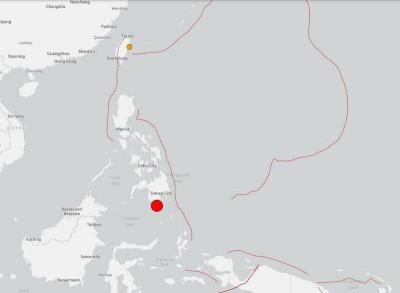
A magnitude 7.8 earthquake struck off the southern coast of Mindanao in the Philippines at 7:38am today, prompting the US Tsunami Warning System to issue an alert for neighboring countries, including Taiwan. The system issued a purple alert indicating a "tsunami threat." The potential threat zone includes Taiwan, the Philippines, Papua New Guinea, Yap and Palau. Philippine authorities were assessing the damage from the quake, with the office of civil defense seeking to verifying initial reports that 15 people had been killed and 129 injured in the region, mostly from falling debris. Arlene Hollero, disaster chief of Maasim town in the Philippines' Sarangani Province,
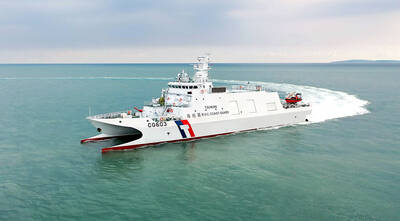
‘GRAY ZONE’ PRESSURE: Beijing’s activities are intended to create the deceitful impression that China has jurisdiction over the area around Taiwan, the CGA said Taiwan’s rights over its territorial waters and exclusive economic zone must not be violated by any country, the Mainland Affairs Council said yesterday, adding that it will not accept any unprovoked actions. The council issued the remarks in response to the China Coast Guard conducting maritime enforcement drills near eastern Taiwan and claiming to fully exercise China’s maritime administrative law enforcement authority. The Coast Guard Administration (CGA) has been closely monitoring the situation and is taking concrete steps to defend the nation’s sovereignty and secure its waters, the council said. China has no sovereign rights over the waters off eastern
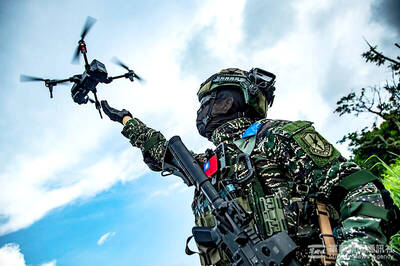
RESILIENCE: Taiwan plays a key role in semiconductors, energy, information infrastructure and advanced manufacturing, AIT Director Raymond Greene said Taiwan’s continued investment in deterrence and resilience remains vital, especially in uncrewed systems and other emerging technologies, American Institute in Taiwan (AIT) Director Raymond Greene said yesterday. Greene made the remarks at the annual National Strategic Summit on Supply Chain Resilience held by the Research Institute for Democracy, Society and Emerging Technology (DSET), a government-backed think tank. As Taiwan last year became the US’ fourth-largest trading partner and supply chain security is becoming more important, cooperation in emerging technologies continues to deepen between the two countries, he said. The US is committed to accelerating innovation, building key infrastructure, strengthening cooperation

RIGHT DIRECTION: Taiwan’s efforts to prevent forced labor include a proposal to ‘fully prohibit’ employers from withholding workers’ documents, an official said Taiwan is to establish a mechanism to restrict imports of goods linked to forced labor, the Executive Yuan said yesterday, after the US proposed imposing additional tariffs on Taiwanese goods over labor concerns. “The Ministry of Labor and the Ministry of Economic Affairs are to establish an interministerial review procedure,” Executive Yuan spokesperson Michelle Lee (李慧芝) said at a news briefing in Taipei. “The government is to use the Foreign Trade Act [貿易法] as the legal basis to restrict imports of goods produced with forced labor” and bring its supply chain governance more in line with international standards on human rights, resilience


 RSS
RSS