


Japanese leaders pushed for an emergency budget to counter economic damage from a powerful earthquake and tsunami that killed hundreds and caused widespread destruction.
The Bank of Japan (BOJ), which has struggled to return the country to growth, said it would cut short a two-day policy review scheduled for next week to one day tomorrow and promised to do its utmost to ensure financial market stability.
“The bank will continue to do its utmost, including the provision of liquidity, to ensure the stability in financial markets and to secure the smooth settlement of funds, in the coming week,” it said.
DISASTER MANAGEMENT
The central bank has set up a disaster management team, headed by Bank of Japan Governor Masaaki Shirakawa, at its head office in Tokyo.
Auto plants, electronics factories and refineries shut, roads buckled and power to millions of homes and businesses was knocked out. Several airports, including Tokyo’s Narita, were closed and rail services halted. All ports were shut.
Japan’s biggest quake on record occurred as the world’s third-largest economy had been showing signs of reviving from an economic contraction in the final quarter of last year.
The disaster raised the prospect of major disruptions for business and a repair bill of billions of US dollars.
Leaders of the ruling and opposition parties agreed on the need for an extra budget after Japanese Prime Minister Naoto Kan asked them to “save the country,” Kyodo news agency reported.
Japan’s economy looked set to return to growth in the first quarter of this year, according to a Reuters poll this week.
After the disaster, it will probably fall again before growing more strongly as a result of rebuilding work, said Chris Low, chief economist at FTN Financial in New York.
SHUTDOWNS
Electronics giant Sony Corp, one of the country’s biggest exporters, shut six factories, just one of scores of major companies affected by the disaster.
Other manufacturing and utilities shut down include Toyota Motor Corp and Nissan Motor Co plants, officials said and media reported. The massive earthquake threatens to crimp US-bound exports of Japanese vehicles and parts in coming months, straining an already stretched supply base in the recovering industry.
If ports remain shut for an extended period, exports of Japanese automobiles to North America could be delayed, analysts said.
“It’s a very bad situation,” said Dennis Virag, president of the Automotive Consulting Group.
“Japan has excellent ports, but they’re going to be the focus of rescue efforts. I don’t know how much [non-relief shipping] is going to be going out for while,” he said.
North American-based auto plants could also be affected if parts shipments are delayed, Virag said.
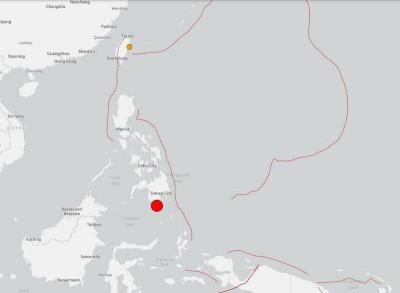
A magnitude 7.8 earthquake struck off the southern coast of Mindanao in the Philippines at 7:38am today, prompting the US Tsunami Warning System to issue an alert for neighboring countries, including Taiwan. The system issued a purple alert indicating a "tsunami threat." The potential threat zone includes Taiwan, the Philippines, Papua New Guinea, Yap and Palau. Philippine authorities were assessing the damage from the quake, with the office of civil defense seeking to verifying initial reports that 15 people had been killed and 129 injured in the region, mostly from falling debris. Arlene Hollero, disaster chief of Maasim town in the Philippines' Sarangani Province,
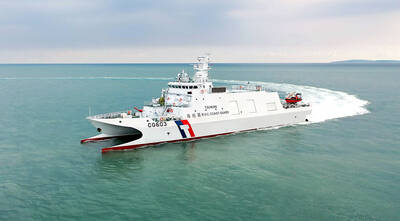
‘GRAY ZONE’ PRESSURE: Beijing’s activities are intended to create the deceitful impression that China has jurisdiction over the area around Taiwan, the CGA said Taiwan’s rights over its territorial waters and exclusive economic zone must not be violated by any country, the Mainland Affairs Council said yesterday, adding that it will not accept any unprovoked actions. The council issued the remarks in response to the China Coast Guard conducting maritime enforcement drills near eastern Taiwan and claiming to fully exercise China’s maritime administrative law enforcement authority. The Coast Guard Administration (CGA) has been closely monitoring the situation and is taking concrete steps to defend the nation’s sovereignty and secure its waters, the council said. China has no sovereign rights over the waters off eastern

RESILIENCE: Taiwan plays a key role in semiconductors, energy, information infrastructure and advanced manufacturing, AIT Director Raymond Greene said Taiwan’s continued investment in deterrence and resilience remains vital, especially in uncrewed systems and other emerging technologies, American Institute in Taiwan (AIT) Director Raymond Greene said yesterday. Greene made the remarks at the annual National Strategic Summit on Supply Chain Resilience held by the Research Institute for Democracy, Society and Emerging Technology (DSET), a government-backed think tank. As Taiwan last year became the US’ fourth-largest trading partner and supply chain security is becoming more important, cooperation in emerging technologies continues to deepen between the two countries, he said. The US is committed to accelerating innovation, building key infrastructure, strengthening cooperation

RIGHT DIRECTION: Taiwan’s efforts to prevent forced labor include a proposal to ‘fully prohibit’ employers from withholding workers’ documents, an official said Taiwan is to establish a mechanism to restrict imports of goods linked to forced labor, the Executive Yuan said yesterday, after the US proposed imposing additional tariffs on Taiwanese goods over labor concerns. “The Ministry of Labor and the Ministry of Economic Affairs are to establish an interministerial review procedure,” Executive Yuan spokesperson Michelle Lee (李慧芝) said at a news briefing in Taipei. “The government is to use the Foreign Trade Act [貿易法] as the legal basis to restrict imports of goods produced with forced labor” and bring its supply chain governance more in line with international standards on human rights, resilience


 RSS
RSS