


Iran yesterday launched a probe into the crash of an Iran Air passenger jet, which killed 77 people and injured scores after the airliner broke into pieces in heavy snow and fog, state media said.
The Boeing 727 airliner with the state-run Iran Air crashed near the northwestern city of Orumiyeh at about 7:45pm on Sunday after it took off from Tehran’s Mehrabad Airport, state television said on its Web site.
“Unfortunately, 77 of our citizens were killed” in the accident, the state television said yesterday, out of the 105 people traveling on what reportedly was an ageing Boeing airliner delivered to Iran in 1974.
Television footage of the crash showed the airliner broken into three pieces and buried in thick snow. Some corpses were shown covered in blankets laying on snow near the plane’s debris.
“This flight had 105 persons on board, 94 passengers and 11 flight crew,” ISNA news agency reported quoting Ahmad Majidi, the head of the Iranian Ministry of Road and Transportation’s crisis panel.
Majidi, in a separate report on state news agency IRNA, said one passenger who was missing since the crash was found yesterday.
“He was thrown out of the plane. He has been taken to the hospital in Orumiyeh,” Majidi said, adding that another passenger was still untraceable.
Media reports said eight of the injured passengers were in critical condition, while the travelers included a Turk and two Iraqis.
Majidi said it appeared that bad weather led to the crash.
“Based on the evidence, the plane’s captain could not land at Orumiyeh Airport due to bad weather conditions and he decided to return [to Tehran], but for unknown reasons the plane crashed about 5 miles [8km] from the airport,” he said.
Iranian Minister of Road and Transportation Hamid Behbahani told Mehr news agency that Iranian President Mahmoud Ahmadinejad had ordered a probe into the crash, adding that the “preliminary reason is lack of visibility and fog” for the accident.
Iran Air spokesman Shahrokh Noushabadi had also blamed the bad weather for the crash.
The two black boxes of the Iran Air passenger jet had been recovered yesterday, Majidi said in a telephone interview from Tehran.
Meanwhile, ISNA reported that the crashed aircraft had been in service since 1974.
“The plane was given to Iran in 1974 and at that time it was a secondhand” aircraft, ISNA said, quoting what it identified as an unnamed informed source.
Iran’s civil and military fleet is made up of ancient aircraft in very poor condition because of their age and lack of maintenance.
Iran, which has been under years of international sanctions, has suffered a number of aviation disasters over the past decade, several involving small companies using Russian crew or crews from former Soviet republics in Central Asia.
In Iran’s worst air accident, a plane carrying members of the elite Revolutionary Guards crashed in February 2003, killing 302 people on board.
In July 2009, a Soviet-designed Tupolev caught fire in mid-air and plunged flaming into farmland northeast of Tehran, killing all 168 people on board.
In December 2005, a total of 108 people were killed when a Lockheed transport plane crashed into a high-rise housing block outside Tehran.
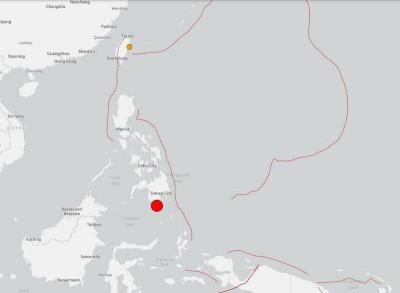
A magnitude 7.8 earthquake struck off the southern coast of Mindanao in the Philippines at 7:38am today, prompting the US Tsunami Warning System to issue an alert for neighboring countries, including Taiwan. The system issued a purple alert indicating a "tsunami threat." The potential threat zone includes Taiwan, the Philippines, Papua New Guinea, Yap and Palau. Philippine authorities were assessing the damage from the quake, with the office of civil defense seeking to verifying initial reports that 15 people had been killed and 129 injured in the region, mostly from falling debris. Arlene Hollero, disaster chief of Maasim town in the Philippines' Sarangani Province,
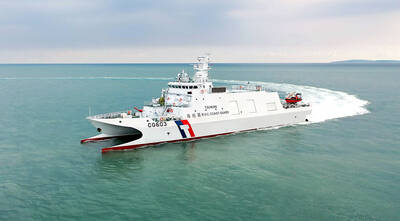
‘GRAY ZONE’ PRESSURE: Beijing’s activities are intended to create the deceitful impression that China has jurisdiction over the area around Taiwan, the CGA said Taiwan’s rights over its territorial waters and exclusive economic zone must not be violated by any country, the Mainland Affairs Council said yesterday, adding that it will not accept any unprovoked actions. The council issued the remarks in response to the China Coast Guard conducting maritime enforcement drills near eastern Taiwan and claiming to fully exercise China’s maritime administrative law enforcement authority. The Coast Guard Administration (CGA) has been closely monitoring the situation and is taking concrete steps to defend the nation’s sovereignty and secure its waters, the council said. China has no sovereign rights over the waters off eastern
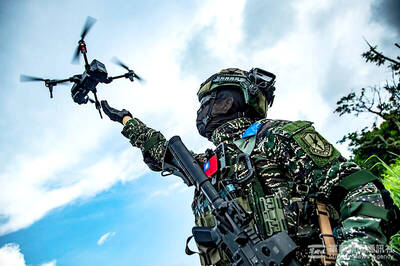
RESILIENCE: Taiwan plays a key role in semiconductors, energy, information infrastructure and advanced manufacturing, AIT Director Raymond Greene said Taiwan’s continued investment in deterrence and resilience remains vital, especially in uncrewed systems and other emerging technologies, American Institute in Taiwan (AIT) Director Raymond Greene said yesterday. Greene made the remarks at the annual National Strategic Summit on Supply Chain Resilience held by the Research Institute for Democracy, Society and Emerging Technology (DSET), a government-backed think tank. As Taiwan last year became the US’ fourth-largest trading partner and supply chain security is becoming more important, cooperation in emerging technologies continues to deepen between the two countries, he said. The US is committed to accelerating innovation, building key infrastructure, strengthening cooperation

RIGHT DIRECTION: Taiwan’s efforts to prevent forced labor include a proposal to ‘fully prohibit’ employers from withholding workers’ documents, an official said Taiwan is to establish a mechanism to restrict imports of goods linked to forced labor, the Executive Yuan said yesterday, after the US proposed imposing additional tariffs on Taiwanese goods over labor concerns. “The Ministry of Labor and the Ministry of Economic Affairs are to establish an interministerial review procedure,” Executive Yuan spokesperson Michelle Lee (李慧芝) said at a news briefing in Taipei. “The government is to use the Foreign Trade Act [貿易法] as the legal basis to restrict imports of goods produced with forced labor” and bring its supply chain governance more in line with international standards on human rights, resilience


 RSS
RSS