


Taiwan can terminate the Economic Cooperation Framework Agreement (ECFA) 180 days after notifying China should bilateral negotiations break down, the Mainland Affairs Council (MAC) said yesterday.
In a statement, the MAC said Article 1 of the ECFA states that if either party wishes to terminate the agreement, it must notify the other in writing.
Both contracting parties should then begin negotiations 30 days after a notification of termination is issued. The agreement will be terminated 180 days after the notification is issued should those negotiations fail, the statement said.

PHOTO: LIN CHENG-KUNG, TAIPEI TIMES
The statement said the spirit of the clause is that both sides would begin negotiations first before any party rushes into reckless action. The agreement can be unilaterally annulled at the request of either party 180 days after a notice is issued and bilateral negotiations have failed, without having to obtain the consent of the other party.
The statement said the term was one of the provisions the Taiwanese team fought hard to include in the accord.
“It is the ultimate safety net,” the statement said.
“It is improper to describe it as a bargaining chip that China will use to threaten Taiwan or to demand that it toe the line,” it added.
The statement was made in response to a Chinese-language Liberty Times (the Taipei Times’ sister newspaper) report that warned Beijing could use the termination clause to demand that Taiwan behave.
Commenting on the termination clause yesterday, the Democratic Progressive Party’s (DPP) spokesperson on ECFA related issues, Julian Kuo (郭正亮), said: “It doesn’t matter either way ... the Chinese Nationalist Party (KMT) government doesn’t have the courage to activate this exit clause anyway.”
He said DPP headquarters would, along with the DPP legislative caucus, look into a proposal to table a bill that would force the KMT government to invoke the exit clause of the agreement if it were not able to sign free-trade agreements (FTA) with other countries within a year.
DPP lawmakers would also consider attempting to force the government to terminate the agreement if GDP growth did not reach government estimates, unemployment continued to increase or if average salaries remained stagnant, Kuo added.
Commenting on the DPP caucus’ reported proposal, KMT Legislator Alex Tsai (蔡正元) said setting a timetable to sign FTAs with other countries would only place Taiwan in a disadvantageous position during negotiations.
KMT Legislator Lai Shyh-bao (賴士葆) said that while the DPP caucus has the right to table such a bill, activating the “termination clause” would only reverse the country’s development and restrict Taiwan from reaching out to the world.
“The DPP should ask businesses and farmers that will benefit from the ECFA if they agree that the ECFA and the FTA issue should be linked,” Lai said.
Legislative Speaker Wang Jyn-ping (王金平) said the proposal “did not make any sense” as it usually “takes about two years or more” for a country to complete negotiations on an FTA with a major trading partner.
Meanwhile, Wang said he would call a meeting this week so that lawmakers could decide the dates and the format of a provisional session to review the ECFA.
The DPP caucus has called for the ECFA to be screened “article by article.”
DPP spokesperson Lin Yu-chang (林右昌) said it was important that lawmakers carefully screened the ECFA before it became valid, based on public concerns that the controversial trade pact could impact Taiwan’s more fragile industries and the labor market because of competition from cheaper Chinese products.
“We are going to stand with the Taiwanese public and demand that the legislature conducts a thorough review of the ECFA,” Lin said.
The KMT caucus, however, is of the view that the legislature can only vote to accept or reject the agreement as a whole.
Noting the caucuses’ different stances on the issue, Wang said lawmakers needed to find a consensus on how to review the ECFA before deliberations begin because of the lack of a precedent in screening cross-strait agreements.
At a separate setting yesterday, Premier Wu Den-yih (吳敦義) said he would lead a group of officials that would defend the ECFA.
Wu was reluctant to put a figure on how much the trade deal would boost the economy, saying “much depends on the global economy and an individual country’s diligence.”
“The world is still feeling the aftermath of the global economic tsunami, but the ECFA helps to remove many obstacles, such as the unfair tariff terms, and therefore it increases Taiwan’s competitiveness,” Wu said.
Wu did not specify when he would appear at the legislature, but said he believed a second provisional session would be held in mid-to-late August.
At the same time, amendments to four laws — the Patent Act (專利法), the Customs Import Tariff Act (海關進口稅則), the Plant Variety and Plant Seed Act (植物品種及種苗法) and the Trademark Act (商標法) — will also be reviewed, with the goal of passing the amendments by the end of the year.
When asked if President Ma Ying-jeou (馬英九) would attend a question-and-answer session at the legislature as has been rumored, Wu answered with a categorical “no,” saying the law of the land does not require the president to appear in front of the legislature.
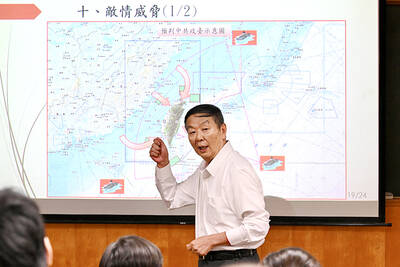
RETHINK? The defense ministry and Navy Command Headquarters could take over the indigenous submarine project and change its production timeline, a source said Admiral Huang Shu-kuang’s (黃曙光) resignation as head of the Indigenous Submarine Program and as a member of the National Security Council could affect the production of submarines, a source said yesterday. Huang in a statement last night said he had decided to resign due to national security concerns while expressing the hope that it would put a stop to political wrangling that only undermines the advancement of the nation’s defense capabilities. Taiwan People’s Party Legislator Vivian Huang (黃珊珊) yesterday said that the admiral, her older brother, felt it was time for him to step down and that he had completed what he
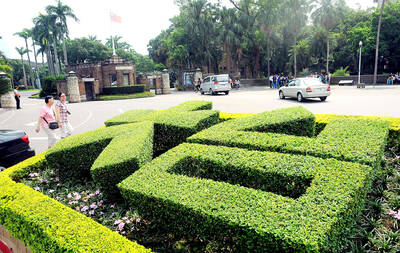
Taiwan has experienced its most significant improvement in the QS World University Rankings by Subject, data provided on Sunday by international higher education analyst Quacquarelli Symonds (QS) showed. Compared with last year’s edition of the rankings, which measure academic excellence and influence, Taiwanese universities made great improvements in the H Index metric, which evaluates research productivity and its impact, with a notable 30 percent increase overall, QS said. Taiwanese universities also made notable progress in the Citations per Paper metric, which measures the impact of research, achieving a 13 percent increase. Taiwanese universities gained 10 percent in Academic Reputation, but declined 18 percent
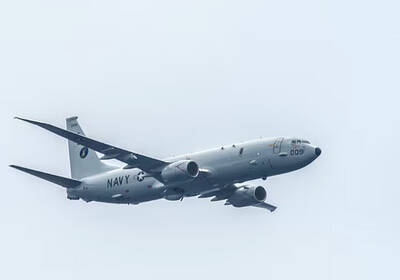
CHINA REACTS: The patrol and reconnaissance plane ‘transited the Taiwan Strait in international airspace,’ the 7th Fleet said, while Taipei said it saw nothing unusual The US 7th Fleet yesterday said that a US Navy P-8A Poseidon flew through the Taiwan Strait, a day after US and Chinese defense heads held their first talks since November 2022 in an effort to reduce regional tensions. The patrol and reconnaissance plane “transited the Taiwan Strait in international airspace,” the 7th Fleet said in a news release. “By operating within the Taiwan Strait in accordance with international law, the United States upholds the navigational rights and freedoms of all nations.” In a separate statement, the Ministry of National Defense said that it monitored nearby waters and airspace as the aircraft
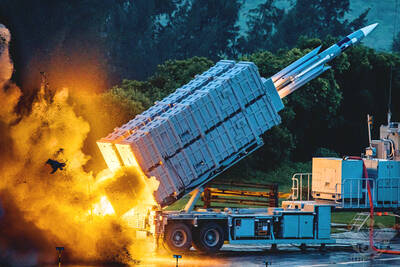
UNDER DISCUSSION: The combatant command would integrate fast attack boat and anti-ship missile groups to defend waters closest to the coastline, a source said The military could establish a new combatant command as early as 2026, which would be tasked with defending Taiwan’s territorial waters 24 nautical miles (44.4km) from the nation’s coastline, a source familiar with the matter said yesterday. The new command, which would fall under the Naval Command Headquarters, would be led by a vice admiral and integrate existing fast attack boat and anti-ship missile groups, along with the Naval Maritime Surveillance and Reconnaissance Command, said the source, who asked to remain anonymous. It could be launched by 2026, but details are being discussed and no final timetable has been announced, the source


 RSS
RSS