


Thai Prime Minister Abhisit Vejjajiva and his political opponents sat down last night for a second set of talks meant to defuse tensions over a protest group’s insistence he call new elections.
The first round of talks on Sunday, which were televised, were a relatively calm moment after more than two weeks of protests that have drawn about 100,000 people to increasingly confrontational rallies against a government that demonstrators consider illegitimate. The protests have raised concerns of violence and prompted travel warnings from three dozen countries.
Three “Red Shirt” protest leaders met Abhisit and two of his advisers in the same room where they held three hours of discussions a day earlier. So far, they have failed to resolve differences between the two sides.
The Red Shirts say Abhisit came to power with the connivance of the military and other parts of the traditional ruling class, and only new elections can restore integrity to Thai democracy.
“Our request is simple and direct. We would like parliament dissolved to return power to the people, so they can make their decision,” said Veera Musikapong, one of the protest leaders.
The leaders gave Abhisit 15 days to meet their demands, which Abhisit has repeatedly rejected, saying that calling new elections would not fix Thailand’s deep political problems.
While both sides have vowed to remain nonviolent, a string of nonfatal attacks have unnerved Bangkok in recent days.
One person was wounded when a bomb exploded near the home of former Thai prime minister Banharn Silapa-archa on Sunday night, gunfire struck a branch of Bangkok Bank and a tent that served food to protesters was burned down.
A dozen soldiers and four civilians were wounded in weekend blasts at the army base serving as Abhisit’s office and at two state-run TV stations.
The prime minister had initially refused protesters’ demands for talks on live television but abruptly reversed course on Sunday “to restore peace and minimize the chance of violence,” his office said.
He met protest leaders at an academic institute in a Bangkok suburb.
Thailand’s political crisis started in 2006 when protesters wearing yellow shirts demanded the ouster of then-prime minister Thaksin Shinawatra, whom they accused of corruption. Thaksin was toppled later that year by a military coup.
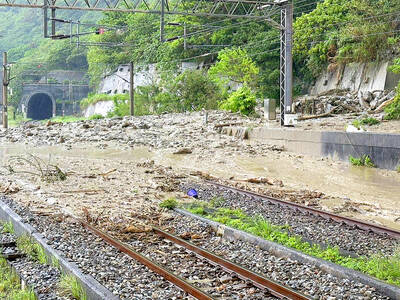
ROLLER-COASTER RIDE: More than five earthquakes ranging from magnitude 4.4 to 5.5 on the Richter scale shook eastern Taiwan in rapid succession yesterday afternoon Back-to-back weather fronts are forecast to hit Taiwan this week, resulting in rain across the nation in the coming days, the Central Weather Administration said yesterday, as it also warned residents in mountainous regions to be wary of landslides and rockfalls. As the first front approached, sporadic rainfall began in central and northern parts of Taiwan yesterday, the agency said, adding that rain is forecast to intensify in those regions today, while brief showers would also affect other parts of the nation. A second weather system is forecast to arrive on Thursday, bringing additional rain to the whole nation until Sunday, it

CONDITIONAL: The PRC imposes secret requirements that the funding it provides cannot be spent in states with diplomatic relations with Taiwan, Emma Reilly said China has been bribing UN officials to obtain “special benefits” and to block funding from countries that have diplomatic ties with Taiwan, a former UN employee told the British House of Commons on Tuesday. At a House of Commons Foreign Affairs Committee hearing into “international relations within the multilateral system,” former Office of the UN High Commissioner for Human Rights (OHCHR) employee Emma Reilly said in a written statement that “Beijing paid bribes to the two successive Presidents of the [UN] General Assembly” during the two-year negotiation of the Sustainable Development Goals. Another way China exercises influence within the UN Secretariat is
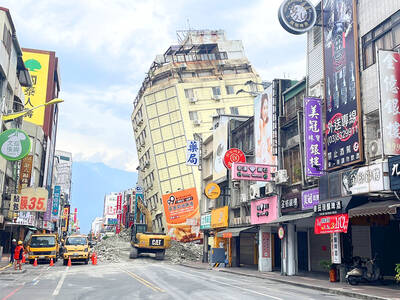
LANDSLIDES POSSIBLE: The agency advised the public to avoid visiting mountainous regions due to more expected aftershocks and rainfall from a series of weather fronts A series of earthquakes over the past few days were likely aftershocks of the April 3 earthquake in Hualien County, with further aftershocks to be expected for up to a year, the Central Weather Administration (CWA) said yesterday. Based on the nation’s experience after the quake on Sept. 21, 1999, more aftershocks are possible over the next six months to a year, the agency said. A total of 103 earthquakes of magnitude 4 on the local magnitude scale or higher hit Hualien County from 5:08pm on Monday to 10:27am yesterday, with 27 of them exceeding magnitude 5. They included two, of magnitude

Taiwan’s first drag queen to compete on the internationally acclaimed RuPaul’s Drag Race, Nymphia Wind (妮妃雅), was on Friday crowned the “Next Drag Superstar.” Dressed in a sparkling banana dress, Nymphia Wind swept onto the stage for the final, and stole the show. “Taiwan this is for you,” she said right after show host RuPaul announced her as the winner. “To those who feel like they don’t belong, just remember to live fearlessly and to live their truth,” she said on stage. One of the frontrunners for the past 15 episodes, the 28-year-old breezed through to the final after weeks of showcasing her unique


 RSS
RSS