


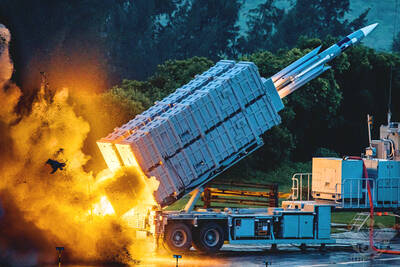
China said yesterday it had successfully tested a missile intercept system in what analysts described as a show of its advanced air defense capabilities amid tensions over US arms sales to Taiwan.
“China conducted a test of ground-based mid-range missile interception technology within its territory, which achieved its objective,” Chinese foreign ministry spokeswoman Jiang Yu (姜瑜) said.
“This test is defensive in nature and not targeted at any other country and is consistent with the national defense policy of China,” Jiang told reporters.
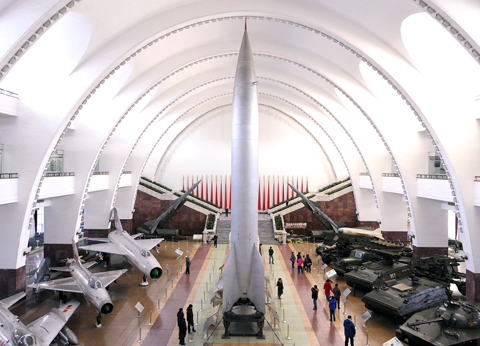
PHOTO: AFP
Government response in Taiwan was muted, with the Ministry of National Defense saying it had no comment.
“We continue to monitor China’s latest weapons development and will continue to do so,” said Major General Yu Sy-tue (虞思祖), spokesman for the ministry.
News of China’s test came soon after an announcement by a US official in Taipei that the Pentagon had approved the sale of Patriot missile equipment to Taiwan as part of a package passed by Congress more than a year ago.
Beijing has repeatedly voiced its opposition to the sales and urged Washington to cancel the deal.
The Chinese defense ministry had warned at the weekend that it reserved the right to take unspecified action if Washington followed through with the sale, which it called a “severe obstacle” to China-US military ties.
However, analysts said while China’s test would keep pressure on the US over deals with Taiwan, it was likely to have been conducted as a general show of force.
“It sounds pretty significant to me,” said Richard Bitzinger, an expert on China’s military at Nanyang Technological University in Singapore.
“The information is pretty thin, but the critical fact is that they conducted a successful missile intercept,” he said.
Scott Harold, an analyst at RAND Corporation, agreed, saying: “I would be inclined to view the test as a stride, but how much of one is unclear in the absence of more information, towards a missile defense capability.”
Arthur Ding (丁樹範), a research fellow and China specialist at National Chengchi University, said the test sends a “political signal to the United States and to other countries that China is prepared for air operations, full-scale operations by whatever country.”
“There is no detailed information so it is very hard to assess how much China has achieved, but at least it can show a trend that air defense is an area of focus for the overall military modernization,” he said.
Beijing has poured money into its military in recent years as part of a major drive to upgrade the equipment used by the nation’s 2.3-million-strong armed forces.
A budget submitted to parliament in March showed that Chinese military spending rose 15.3 percent last year to US$69 billion, the latest in more than a decade-long string of double-digit increases.
Faced with growing concern overseas about its military intentions, Beijing frequently stresses the defensive nature of its armed forces.
“China’s defense modernization is for the legitimate needs of safeguarding national sovereignty, security and territorial integrity,” Jiang said yesterday.
The Global Times quoted senior military strategist Yang Chengjun as saying that the test had “ushered China into a new phase in terms of missile interception technologies.”
“China needs an improved capability and more means of military defense as the country faces increasing security threats,” Yang said.
In Taiwan, Chinese Nationalist Party (KMT) Legislator Lin Yu-fang (林郁方), a member of the Foreign and National Defense Committee, said the test was China’s way of “telling the world that it has the capability to intercept ballistic missiles.”
Lin said it was not surprising, as many countries are developing anti-ballistic missile systems. He added, however, that he did not know whether the test was directly related to the US’ recent announcement of arms sales to Taiwan.
Democratic Progressive Party (DPP) spokesman Tsai Chi-chang (蔡其昌) disagreed, saying the party thought it could be related to US arms sales to Taiwan.
He said China should not protest against the arms sales because they are in accordance with the US’ Taiwan Relations Act.
He added that China’s move would only increase Taiwanese feelings of intimidation and discontent with Beijing.
DPP Legislator Tsai Huang-liang (蔡煌瑯) said President Ma Ying-jeou (馬英九) had neglected national defense and the test showed that his China-leaning policies had not stopped Beijing’s ambition to take Taiwan by force.
Wendell Minnick, Asia Bureau Chief at the military periodical Defense News, dismissed the linking of the missile test to Taiwan, which has no offensive missile capability.
“It’s China aiming missiles at Taiwan, not vice versa,” he said.
ADDITIONAL REPORTING BY JIMMY CHUANG, FLORA WANG, RICH CHANG AND STAFF WRITER
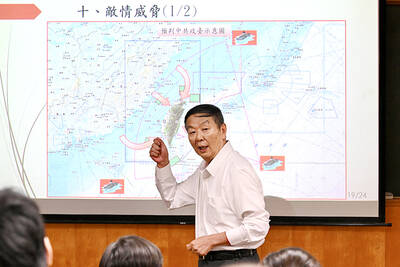
RETHINK? The defense ministry and Navy Command Headquarters could take over the indigenous submarine project and change its production timeline, a source said Admiral Huang Shu-kuang’s (黃曙光) resignation as head of the Indigenous Submarine Program and as a member of the National Security Council could affect the production of submarines, a source said yesterday. Huang in a statement last night said he had decided to resign due to national security concerns while expressing the hope that it would put a stop to political wrangling that only undermines the advancement of the nation’s defense capabilities. Taiwan People’s Party Legislator Vivian Huang (黃珊珊) yesterday said that the admiral, her older brother, felt it was time for him to step down and that he had completed what he
Taiwan has experienced its most significant improvement in the QS World University Rankings by Subject, data provided on Sunday by international higher education analyst Quacquarelli Symonds (QS) showed. Compared with last year’s edition of the rankings, which measure academic excellence and influence, Taiwanese universities made great improvements in the H Index metric, which evaluates research productivity and its impact, with a notable 30 percent increase overall, QS said. Taiwanese universities also made notable progress in the Citations per Paper metric, which measures the impact of research, achieving a 13 percent increase. Taiwanese universities gained 10 percent in Academic Reputation, but declined 18 percent
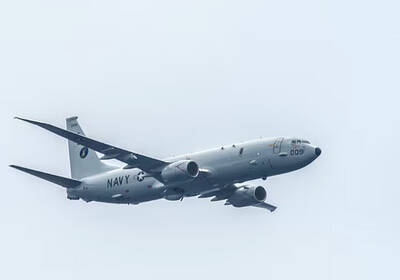
CHINA REACTS: The patrol and reconnaissance plane ‘transited the Taiwan Strait in international airspace,’ the 7th Fleet said, while Taipei said it saw nothing unusual The US 7th Fleet yesterday said that a US Navy P-8A Poseidon flew through the Taiwan Strait, a day after US and Chinese defense heads held their first talks since November 2022 in an effort to reduce regional tensions. The patrol and reconnaissance plane “transited the Taiwan Strait in international airspace,” the 7th Fleet said in a news release. “By operating within the Taiwan Strait in accordance with international law, the United States upholds the navigational rights and freedoms of all nations.” In a separate statement, the Ministry of National Defense said that it monitored nearby waters and airspace as the aircraft
UNDER DISCUSSION: The combatant command would integrate fast attack boat and anti-ship missile groups to defend waters closest to the coastline, a source said The military could establish a new combatant command as early as 2026, which would be tasked with defending Taiwan’s territorial waters 24 nautical miles (44.4km) from the nation’s coastline, a source familiar with the matter said yesterday. The new command, which would fall under the Naval Command Headquarters, would be led by a vice admiral and integrate existing fast attack boat and anti-ship missile groups, along with the Naval Maritime Surveillance and Reconnaissance Command, said the source, who asked to remain anonymous. It could be launched by 2026, but details are being discussed and no final timetable has been announced, the source


 RSS
RSS