


The Central Epidemic Command Center (CECC) has denied a link between swine flu vaccinations and reports of children feeling unwell after receiving the shot.
The denial came after several reports from around the nation said many children began to feel unwell after receiving a locally produced vaccine against influenza A(H1N1).
On Thursday, Taichung City’s health bureau said 36 students from the city’s Zhongshan Junior High School felt dizzy, fainted and vomited after receiving the shots.
However, the students were fine after they were sent to hospitals for treatment, the bureau said.
Similar incidents were reported at Kuang-rong Junior High school in Sanchong (三重), Taipei County, on Thursday, where 24 students were hospitalized after they felt dizzy following vaccinations.
The students were fine after they were sent to a hospital for observation.
Saying that doctors have noted that signs of vaccination dizziness could be easily triggered by psychological stress, Taichung City Education Bureau Director Chang Kung-ming (張光銘) suggested that teachers give students pep talks before they receive shots to help reduce their fears.
“Most children will feel a little dizzy after the shot. It is probably because the children are too nervous, but I can assure you that feeling unwell has nothing to do with the vaccine,” CECC spokesman Chou Jih-haw (周志浩) said at a separate setting.
Chou’s remarks were backed by Huang Li-min (黃立民), a doctor from National Taiwan University Hospital’s Department of Pediatrics.
Huang said that flu symptoms were a normal side effect of receiving a flu shot.
“As long as these symptoms go away within a few days, they are considered normal,” he said.
Meanwhile, Chou said the death of a Kaohsiung County boy on Wednesday night was not related to him receiving the vaccine.
Chou said the boy received his vaccination shot on Nov. 19.
He was sent to hospital four days later because of a fever, but died on Nov. 25.
“Initial research shows his death had nothing to do with the vaccination,” Chou said.
The CECC yesterday said that approximately 7 percent of the nation’s population, about 1.6 million people, had received A(H1N1) influenza vaccine shots.
Starting on Monday, the next group to receive vaccination shots in the national anti-A(H1N1) inoculation drive will be high school students, followed by young adults aged between 19 and 24 beginning on Dec. 1.
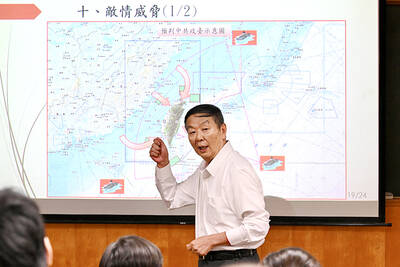
RETHINK? The defense ministry and Navy Command Headquarters could take over the indigenous submarine project and change its production timeline, a source said Admiral Huang Shu-kuang’s (黃曙光) resignation as head of the Indigenous Submarine Program and as a member of the National Security Council could affect the production of submarines, a source said yesterday. Huang in a statement last night said he had decided to resign due to national security concerns while expressing the hope that it would put a stop to political wrangling that only undermines the advancement of the nation’s defense capabilities. Taiwan People’s Party Legislator Vivian Huang (黃珊珊) yesterday said that the admiral, her older brother, felt it was time for him to step down and that he had completed what he
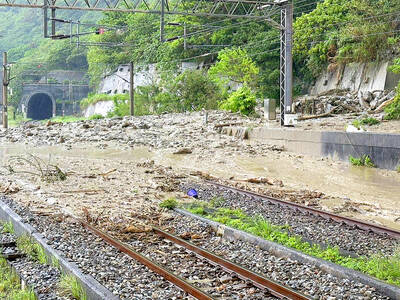
ROLLER-COASTER RIDE: More than five earthquakes ranging from magnitude 4.4 to 5.5 on the Richter scale shook eastern Taiwan in rapid succession yesterday afternoon Back-to-back weather fronts are forecast to hit Taiwan this week, resulting in rain across the nation in the coming days, the Central Weather Administration said yesterday, as it also warned residents in mountainous regions to be wary of landslides and rockfalls. As the first front approached, sporadic rainfall began in central and northern parts of Taiwan yesterday, the agency said, adding that rain is forecast to intensify in those regions today, while brief showers would also affect other parts of the nation. A second weather system is forecast to arrive on Thursday, bringing additional rain to the whole nation until Sunday, it

CONDITIONAL: The PRC imposes secret requirements that the funding it provides cannot be spent in states with diplomatic relations with Taiwan, Emma Reilly said China has been bribing UN officials to obtain “special benefits” and to block funding from countries that have diplomatic ties with Taiwan, a former UN employee told the British House of Commons on Tuesday. At a House of Commons Foreign Affairs Committee hearing into “international relations within the multilateral system,” former Office of the UN High Commissioner for Human Rights (OHCHR) employee Emma Reilly said in a written statement that “Beijing paid bribes to the two successive Presidents of the [UN] General Assembly” during the two-year negotiation of the Sustainable Development Goals. Another way China exercises influence within the UN Secretariat is
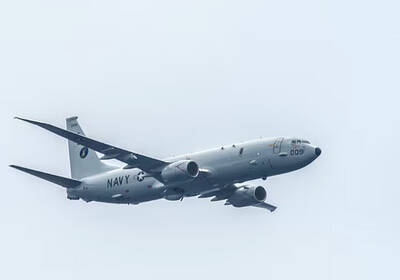
CHINA REACTS: The patrol and reconnaissance plane ‘transited the Taiwan Strait in international airspace,’ the 7th Fleet said, while Taipei said it saw nothing unusual The US 7th Fleet yesterday said that a US Navy P-8A Poseidon flew through the Taiwan Strait, a day after US and Chinese defense heads held their first talks since November 2022 in an effort to reduce regional tensions. The patrol and reconnaissance plane “transited the Taiwan Strait in international airspace,” the 7th Fleet said in a news release. “By operating within the Taiwan Strait in accordance with international law, the United States upholds the navigational rights and freedoms of all nations.” In a separate statement, the Ministry of National Defense said that it monitored nearby waters and airspace as the aircraft


 RSS
RSS