


For many of its 300 million enthusiasts, Facebook is a convenient way to keep in touch with friends, track down old sweethearts and share drunken photographs with the world. But the global power of the social networking site is now being harnessed for a rather more laudable aim: the pursuit of world peace.
A joint project between Facebook and the Persuasive Technology Lab at Stanford University in California — peace.facebook.com — is trying to bring together opposing sides in some of the most bitterly divided areas of the planet, encouraging online friendships between Jews and Muslims, US liberals and conservatives, and Turks and Greeks.
By tracking Facebook friendships and crunching the numbers, the site provides a daily snapshot of who is talking to whom and where.
Thursday afternoon, for example, peace.facebook revealed that over the previous 24 hours, there had been 7,339 India-Pakistan connections; 5,158 Israel-Palestine connections and 13,790 Greece-Turkey connections.
A click on the button for religious contact showed that over the same 24 hours, there had been 53,100 Christians and atheists in touch with each other, 1,250 Muslims and Jews talking, and 667 Sunni-Shiite connections. In the US, meanwhile, the number of conservative-liberal connections was 27,896.
Every day, the site also asks thousands of Facebook users the same question: Do you think we will achieve world peace within 50 years? The answers — broken down by country — reveal fluctuating geographic levels of optimism. In Colombia, nearly 40 percent said yes; in the US, the figure was just 7.8 percent.
Facebook says it is proud to be doing its bit for world peace by using technology to “help people better understand each other.”
“By enabling people from diverse backgrounds to easily connect and share their ideas, we can decrease world conflict in the short and long term,” it said in a statement on its Web site.
BJ Fogg, director of the Persuasive Technology Lab and a pioneer in the field of using computer technology to influence people, said the Facebook page was just one component of a larger Stanford University project called Peace Innovation.
The Peace Dot initiative, of which the Facebook page is part, aims to encourage people to create Web pages using the “peace.[address]” format in an effort to highlight the strides already being made toward peace around the world.
To date, 19 very different groups have signed up to the Peace Dot project, registering addresses ranging from peace.couchsurfing.org to peace.dalailamafoundation.org and even peace.safeway.com.
Fogg said he was confident “substantial global peace” could be brought about in the next 30 years.
“The process for increasing world peace is innovation,” he said. “Lots of it. There’s no single answer, no single solution. Together we must innovate to create more empathy, understanding, tolerance and so on.”
“We must innovate to help people everywhere have basic needs met, like access to clean water. These are the roots of peace. We can create new ways to strengthen these roots of peace,” he said.
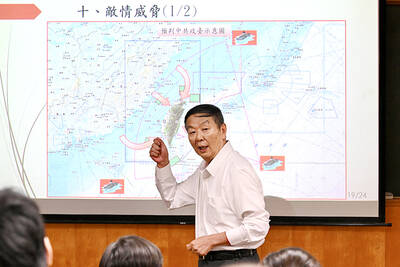
RETHINK? The defense ministry and Navy Command Headquarters could take over the indigenous submarine project and change its production timeline, a source said Admiral Huang Shu-kuang’s (黃曙光) resignation as head of the Indigenous Submarine Program and as a member of the National Security Council could affect the production of submarines, a source said yesterday. Huang in a statement last night said he had decided to resign due to national security concerns while expressing the hope that it would put a stop to political wrangling that only undermines the advancement of the nation’s defense capabilities. Taiwan People’s Party Legislator Vivian Huang (黃珊珊) yesterday said that the admiral, her older brother, felt it was time for him to step down and that he had completed what he

Taiwan has experienced its most significant improvement in the QS World University Rankings by Subject, data provided on Sunday by international higher education analyst Quacquarelli Symonds (QS) showed. Compared with last year’s edition of the rankings, which measure academic excellence and influence, Taiwanese universities made great improvements in the H Index metric, which evaluates research productivity and its impact, with a notable 30 percent increase overall, QS said. Taiwanese universities also made notable progress in the Citations per Paper metric, which measures the impact of research, achieving a 13 percent increase. Taiwanese universities gained 10 percent in Academic Reputation, but declined 18 percent
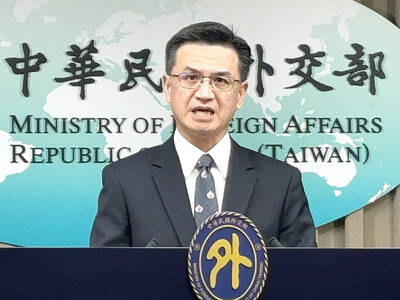
BULLY TACTICS: Beijing has continued its incursions into Taiwan’s airspace even as Xi Jinping talked about Taiwan being part of the Chinese family and nation China should stop its coercion of Taiwan and respect mainstream public opinion in Taiwan about sovereignty if its expression of goodwill is genuine, the Ministry of Foreign Affairs (MOFA) said yesterday. Ministry spokesman Jeff Liu (劉永健) made the comment in response to media queries about a meeting between former president Ma Ying-jeou (馬英九) and Chinese President Xi Jinping (習近平) the previous day. Ma voiced support for the so-called “1992 consensus,” while Xi said that although the two sides of the Taiwan Strait have “different systems,” this does not change the fact that they are “part of the same country,” and that “external

UNDER DISCUSSION: The combatant command would integrate fast attack boat and anti-ship missile groups to defend waters closest to the coastline, a source said The military could establish a new combatant command as early as 2026, which would be tasked with defending Taiwan’s territorial waters 24 nautical miles (44.4km) from the nation’s coastline, a source familiar with the matter said yesterday. The new command, which would fall under the Naval Command Headquarters, would be led by a vice admiral and integrate existing fast attack boat and anti-ship missile groups, along with the Naval Maritime Surveillance and Reconnaissance Command, said the source, who asked to remain anonymous. It could be launched by 2026, but details are being discussed and no final timetable has been announced, the source


 RSS
RSS