


The legislature’s Judiciary and Organic Laws and Statutes Committee ground to a halt yesterday as Democratic Progressive Party (DPP) lawmakers insisted National Security Council (NSC) Secretary-General Su Chi (蘇起) deliver a report on the decision-making process behind a change on US beef imports and vowed to pursue a better deal.
The committee’s morning session got off to a rough start as the DPP asked that the agenda be changed from reviewing the Presidential Office and NSC’s budget requests to having Su report on the policy shift. DPP lawmakers said that the beef policy was more urgent than the budgets because the policy would be implemented next month but the budgets were for next year.
The DPP, however, did not have enough members to file such a motion.
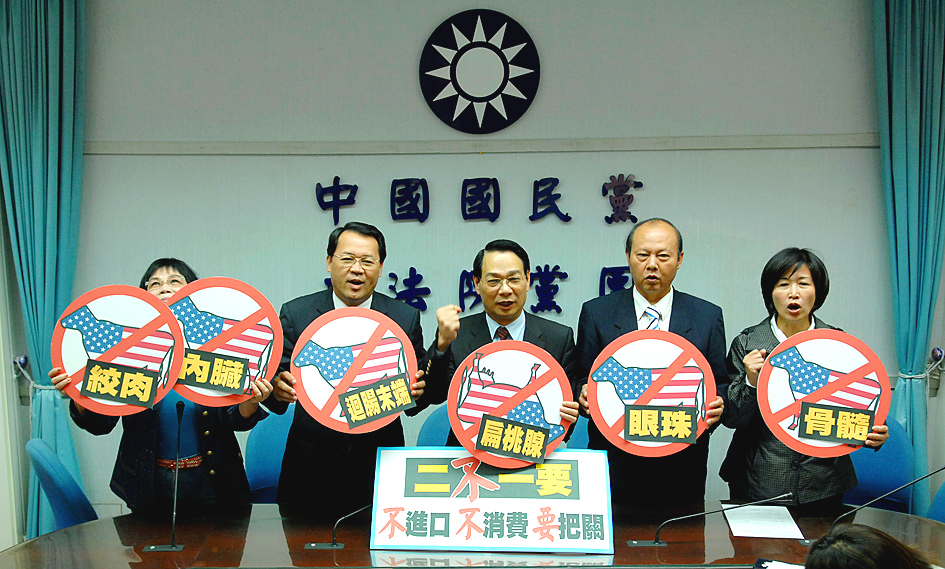
PHOTO: CNA
The afternoon session was not much better. Cashing in on their numerical leverage, Chinese Nationalist Party (KMT) lawmakers voted in favor of a proposal to prolong the meeting to midnight if necessary.
The session ended at 5:30pm after Su finally made it to the podium and said, “Please refer the council’s budget request to the written report. That’s all.”
During the morning session lawmakers were allowed to speak for three minutes each.
DPP Legislator Ker Chien-ming (柯建銘) demanded Su step down, President Ma Ying-jeou (馬英九) apologize and the government begin new negotiations with Washington. He promised to boycott the Presidential Office and NSC budgets if his demands were not met.
DPP Legislator Lee Chun-yee (李俊毅) criticized the protocol Taipei signed with Washington, saying it amounted to a humiliating surrender of the country’s sovereignty.
“Unless Su delivers a satisfactory report to the committee, we refuse to review their budget plans,” he said.
Describing Su as an “enemy of the state” and a “sinner of Asia,” DPP Legislator Liu Chien-kuo (劉建國) said it was amazing how the KMT administration ignored a legislative resolution demanding the executive branch obtain legislative consent before lifting the ban on US beef.
DPP Legislator Gao Jyh-peng (高志鵬), in a play on words, said in Hoklo (also known as Taiwanese) that Su made Taiwan “Su Su Ki” (輸輸去) or “lose everything” at the negotiating table and that the deal had cost Taiwan so much that it would have to “pull its pants down.”
DPP Legislator Chen Ting-fei (陳亭妃) said she would like to know exactly what the government offered to seal the deal, saying that Ma and Su were the masterminds of the policy and that the Department of Health was just a scapegoat.
DPP legislators William Lai (賴清德) and Kuan Bi-ling (管碧玲) both asked Su to tell the public once and for all whether he has a valid green card or US citizenship and if he has made a real effort to protect the health of the Taiwanese.
DPP Legislator Yu Tian (余天) criticized Premier Wu Den-yih (吳敦義) for being irresponsible for saying that it was up to the public to decide whether to eat US beef.
Yu asked if Wu would also lift the ban on marijuana and tell the public it was their decision whether to use it.
DPP Legislator Tsai Huang-liang (蔡煌瑯) criticized the administration for being incompetent in domestic affairs, obedient to China and weak in foreign affairs.
KMT lawmakers, however, criticized the former DPP administration for violating a 2006 legislative resolution to allow the import of US beef, although they said the resolution was “not legally binding.”
KMT Legislator Wu Ching-chih (吳清池), however, said he was “100 percent” against lifting the ban on cow intestines. He also demanded American Institute in Taiwan (AIT) Director William Stanton apologize for comparing eating beef with motorcycle accidents.
Stanton said on Tuesday that “when you look at the risk, statistically, [in contrast to] no cases of mad cow disease [reported in the US], well, one might conclude that one should stop driving motor scooters because of the risk.”
KMT lawmakers asked Su to comment on both the green card allegation and the uproar over beef imports.
Su first denied that he had a green card and then dismissed the allegation that there had been any trade-offs in the negotiations. He also ruled out the possibility of relaunching negotiations, saying it would be a significant blow to the country’s credibility and reputation.
Criticizing the foreign policy of the former DPP administration, he said the KMT administration was trying to turn things around. He said the country must make friends with the US, Japan and China and that there would be more negotiations in the future including an economic cooperation framework agreement with Beijing.
As for the decision making on US beef import, he said Ma gave only three instructions: safety, safety, safety.
“Our priority is the health of the Taiwan people,” Su said. “The Americans thought we were very tough at the negotiating table.”
A one-year study by the government concluded that the risks posed by bone-in beef, intestines and ground beef were miniscule, so the administration decided to follow the “South Korean model” and partially lift the ban on US beef, he said.
While a US report claimed that government officials would review the 30-month age limit for cows and consider full trade access 180 days after the new protocol takes effect, Su said this was “misinformation.” Taipei and Washington would review the “implementation” of the policy, he said.
NO SECRET DEALS
Wu Den-yih also dismissed the need for the government to renegotiate the deal.
Wu told reporters yesterday that said he respected beef importers’ decision not to apply for imports of US cow’s internal organs and ground beef. He also rebutted media speculation that there had been any under-the-table deals with the US.
“The government would never sacrifice the health of the people in exchange for [something] from the US,” he said.
Meanwhile, KMT caucus members continued to voice their opposition to the import plan. Caucus secretary-general Lu Hsueh-chang (呂學樟) suggested that the legislature pass a resolution to empower the government to delete cow’s internal organs from the list of beef products allowed to enter Taiwan.
Cheng Ru-fen (鄭汝芬), caucus deputy secretary-general, called on housewives to boycott cow’s internal organs from the US.
President Ma Ying-jeou (馬英九) also defended the government’s decision to relax import restrictions, while promising to respect any boycotts.
“The government will not exchange the people’s health for anything with foreign countries. Any products we import will comply with both local and international health and safety regulations,” Ma said at a KMT event yesterday.
He said the government agreed to import US ground beef, bone-in beef and internal organs to follow the rules in bilateral negotiation as a member of international organizations.
“The negotiations were made to seek more space for the country’s participation in international society,” he said.
Ma said the government would act as the “gatekeeper” to ensure public safety, but said: “We respect any consumers who decide to adopt higher standards or take certain action.”
SCHOOL LUNCHES
Taichung Mayor Jason Hu (胡志強), a KMT member, announced yesterday that US beef or beef products would not be served in school lunches in his city.
“I accept the government policy but execution of the policy would be a different story, because public health must be the foremost priority. The central government should publish a list of US beef exporters and the history of the cattle for every meat shipment,” the mayor said.
The DPP’s Tsai said there was no way to ensure the public would be safe unless such imports were banned.
“No matter how local governments or vendors try to exercise self-monitoring, it will never be completely foolproof. The public might still end up consuming meat and internal organs without knowing,” Tsai said.
Restaurant owners, however, have mixed feelings about the controversial imports.
Sabrina Yu (尤君惠), the manager of Frank’s Texas Barbecue, a steak house in Taipei County that only serves US beef, said the restaurant welcomed the lifting of the ban on bone-in beef such as T-bone steak or ribs, but such items would not appear on its menu until they have been proven to be risk-free, she said.
A beef noodle shop owner in Tamsui Township (淡水) surnamed Chao said he was willing to use imported cow organs from the US such as tripe as long as the price was reasonable and the customers liked the flavor.
“Of course I am worried that some customers who are more politically minded might refuse to eat at my restaurant. But this is a business and if the internal organs from the US are safe and cheap, then I will use them,” he said.
Jeffrey Chen (陳毅達), a graduate student who lived in the US for nine years, said he was not worried about mad cow disease in US beef but still refuses to buy the meat because “it would be supporting a policy that I strongly disagree with.”
The Ma administration should have asked for more from the US before signing the deal, he said.
Taiwan has experienced its most significant improvement in the QS World University Rankings by Subject, data provided on Sunday by international higher education analyst Quacquarelli Symonds (QS) showed. Compared with last year’s edition of the rankings, which measure academic excellence and influence, Taiwanese universities made great improvements in the H Index metric, which evaluates research productivity and its impact, with a notable 30 percent increase overall, QS said. Taiwanese universities also made notable progress in the Citations per Paper metric, which measures the impact of research, achieving a 13 percent increase. Taiwanese universities gained 10 percent in Academic Reputation, but declined 18 percent

Chinese President Xi Jinping (習近平) yesterday met with former president Ma Ying-jeou (馬英九) at the Great Hall of the People in Beijing, with Xi’s opening statement once more emphasizing that people on both sides of the Taiwan Strait are Chinese and that foreign intervention cannot change their inevitable unification. Xi said that 5,000 years of history of zhonghua minzu (中華民族, ethnic Chinese group) have seen their ancestors move to Taiwan to establish new lives, while also documenting them fighting side-by-side against foreign forces and finally freeing Taiwan. “Both sides are Chinese,” and there are no issues that cannot be worked through, he
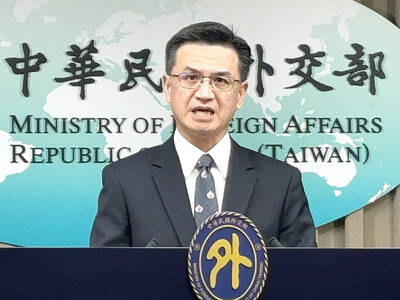
BULLY TACTICS: Beijing has continued its incursions into Taiwan’s airspace even as Xi Jinping talked about Taiwan being part of the Chinese family and nation China should stop its coercion of Taiwan and respect mainstream public opinion in Taiwan about sovereignty if its expression of goodwill is genuine, the Ministry of Foreign Affairs (MOFA) said yesterday. Ministry spokesman Jeff Liu (劉永健) made the comment in response to media queries about a meeting between former president Ma Ying-jeou (馬英九) and Chinese President Xi Jinping (習近平) the previous day. Ma voiced support for the so-called “1992 consensus,” while Xi said that although the two sides of the Taiwan Strait have “different systems,” this does not change the fact that they are “part of the same country,” and that “external
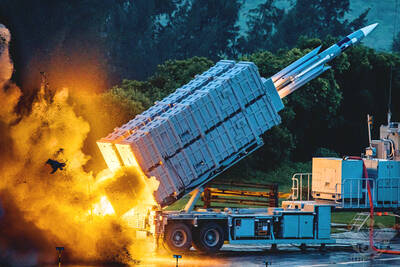
UNDER DISCUSSION: The combatant command would integrate fast attack boat and anti-ship missile groups to defend waters closest to the coastline, a source said The military could establish a new combatant command as early as 2026, which would be tasked with defending Taiwan’s territorial waters 24 nautical miles (44.4km) from the nation’s coastline, a source familiar with the matter said yesterday. The new command, which would fall under the Naval Command Headquarters, would be led by a vice admiral and integrate existing fast attack boat and anti-ship missile groups, along with the Naval Maritime Surveillance and Reconnaissance Command, said the source, who asked to remain anonymous. It could be launched by 2026, but details are being discussed and no final timetable has been announced, the source


 RSS
RSS