


Two former aides to former president Chen Shui-bian (陳水扁) yesterday said they were not involved in wrongdoing as Chen’s embezzlement trial opened at the Taiwan High Court.
Former deputy secretary-general Ma Yung-cheng (馬永成) and former Presidential Office director Lin Teh-hsun (林德訓) said they followed precedents when handling the presidential “state affairs fund” and accused the court of not taking into consideration evidence and statements that helped build their case.
“I did not pocket one dollar of the [state affairs fund],” Ma said.
They were found guilty by the Taipei District Court of helping the former first couple embezzle money from public funds and were sentenced to 20 years and 16 years respectively, and stripped of their civil rights for 10 years and eight years respectively.
The former first family’s bookkeeper, Chen Chen-hui (陳鎮慧), said very little in court. She admitted to the charges against her, but said she wanted to appeal because if she had to return more than NT$100 million (US$3.1 million) in embezzled funds as the district court ruled, she and her family would lose everything they own.
The hearing began several hours after High Court judges ruled at midnight to keep Chen Shui-bian behind bars following a four-hour detention hearing on Thursday night.
Presiding Judge Teng Chen-chiu (鄧振球) listed several reasons for the court’s decision, saying that since Chen left office he has kept in frequent contact with people overseas and, as a former president, he knows more channels for fleeing the country than ordinary citizens. The judges also said that if he chose to escape, he would live comfortably off the funds he and his family had overseas.
The court said because Chen received a life sentence from the lower court, he was a flight risk and would likely hide his assets, so detaining Chen was a necessity as there was no suitable alternative.
Teng had previously ruled on Sept. 24 to keep the former president behind bars for another three months, citing the same reasons.
Chen and his attorneys then filed an appeal against the High Court’s ruling to the Supreme Court, which on Thursday sent the case back to the appeals court for a new hearing.
The Supreme Court said the High Court’s reasons for keeping Chen in detention did not adequately explain why this was necessary and questioned evidence supporting the High Court’s notion that Chen and his family had huge amounts of undisclosed cash and other assets hidden overseas.
The Supreme Court also questioned the High Court’s reasoning that Chen had more channels to flee the country because he was a former president. The Supreme Court asked the lower court to reconsider whether it was necessary to keep Chen detained, since as a former president, he was under 24-hour surveillance by between eight to 12 National Security Council bodyguards.
At the beginning of the hearing, Chen kept his answers brief and let his lawyers do most of the talking. However, toward the end, he spoke for 40 minutes.
Chen said if he had wanted to escape, he “would have done it a long time ago,” but in order to prove he has no intention of leaving the country, he requested that the court inform foreign affairs authorities to void his passport.
He was emphatic when talking about his family’s offshore funds, which he said Swiss authorities had frozen.
He also said that as a former president, he did not know of any methods of escaping the country to which he had access because they were only accessible from places such as the Presidential Office.
Chen has been in detention since last December. He and former first lady Wu Shu-jen (吳淑珍) received life sentences and fines of NT$200 million and NT$300 million respectively in the first trial on Sept. 11.
After the hearing concluded, dozens of Chen’s supporters protested in front the Taiwan High Court, demanding his immediate release.
Led by Democratic Progressive Party (DPP) Taipei Branch director Huang Ching-lin (黃慶林), the protesters wore yellow headbands and held banners supporting the former president and criticizing the legal system for not processing a constitutional interpretation on whether the Taipei District Court’s judicial process was unconstitutional.
“The Council of Grand Justices should promptly interpret whether switching judges in Chen’s trial was unconstitutional. We are calling on Judiciary President Lai In-jaw (賴英照) to stop protecting judges,” said Huang, who said he had not been surprised by the hearing’s outcome “because Taiwan’s judicial system has no fairness to speak of, especially as it is under the Chinese Nationalist Party’s [KMT] control.”
The DPP released a statement expressing “regret” over the High Court’s ruling, saying it had discredited the nation’s legal system.
The decision to continue detaining Chen highlighted the flaws of the system and “seriously disregarded the defendant’s legal rights” by robbing him of a fair trial, the statement said.
DPP acting spokesman Chuang Shuo-han (莊碩漢) said the party would continue to support Chen. A more definite plan of action on how to “save Chen,” which includes the possible mobilization of 1,000 people to sue the Council of Grand Justices for malfeasance, would most likely be announced on Wednesday at the party’s Central Standing Committee, he said.
Meanwhile, National Police Agency Director General Wang Cho-chiun (王卓鈞) said it was inappropriate for Chen to disclose the location of secret tunnels.
KMT Legislator Luo Shu-lei (羅淑蕾) also criticized Chen at the legislature’s State Affairs Forum for revealing the information, saying it was “mean” of him because it would jeopardize the nation’s safety.
Democratic Progressive Party Legislator Wang Sing-nan (王幸男) said he did not think Chen was wrong and attacked the High Court’s decision to keep him in detention.
Also See: EDITORIAL: ... and justice for none
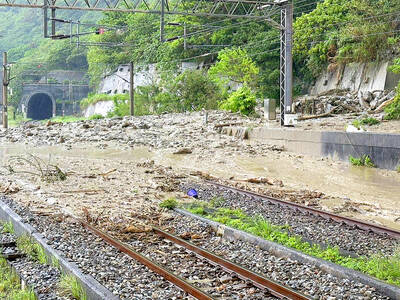
ROLLER-COASTER RIDE: More than five earthquakes ranging from magnitude 4.4 to 5.5 on the Richter scale shook eastern Taiwan in rapid succession yesterday afternoon Back-to-back weather fronts are forecast to hit Taiwan this week, resulting in rain across the nation in the coming days, the Central Weather Administration said yesterday, as it also warned residents in mountainous regions to be wary of landslides and rockfalls. As the first front approached, sporadic rainfall began in central and northern parts of Taiwan yesterday, the agency said, adding that rain is forecast to intensify in those regions today, while brief showers would also affect other parts of the nation. A second weather system is forecast to arrive on Thursday, bringing additional rain to the whole nation until Sunday, it

CONDITIONAL: The PRC imposes secret requirements that the funding it provides cannot be spent in states with diplomatic relations with Taiwan, Emma Reilly said China has been bribing UN officials to obtain “special benefits” and to block funding from countries that have diplomatic ties with Taiwan, a former UN employee told the British House of Commons on Tuesday. At a House of Commons Foreign Affairs Committee hearing into “international relations within the multilateral system,” former Office of the UN High Commissioner for Human Rights (OHCHR) employee Emma Reilly said in a written statement that “Beijing paid bribes to the two successive Presidents of the [UN] General Assembly” during the two-year negotiation of the Sustainable Development Goals. Another way China exercises influence within the UN Secretariat is
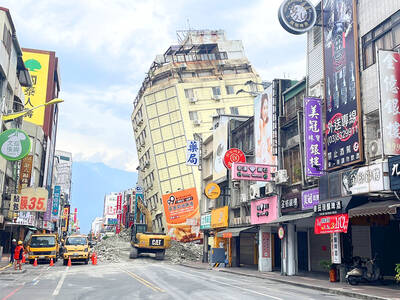
LANDSLIDES POSSIBLE: The agency advised the public to avoid visiting mountainous regions due to more expected aftershocks and rainfall from a series of weather fronts A series of earthquakes over the past few days were likely aftershocks of the April 3 earthquake in Hualien County, with further aftershocks to be expected for up to a year, the Central Weather Administration (CWA) said yesterday. Based on the nation’s experience after the quake on Sept. 21, 1999, more aftershocks are possible over the next six months to a year, the agency said. A total of 103 earthquakes of magnitude 4 on the local magnitude scale or higher hit Hualien County from 5:08pm on Monday to 10:27am yesterday, with 27 of them exceeding magnitude 5. They included two, of magnitude
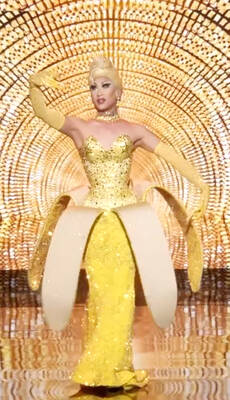
Taiwan’s first drag queen to compete on the internationally acclaimed RuPaul’s Drag Race, Nymphia Wind (妮妃雅), was on Friday crowned the “Next Drag Superstar.” Dressed in a sparkling banana dress, Nymphia Wind swept onto the stage for the final, and stole the show. “Taiwan this is for you,” she said right after show host RuPaul announced her as the winner. “To those who feel like they don’t belong, just remember to live fearlessly and to live their truth,” she said on stage. One of the frontrunners for the past 15 episodes, the 28-year-old breezed through to the final after weeks of showcasing her unique


 RSS
RSS