


More than 17,000 people from across the country packed the Kaohsiung Arena yesterday morning as the Dalai Lama held a two-hour prayer ceremony for the victims of Typhoon Morakot.
Although the ceremony officially started at 9:30am, many people began lining up on Monday night and by 9am the stadium was packed.
Admission to the event was on first-come-first-serve basis beginning at 7:30am.
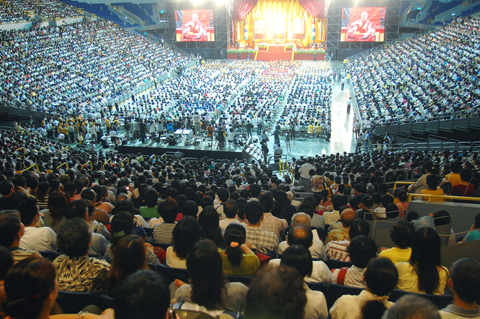
PHOTO: PATRICK LIN, AFP
Aside from locals, hundreds of people arrived from Taipei via charter bus at about 6am.
Awaiting the spiritual leader’s arrival, members of the audience chanted om mani padme hum — the most commonly recited Buddhist mantra — in unison.
“I came here not to take pictures but to do something meaningful,” the Dalai Lama told the audience.
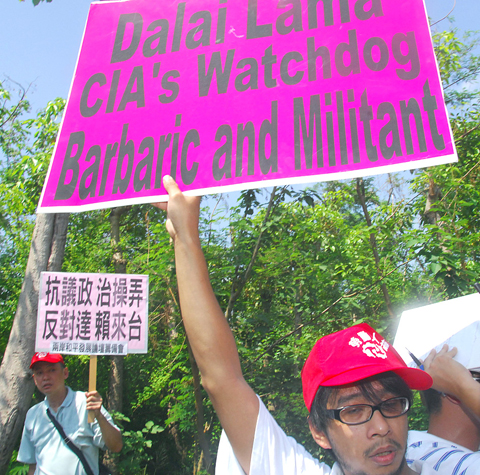
PHOTO: PATRICK LIN, AFP
“All Buddhists today — monks, men and women — must bear compassion at heart, pray and dedicate all the merits to the deceased and their families,” he said.
“Many people asked if we want to do good things and pray, why don’t we just do it in our own rooms? Well, when so many people are gathered here at the same time to pray, we could create a very powerful force that would generate special fruits,” he said.
The leader led the audience in reciting Buddhist chants and commented on the teachings of the Buddha.
He also urged the public to think positively and live their lives without losing confidence, even in difficult times.
“More than 500 people lost their lives in the disaster and the survivors are very worried,” he said.
“But in Linbian Township [林邊, Pingtung County], a lot of fish were able to escape [from fishponds] because of the flooding,” he said, followed by laughter from the audience.
Many people in attendance said they were impressed by the Dalai Lama’s wittiness in his teachings on a subject that can sometimes be dry, as well as his quick reaction to unexpected events.
“It was spectacular and the Dalai Lama was so witty, I loved how he reacted to the collapse of the table, which could have been an embarrassing moment,” a member of the audience surnamed Chao (趙) said after the ceremony was over.
At the beginning of the ceremony, the Dalai Lama asked that a small table in front of his seat be removed. However, as officials were in the process of removing it, it collapsed, to a complete silence in the audience.
The Dalai Lama broke the silence with loud laughter, which triggered more laughter and applauses from the crowd.
Chen Yu-ching (陳毓青), a follower of Tibetan Buddhism, said she was excited to see the Dalai Lama in person for the first time.
“I’m so happy, because I don’t know if I’ll have another chance to see the Dalai Lama again,” she said, adding that she took the day off from work and got up at 5am to drive down from Taichung for the event.
The 1989 Nobel Peace Prize-winner gave another lecture at an auditorium at his hotel in the afternoon.
Most of the problems that trouble our world are manmade, he said, and they can only be resolved when people consider all 6 billion human beings as brothers as sisters.
Many are “too much concerned about the ‘we’ and ‘they’ and are willing to sacrifice one’s life to destroy ‘the other,’” he said.
“That’s foolish, unwise,” he said.
“Think of humanity as part of ‘we,’” he said, adding that thought alone would not resolve all problems, but that problems can be resolved through compromise and dialogue.
Admission tickets for the afternoon lecture were distributed at the hotel starting at noon, with all 500 tickets gone in half an hour.
Unable to secure tickets for the lecture, more than 1,000 people stayed in the hotel lobby and courtyard, hoping to greet the Dalai Lama after the lecture. However, the Dalai Lama returned to his room directly after the lecture.
Not everyone welcomed the Dalai Lama.
Dozens of people from the China Unification Promotion Party (CUPP) and the True Awakening Joint Cultivation Buddhist Association (正覺佛教同修會) staged protests outside the Kaohsiung Arena in the morning and the hotel in the afternoon.
CUPP members shouted slogans accusing the Dalai Lama of engaging in “separatist” activities and claiming that Tibet and Taiwan are part of China.
Members from the True Awakening Buddhist Joint Cultivation Association, meanwhile, held up banners saying that the Dalai Lama refuses to accept the true teachings of the Buddha.
The group, established in 1997, represents a newly evolved Buddhist faction and is strongly critical of Tibetan Buddhism.
At a separate setting yesterday, Premier Liu Chao-shiuan (劉兆玄) said the visit by the Dalai Lama would influence cross-strait relations, but that the government hoped the impact would be minimal and of short duration.
“If the visit remains confined to humanitarian and religious subjects and is purely for the purpose of consoling the souls of the victims, it won’t be a big problem,” Liu told a press conference at the 8th Field Army in Kaohsiung Country’s Cishan Township (旗山), where Cabinet officials set up a makeshift office to oversee resettlement of victims and reconstruction in the wake of Morakot.
Liu said it was impossible to measure the extent of the influence the visit by the Dalai Lama would have on cross-strait relations because “it’s sort of abstract” and the visit is “just beginning.”
Asked whether the visit would hinder the government’s agenda for signing an economic cooperation framework agreement with China, Liu said the matter was “not a unilateral decision” but depended on “how the two sides interact with each other.”
Liu would not comment on the nature of the communication that had occurred between Taiwan and China on the visit by the Dalai Lama, saying that he “was not involved” but was “aware of the process.”
“We had some information and made some impact assessments … But to say more about this would do no good,” Liu said.
Meanwhile in Taipei, Chinese Nationalist Party (KMT) Legislator Lee Hung-chun (李鴻鈞) said the government should take this opportunity to review whether Taiwan is overly dependent on China.
KMT Legislator Lo Shu-lei (羅淑蕾) said the government needed to patch up the nation’s relations with Beijing as soon as possible because between 60 percent and 70 percent of Taiwan’s exports go to China.
ADDITIONAL REPORTING BY FLORA WANG
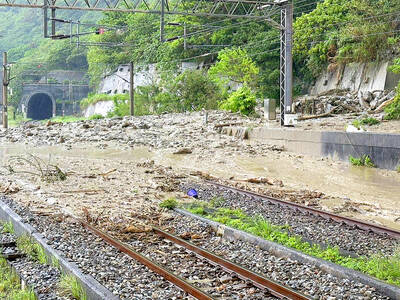
ROLLER-COASTER RIDE: More than five earthquakes ranging from magnitude 4.4 to 5.5 on the Richter scale shook eastern Taiwan in rapid succession yesterday afternoon Back-to-back weather fronts are forecast to hit Taiwan this week, resulting in rain across the nation in the coming days, the Central Weather Administration said yesterday, as it also warned residents in mountainous regions to be wary of landslides and rockfalls. As the first front approached, sporadic rainfall began in central and northern parts of Taiwan yesterday, the agency said, adding that rain is forecast to intensify in those regions today, while brief showers would also affect other parts of the nation. A second weather system is forecast to arrive on Thursday, bringing additional rain to the whole nation until Sunday, it

CONDITIONAL: The PRC imposes secret requirements that the funding it provides cannot be spent in states with diplomatic relations with Taiwan, Emma Reilly said China has been bribing UN officials to obtain “special benefits” and to block funding from countries that have diplomatic ties with Taiwan, a former UN employee told the British House of Commons on Tuesday. At a House of Commons Foreign Affairs Committee hearing into “international relations within the multilateral system,” former Office of the UN High Commissioner for Human Rights (OHCHR) employee Emma Reilly said in a written statement that “Beijing paid bribes to the two successive Presidents of the [UN] General Assembly” during the two-year negotiation of the Sustainable Development Goals. Another way China exercises influence within the UN Secretariat is
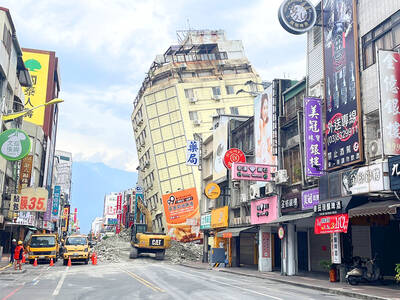
LANDSLIDES POSSIBLE: The agency advised the public to avoid visiting mountainous regions due to more expected aftershocks and rainfall from a series of weather fronts A series of earthquakes over the past few days were likely aftershocks of the April 3 earthquake in Hualien County, with further aftershocks to be expected for up to a year, the Central Weather Administration (CWA) said yesterday. Based on the nation’s experience after the quake on Sept. 21, 1999, more aftershocks are possible over the next six months to a year, the agency said. A total of 103 earthquakes of magnitude 4 on the local magnitude scale or higher hit Hualien County from 5:08pm on Monday to 10:27am yesterday, with 27 of them exceeding magnitude 5. They included two, of magnitude

Taiwan’s first drag queen to compete on the internationally acclaimed RuPaul’s Drag Race, Nymphia Wind (妮妃雅), was on Friday crowned the “Next Drag Superstar.” Dressed in a sparkling banana dress, Nymphia Wind swept onto the stage for the final, and stole the show. “Taiwan this is for you,” she said right after show host RuPaul announced her as the winner. “To those who feel like they don’t belong, just remember to live fearlessly and to live their truth,” she said on stage. One of the frontrunners for the past 15 episodes, the 28-year-old breezed through to the final after weeks of showcasing her unique


 RSS
RSS