


Kim Dae-jung, a renowned democracy campaigner who survived assassination attempts and a death sentence to win South Korea’s presidency and the Nobel Peace Prize, died yesterday aged 85.
“He was declared dead at 1:43pm,” a spokesman for Seoul’s Severance Hospital said. “His heart began failing at 1:35pm and stopped minutes later despite our efforts to revive it.”
Kim, who was president from 1998 to 2003, had been admitted on July 13 with pneumonia and related complications.
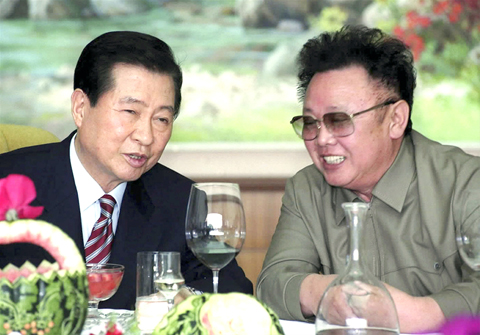
PHOTO: REUTERS
He held South Korea’s first-ever summit with communist North Korea in 2000 and was awarded the Nobel prize later that year.
“We lost a great political leader today,” South Korean President Lee Myung-bak said in a statement. “His accomplishments and aspirations to achieve democratization and inter-Korean reconciliation will long be remembered by the people.”
The presidential office said it would respect the family’s wishes over whether to organize a state funeral. It said Seoul would not stop North Korea from sending a delegation to the funeral if it wishes.
Past leaders, including the man whose government condemned Kim to death, also paid tribute.
Kim campaigned against the 1961 to 1979 rule of dictator Park Chung-hee and in August 1973 South Korean intelligence agents kidnapped him from a Tokyo hotel.
He was about to be dumped in the sea, but intervention by Washington and Tokyo saved his life. In May 1980, during Chun Doo-hwan’s army-backed rule, Kim was thrown into prison on charges of treason. He was sentenced to death by a martial law court but gained a reprieve following strong US pressure.
“I hope former President Kim, who underwent a stormy political life, will rest peacefully in the bosom of God,” Chun told reporters of the devout Catholic.
A wave of mass street protests in 1987 ended decades of army-backed rule, but Kim won the presidency only in 1997 on his fourth attempt.
He took office the following February at the height of the Asian economic crisis, which ravaged South Korea and forced it to seek a US$57 billion bailout from the IMF.
The man once branded as a communist won praise for working with international financial bodies to revive the economy and launch major reforms.
He never wavered on the need for reconciliation with North Korea, even though his policies failed to halt the North’s drive for nuclear weapons and its two atomic tests.
“This is the best way to end the national tragedy and make a reunified motherland,” Kim said in his final speech in office.
In domestic politics, Kim also practiced forgiveness. One of his first acts as president was to pardon Chun, who had been convicted of treason and corruption after leaving office.
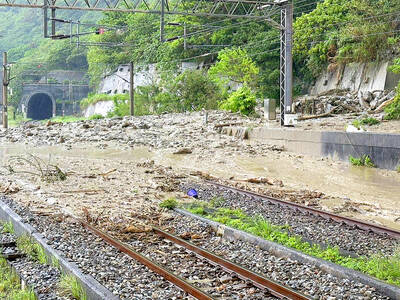
ROLLER-COASTER RIDE: More than five earthquakes ranging from magnitude 4.4 to 5.5 on the Richter scale shook eastern Taiwan in rapid succession yesterday afternoon Back-to-back weather fronts are forecast to hit Taiwan this week, resulting in rain across the nation in the coming days, the Central Weather Administration said yesterday, as it also warned residents in mountainous regions to be wary of landslides and rockfalls. As the first front approached, sporadic rainfall began in central and northern parts of Taiwan yesterday, the agency said, adding that rain is forecast to intensify in those regions today, while brief showers would also affect other parts of the nation. A second weather system is forecast to arrive on Thursday, bringing additional rain to the whole nation until Sunday, it

CONDITIONAL: The PRC imposes secret requirements that the funding it provides cannot be spent in states with diplomatic relations with Taiwan, Emma Reilly said China has been bribing UN officials to obtain “special benefits” and to block funding from countries that have diplomatic ties with Taiwan, a former UN employee told the British House of Commons on Tuesday. At a House of Commons Foreign Affairs Committee hearing into “international relations within the multilateral system,” former Office of the UN High Commissioner for Human Rights (OHCHR) employee Emma Reilly said in a written statement that “Beijing paid bribes to the two successive Presidents of the [UN] General Assembly” during the two-year negotiation of the Sustainable Development Goals. Another way China exercises influence within the UN Secretariat is
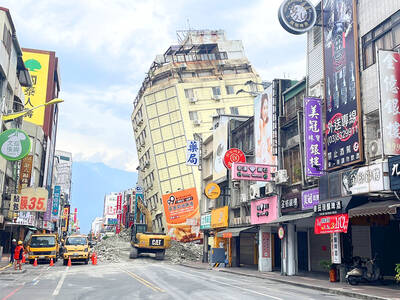
LANDSLIDES POSSIBLE: The agency advised the public to avoid visiting mountainous regions due to more expected aftershocks and rainfall from a series of weather fronts A series of earthquakes over the past few days were likely aftershocks of the April 3 earthquake in Hualien County, with further aftershocks to be expected for up to a year, the Central Weather Administration (CWA) said yesterday. Based on the nation’s experience after the quake on Sept. 21, 1999, more aftershocks are possible over the next six months to a year, the agency said. A total of 103 earthquakes of magnitude 4 on the local magnitude scale or higher hit Hualien County from 5:08pm on Monday to 10:27am yesterday, with 27 of them exceeding magnitude 5. They included two, of magnitude

Taiwan’s first drag queen to compete on the internationally acclaimed RuPaul’s Drag Race, Nymphia Wind (妮妃雅), was on Friday crowned the “Next Drag Superstar.” Dressed in a sparkling banana dress, Nymphia Wind swept onto the stage for the final, and stole the show. “Taiwan this is for you,” she said right after show host RuPaul announced her as the winner. “To those who feel like they don’t belong, just remember to live fearlessly and to live their truth,” she said on stage. One of the frontrunners for the past 15 episodes, the 28-year-old breezed through to the final after weeks of showcasing her unique


 RSS
RSS