


President Ma Ying-jeou (馬英九) had a brief exchange with US Secretary of State Hillary Clinton on Sunday in an unofficial but symbolic meeting.
Introducing himself as “president of Taiwan,” Ma thanked Clinton for Washington’s support on cross-strait matters.
He told Clinton his administration would do everything it could to stabilize cross-strait relations, to which she replied that this was what the US hoped for, adding: “That’s good for everyone.”

PHOTO: CNA
The exchange took place at a state dinner hosted by former Salvadoran president Elias Antonio Saca on Sunday, the last day of his presidential term.
Ma and Clinton, who were seated at the same table, exchanged greetings after Clinton approached Ma and first lady Chow Mei-ching (周美青).
Taiwan and the US suspended high-level contact after Washington switched allegiance to Beijing in 1979.
In 2003, then-president Chen Shui-bian (陳水扁) met then-US secretary of state Colin Powell during a visit to Panama to attend the country’s centenary celebrations.
In May 2006, Chen exchanged greetings with then-US first lady Laura Bush at an inauguration ceremony for Costa Rican President Oscar Arias in San Jose.
Ma led a 159-member delegation to Salvadoran President Mauricio Funes’ inauguration, which took place on Monday. Accompanying him were his wife, local government heads, college officials, student representatives and a performance group.
Ma made a stopover in Los Angeles on his way to El Salvador and will stop in Seattle on his way back. The delegation is scheduled to return to Taipei tomorrow.
At a gathering with Taiwanese reporters after the inauguration, Ma downplayed his encounter with Clinton.
“I am the president of the Republic of China,” he said. “I will respond if somebody calls me ‘president of Taiwan’ but I am not the president of the Republic of Taiwan.”
Ma said since the situation in the Taiwan Strait is “very sensitive,” it would be best to view his brief exchange with Clinton as an “exchange of polite greetings” at a diplomatic function.
“Only by doing so can we obtain the trust of our allies that have or do not have diplomatic ties with us,” he said. “We want them to know that we are stable and do not want to make trouble.”
But Taiwan cannot rely on occasional meetings alone to strengthen relations with the US, Ma said, adding that being low-key and “surprise-free” were the best policy.
Ma told reporters he did not think the meeting was “accidental.”
The Ministry of Foreign Affairs (MOFA) had previously said Ma and Clinton would likely meet at the event.
Ma said it was apparent during his trip that his foreign policy and efforts to improve cross-strait relations over the past year had been successful and had earned recognition.
Ma said success in these areas had boosted his confidence, adding that he had achieved the goals he set for the trip and that the outcome was “better than expected.”
Ma said he was not against El Salvador’s plan to develop business ties with Beijing, and that the government’s relationship with El Salvador would be based on openness and practicality.
On foreign aid offered to diplomatic allies, Ma said his policy was teaching them to fish rather than feeding them for a day.
Ma held talks with Honduran President Jose Manuel Zelaya and Nicaraguan President Daniel Ortega after the inauguration.
During Ma’s meeting with Zelaya, the two agreed that Taiwan would assist Honduras in three areas: construction technology for power facilities, development of clean energy and urban development, said Presidential Office Spokesman Wang Yu-chi (王郁琦), who accompanied Ma on the trip.
Meanwhile, although representatives of the Chinese Communist Party were invited to attend Funes’ inauguration, they declined the invitation.
Back in Taipei, Chinese Nationalist Party (KMT) Legislator Lee Ching-hua (李慶華) put El Salvador’s use of the term “Republic of Taiwan” in a press release down to the MOFA’s negligence.
“This is ridiculous. Our ally doesn’t even know the name “Republic of China.” This also proves that MOFA has neglected its duties,” Lee told reporters.
Also yesterday, the Democratic Progressive Party (DPP) caucus panned Ma for staying at the Hilton Los Angeles/Universal City Hotel during his stopover in Los Angeles.
The hotel is run by the fugitive former Tuntex Group chairman, Chen Yu-hao (陳由豪).
In an ironic twist, Ma met with American Institute in Taiwan Chairman Raymond Burghardt at the hotel to talk about signing an extradition treaty
“Ma and MOFA did not care that Chen is the most wanted criminal in the country,” DPP Legislator Yeh Yi-ching (葉宜津) said yesterday, adding that MOFA should not have let Ma stay at the hotel.
ADDITIONAL REPORTING BY FLORA WANG AND RICH CHANG
Also See: MOFA to blame for security tiff, lawmaker says
Also See: Activists planning to protest outside Ma's Seattle hotel
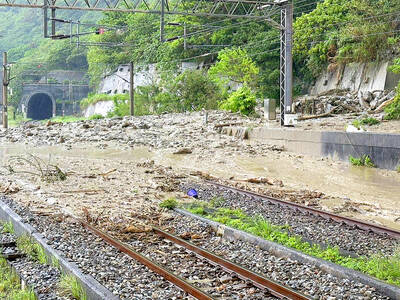
ROLLER-COASTER RIDE: More than five earthquakes ranging from magnitude 4.4 to 5.5 on the Richter scale shook eastern Taiwan in rapid succession yesterday afternoon Back-to-back weather fronts are forecast to hit Taiwan this week, resulting in rain across the nation in the coming days, the Central Weather Administration said yesterday, as it also warned residents in mountainous regions to be wary of landslides and rockfalls. As the first front approached, sporadic rainfall began in central and northern parts of Taiwan yesterday, the agency said, adding that rain is forecast to intensify in those regions today, while brief showers would also affect other parts of the nation. A second weather system is forecast to arrive on Thursday, bringing additional rain to the whole nation until Sunday, it
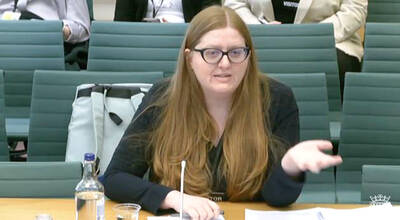
CONDITIONAL: The PRC imposes secret requirements that the funding it provides cannot be spent in states with diplomatic relations with Taiwan, Emma Reilly said China has been bribing UN officials to obtain “special benefits” and to block funding from countries that have diplomatic ties with Taiwan, a former UN employee told the British House of Commons on Tuesday. At a House of Commons Foreign Affairs Committee hearing into “international relations within the multilateral system,” former Office of the UN High Commissioner for Human Rights (OHCHR) employee Emma Reilly said in a written statement that “Beijing paid bribes to the two successive Presidents of the [UN] General Assembly” during the two-year negotiation of the Sustainable Development Goals. Another way China exercises influence within the UN Secretariat is
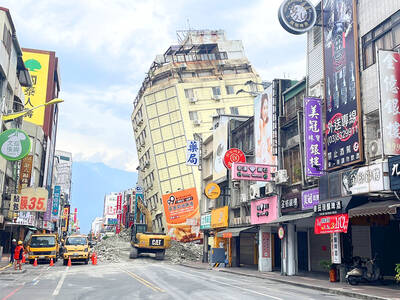
LANDSLIDES POSSIBLE: The agency advised the public to avoid visiting mountainous regions due to more expected aftershocks and rainfall from a series of weather fronts A series of earthquakes over the past few days were likely aftershocks of the April 3 earthquake in Hualien County, with further aftershocks to be expected for up to a year, the Central Weather Administration (CWA) said yesterday. Based on the nation’s experience after the quake on Sept. 21, 1999, more aftershocks are possible over the next six months to a year, the agency said. A total of 103 earthquakes of magnitude 4 on the local magnitude scale or higher hit Hualien County from 5:08pm on Monday to 10:27am yesterday, with 27 of them exceeding magnitude 5. They included two, of magnitude
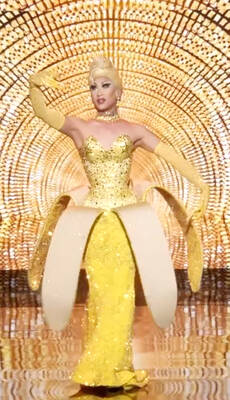
Taiwan’s first drag queen to compete on the internationally acclaimed RuPaul’s Drag Race, Nymphia Wind (妮妃雅), was on Friday crowned the “Next Drag Superstar.” Dressed in a sparkling banana dress, Nymphia Wind swept onto the stage for the final, and stole the show. “Taiwan this is for you,” she said right after show host RuPaul announced her as the winner. “To those who feel like they don’t belong, just remember to live fearlessly and to live their truth,” she said on stage. One of the frontrunners for the past 15 episodes, the 28-year-old breezed through to the final after weeks of showcasing her unique


 RSS
RSS