


Democratic Progressive Party (DPP) Chairperson Tsai Ing-wen (蔡英文) said yesterday that Sunday’s round of cross-strait talks were a failure that made concessions on sovereignty but did not help Taiwanese businesses.
Tsai said the failure of the talks was inevitable given President Ma Ying-jeou’s (馬英九) “mindset.”
She said the Ma government made four mistakes: It made concessions on sovereignty before the talks; it relied too much on China’s goodwill and the Chinese economy; it avoided consultation with or supervision from the legislature and opposition parties; and it had no way of ensuring that national security officials and the government’s negotiators had no conflict of interest.
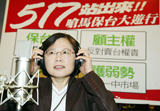
PHOTO: CNA
Tsai said Ma had made a comment supporting Chinese President Hu Jintao’s (胡錦濤) speech marking the 30th anniversary of Beijing’s “open letter to Taiwanese compatriots,” which highlighted the “one China” principle, and which was a concession on sovereignty.
The government also gave up negotiations on the “fifth freedom of the air,” essentially implying that cross-strait flights are domestic flights, she said.
The DPP leader also criticized the government for failing to ink an extradition agreement with China and said the latest financial agreement would only give Taiwan nominal equality because the terms were unfavorable to Taiwan.
Tsai called on the public to join a rally on May 17 against the Ma government’s China-leaning policies and “poor performance.”
Meanwhile, DPP Legislator Gao Jyh-peng (高志鵬) said if the Chinese Nationalist Party (KMT) government avoided putting the three agreements to a legislative vote and allowed them to be enacted by default, it would face a huge protest on May 17.
Article 95 of the Statute Governing Relations Between Peoples of the Taiwan Area and the Mainland Area (兩岸人民關係條例) stipulates that a cross-strait agreement automatically takes effect 30 days after being signed if the legislature does not reject it within that period.
Gao warned the government against allowing the pacts to take effect on June 25, saying the four agreements signed at the previous round of talks were enacted by default last December despite the DPP’s opposition.
He said Article 63 of the Constitution granted the legislature the power to decide by resolution on treaties, and if the KMT-dominated legislature stalled a legislative review of the three new agreements or rejected the legislature’s resolution powers, the DPP and the public would make their voices heard on the streets.
Gao said the legislature should immediately review the pacts and summon National Security Council (NSC) Secretary-General Su Chi (蘇起), Straits Exchange Foundation (SEF) Chairman Chiang Pin-kung (江丙坤), Mainland Affairs Council Chairwoman Lai Shin-yuan (賴幸媛) and other officials for questioning.
Presidential Office Spokesman Wang Yu-chi (王郁琦) said that Su was unlikely to report to the legislature because Ma disagreed with the DPP’s request, which he thought was “unreasonable.”
The president believed that if Su complied with the request it would create a constitutional controversy because Su was an adviser, not a decision maker, Wang said.
Except during reviews of the NSC’s budget and its organic law, Su was not legally required to report to the legislature, Wang said. If the DPP legislative caucus made an official request, Ma would instruct Su to ignore it, the spokesman said.
Meanwhile, Chinese Nationalist Party (KMT) caucus secretary-general Yang Chiung-ying (楊瓊瓔) urged the DPP not to politicize the cross-strait economic agreements.
Yang said the Fifth Freedom of the Air needed to be negotiated “in proper sequence” in future cross-strait talks.
“We will work toward the [fifth] freedom while both sides of the Taiwan Strait remain at peace. We hope our friends at the DPP will stop politicizing economic issues,” she told a press conference.
She also urged the government to focus on improving the quality of the nation’s tourism industry to attract more tourists from China.
When approached for comment, KMT Legislator Chang Hsieh-yao (張顯耀), a member of the Foreign and National Defense Committee, said the third round of cross-strait talks had been successful because progress had been made in terms of regular cross-strait charter flights, cross-strait financial cooperation and crime-fighting.
Chang dismissed media speculation that China had dominated the talks, saying that “domination only happens during negotiations, but this was a meeting.”
When asked for comment on the omission of an economic cooperation framework agreement (ECFA) on the agenda for future talks, KMT Legislator Wu Den-yih (吳敦義) said it was more important for politicians across party lines to reach a consensus regarding an ECFA.
Wu said the KMT respected the DPP’s plan to hold the May 17 rally, but he urged the DPP to respect those who would not join the demonstration.
Meanwhile, former vice president Annette Lu (呂秀蓮) called for transparency in cross-strait negotiations, saying they must be conducted under legislative supervision.
Lu said she was curious to know who authorized Chiang to negotiate with Association for Relations Across the Taiwan Strait (ARATS) Chairman Chen Yunlin (陳雲林) and why the public was kept in the dark about the content of the three agreements. Lu made the remarks before attending a panel discussion on Taiwan’s sovereignty at her office yesterday morning.
Lu said cross-strait negotiations, regardless of the scope or nature of the issue, must be conducted in a transparent fashion.
Before negotiations, Lu said, the issue and content of any agreement should be made public and the government should seek a public consensus.
After an agreement has been signed, it must undergo legislative oversight, she said.
Without legislative oversight, Lu said, there was no justice and the agreement should be deemed invalid.
She urged the public to scrutinize the entire process of cross-strait negotiations.
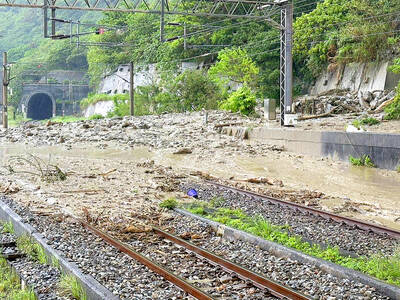
ROLLER-COASTER RIDE: More than five earthquakes ranging from magnitude 4.4 to 5.5 on the Richter scale shook eastern Taiwan in rapid succession yesterday afternoon Back-to-back weather fronts are forecast to hit Taiwan this week, resulting in rain across the nation in the coming days, the Central Weather Administration said yesterday, as it also warned residents in mountainous regions to be wary of landslides and rockfalls. As the first front approached, sporadic rainfall began in central and northern parts of Taiwan yesterday, the agency said, adding that rain is forecast to intensify in those regions today, while brief showers would also affect other parts of the nation. A second weather system is forecast to arrive on Thursday, bringing additional rain to the whole nation until Sunday, it

CONDITIONAL: The PRC imposes secret requirements that the funding it provides cannot be spent in states with diplomatic relations with Taiwan, Emma Reilly said China has been bribing UN officials to obtain “special benefits” and to block funding from countries that have diplomatic ties with Taiwan, a former UN employee told the British House of Commons on Tuesday. At a House of Commons Foreign Affairs Committee hearing into “international relations within the multilateral system,” former Office of the UN High Commissioner for Human Rights (OHCHR) employee Emma Reilly said in a written statement that “Beijing paid bribes to the two successive Presidents of the [UN] General Assembly” during the two-year negotiation of the Sustainable Development Goals. Another way China exercises influence within the UN Secretariat is
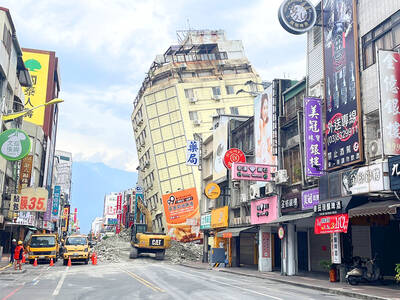
LANDSLIDES POSSIBLE: The agency advised the public to avoid visiting mountainous regions due to more expected aftershocks and rainfall from a series of weather fronts A series of earthquakes over the past few days were likely aftershocks of the April 3 earthquake in Hualien County, with further aftershocks to be expected for up to a year, the Central Weather Administration (CWA) said yesterday. Based on the nation’s experience after the quake on Sept. 21, 1999, more aftershocks are possible over the next six months to a year, the agency said. A total of 103 earthquakes of magnitude 4 on the local magnitude scale or higher hit Hualien County from 5:08pm on Monday to 10:27am yesterday, with 27 of them exceeding magnitude 5. They included two, of magnitude

Taiwan’s first drag queen to compete on the internationally acclaimed RuPaul’s Drag Race, Nymphia Wind (妮妃雅), was on Friday crowned the “Next Drag Superstar.” Dressed in a sparkling banana dress, Nymphia Wind swept onto the stage for the final, and stole the show. “Taiwan this is for you,” she said right after show host RuPaul announced her as the winner. “To those who feel like they don’t belong, just remember to live fearlessly and to live their truth,” she said on stage. One of the frontrunners for the past 15 episodes, the 28-year-old breezed through to the final after weeks of showcasing her unique


 RSS
RSS