


South Korea yesterday vowed a stern response and Japan threatened new sanctions after North Korea’s rocket launch, but the UN struggled for agreement on whether to punish the communist state.
“North Korea’s reckless act that threatens regional and global security cannot be justified under any circumstances,” South Korean President Lee Myung-bak said in a radio address, promising a “stern” response to provocations.
Japan’s government will decide on Friday on new bilateral sanctions, Japanese Chief Cabinet Secretary Takeo Kawamura said. Japanese Foreign Minister Hirofumi Nakasone said it hoped the UN Security Council would agree on a resolution to condemn North Korea.
The council adjourned on Sunday after three hours of closed-door talks with no accord on a response to what Western members called a clear breach of UN resolutions.
Members were to continue consultations.
North Korea announced on Sunday that a long-range rocket had placed into orbit a communications satellite that was beaming “immortal revolutionary songs” in praise of its former and current leaders, former North Korean president Kim Il-sung and North Korean President Kim Jong-il.
Kim Jong-il was present at the launch and “warmly encouraged” scientists and technicians before having his picture taken with them, state media said yesterday.
South Korea and the US military said a satellite never made it into space. A senior Russian military source also said there were no signs of a satellite.
Seoul, Washington and Tokyo, along with other countries, said the launch was a pretext to test a long-range Taepodong-2 missile in violation of UN resolutions.
One diplomat at the UN said US Ambassador to the UN Susan Rice, backed by her British and French colleagues, pressed for “strong condemnation” of the launch.
But Russia, China, Libya, Uganda and Vietnam called for restraint so as not to endanger the six-nation talks on North Korea’s nuclear disarmament.
“All countries concerned should show restraint and refrain from taking action that might lead to increased tension,” China’s UN Ambassador Zhang Yesui (張業遂) told reporters on Sunday.
“The use of ballistic missile technology is a clear violation of the resolution, which prohibits missile-related activities,” Rice said in reference to Resolution 1718 passed after North Korea’s missile and nuclear tests in 2006.
Rice said the council might take up a resolution or a non-binding statement that would reaffirm existing sanctions.
Lee later called for China’s support in dealing with North Korea in a meeting with visiting Chinese Communist Party propaganda chief Li Changchun (李長春), Yonhap news agency reported.
Iran said yesterday that North Korea’s launch was justified and denied any links between the two countries’ missile programs, which analysts have widely alleged.
“We have always maintained that space can be used for peaceful purposes by adhering to international laws,” a Iranian foreign ministry spokesman said. “As it is our right to do so, we maintain that others also have that right.”
The Indian foreign ministry said the launch could have a “destabilizing” effect in the region but urged international restraint.
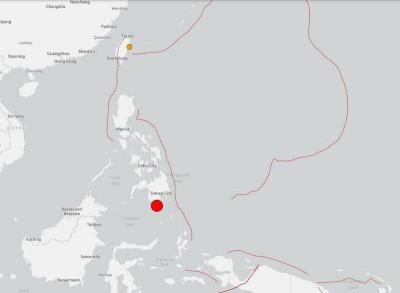
A magnitude 7.8 earthquake struck off the southern coast of Mindanao in the Philippines at 7:38am today, prompting the US Tsunami Warning System to issue an alert for neighboring countries, including Taiwan. The system issued a purple alert indicating a "tsunami threat." The potential threat zone includes Taiwan, the Philippines, Papua New Guinea, Yap and Palau. Philippine authorities were assessing the damage from the quake, with the office of civil defense seeking to verifying initial reports that 15 people had been killed and 129 injured in the region, mostly from falling debris. Arlene Hollero, disaster chief of Maasim town in the Philippines' Sarangani Province,
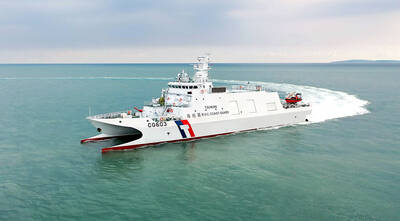
‘GRAY ZONE’ PRESSURE: Beijing’s activities are intended to create the deceitful impression that China has jurisdiction over the area around Taiwan, the CGA said Taiwan’s rights over its territorial waters and exclusive economic zone must not be violated by any country, the Mainland Affairs Council said yesterday, adding that it will not accept any unprovoked actions. The council issued the remarks in response to the China Coast Guard conducting maritime enforcement drills near eastern Taiwan and claiming to fully exercise China’s maritime administrative law enforcement authority. The Coast Guard Administration (CGA) has been closely monitoring the situation and is taking concrete steps to defend the nation’s sovereignty and secure its waters, the council said. China has no sovereign rights over the waters off eastern
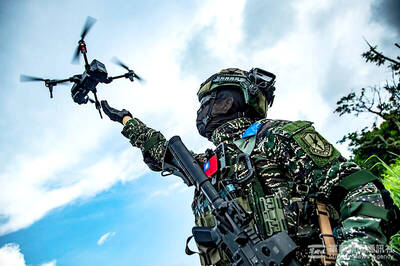
RESILIENCE: Taiwan plays a key role in semiconductors, energy, information infrastructure and advanced manufacturing, AIT Director Raymond Greene said Taiwan’s continued investment in deterrence and resilience remains vital, especially in uncrewed systems and other emerging technologies, American Institute in Taiwan (AIT) Director Raymond Greene said yesterday. Greene made the remarks at the annual National Strategic Summit on Supply Chain Resilience held by the Research Institute for Democracy, Society and Emerging Technology (DSET), a government-backed think tank. As Taiwan last year became the US’ fourth-largest trading partner and supply chain security is becoming more important, cooperation in emerging technologies continues to deepen between the two countries, he said. The US is committed to accelerating innovation, building key infrastructure, strengthening cooperation

RIGHT DIRECTION: Taiwan’s efforts to prevent forced labor include a proposal to ‘fully prohibit’ employers from withholding workers’ documents, an official said Taiwan is to establish a mechanism to restrict imports of goods linked to forced labor, the Executive Yuan said yesterday, after the US proposed imposing additional tariffs on Taiwanese goods over labor concerns. “The Ministry of Labor and the Ministry of Economic Affairs are to establish an interministerial review procedure,” Executive Yuan spokesperson Michelle Lee (李慧芝) said at a news briefing in Taipei. “The government is to use the Foreign Trade Act [貿易法] as the legal basis to restrict imports of goods produced with forced labor” and bring its supply chain governance more in line with international standards on human rights, resilience


 RSS
RSS