


President Ma Ying-jeou (馬英九) yesterday reiterated the government’s determination to sign an economic cooperation framework agreement (ECFA) with China.
Ma said that signing an ECFA with China would prevent Taiwan from being marginalized amid regional economic development, but said that his administration was willing to listen to opposing voices.
“We welcome all those who feel they have something to lose from an ECFA to speak up and voice their concerns. The government will examine the situation and include any items that may cause problems later,” Ma told reporters at the Presidential Office.
Stressing the urgency of the economic pact, Ma said the government planned to exchange ideas about the agreement with China during the forthcoming round of cross-strait talks between Straits Exchange Foundation (SEF) Chairman Chiang Pin-kung (江丙坤) and Association for Relations Across the Taiwan Strait (ARATS) Chairman Chen Yunlin (陳雲林) in Beijing.
He said he expected more substantial details to be discussed after the third round of negotiations. The two sides could reach a conclusion on certain details of the agreement after the negotiations, scheduled for May or June, he added.
“The situation is unfavorable for us when other nations are teaming up and we are left on the sidelines,” Ma said, insisting that signing an ECFA would help strengthen economic cooperation with the nation’s major trading partners.
While acknowledging that signing an ECFA with China would not guarantee that other nations would be more willing to sign free-trade agreements (FTA) or similar economic pacts with Taiwan, Ma said signing an ECFA was a necessary step toward more economic cooperation with other countries.
Without such a framework, industries such as textiles, petrochemicals and heavy machinery would relocate overseas, creating more unemployment, Ma said.
In response to concerns about the economic pact’s impact on the national interest and the nation’s sovereignty from the Democratic Progressive Party (DPP) and representatives of the leather and shoe industries, Ma said he would invite DPP Chairperson Tsai Ing-wen (蔡英文) to discuss the issues with him.
When asked to comment on Tsai’s call for a debate on the issue, Ma said a debate was not necessary.
As the ruling party, the government would seek a public consensus and promote the signing of an ECFA through explaining the policy, he said.
“We will continue to communicate with the public on the ECFA issue, but we won’t [abandon] the agreement because the opposition parties are against it,” Ma said.
Ma promised that signing an ECFA would not mean sacrificing the nation’s sovereignty because the issue would not be part of the discussions.
Also yesterday, Premier Liu Chao-shiuan (劉兆玄) restated his position that the government would not negotiate an ECFA under a political framework set out by Beijing, saying the talks would not reach a result under that framework.
Liu made the remarks during a question-and-answer session with DPP legislators Wang Sing-nan (王幸男), Chai Trong-rong (蔡同榮) and Kuo Wen-cheng (郭玟成).
“[Chinese President] Hu Jintao (胡錦濤) stipulated that China and Taiwan should scrupulously abide by the so-called ‘one China’ principle. Signing an ECFA with China would imply acceptance of that principle,” Chai said.
“Whatever [China] has said, there are things I have insisted on. We don’t have to act on [China’s words] in this regard; we should be confident in ourselves,” Liu said. “No matter what kind of political framework is set out [by the Chinese], issues to be dealt with within the context of an ECFA are connected to economics and trade. The talks will not touch upon sovereignty-related issues.”
Wang asked Liu if China would refrain from objecting to other nations signing FTAs with Taiwan after an ECFA is signed.
“Although an ECFA is not a prerequisite for possible FTAs with other nations, it would help push them forward,” Liu said, adding that the government had started talks on FTAs with some ASEAN members.
Meanwhile, DPP sources said yesterday that the party was planning to hold a large demonstration on May 17 to protest the Ma administration’s “incompetent governance” and its proposal to sign an ECFA with China.
The date had been selected to coincide with Ma’s first anniversary in office, said the sources, adding that details would be announced on March 29.
ADDITIONAL REPORTING BY LEE HSIN-FANG
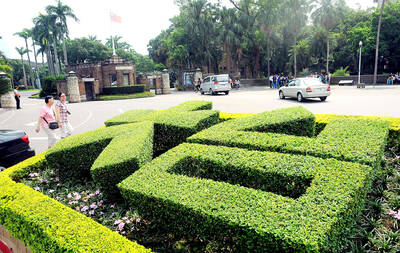
Taiwan has experienced its most significant improvement in the QS World University Rankings by Subject, data provided on Sunday by international higher education analyst Quacquarelli Symonds (QS) showed. Compared with last year’s edition of the rankings, which measure academic excellence and influence, Taiwanese universities made great improvements in the H Index metric, which evaluates research productivity and its impact, with a notable 30 percent increase overall, QS said. Taiwanese universities also made notable progress in the Citations per Paper metric, which measures the impact of research, achieving a 13 percent increase. Taiwanese universities gained 10 percent in Academic Reputation, but declined 18 percent

Chinese President Xi Jinping (習近平) yesterday met with former president Ma Ying-jeou (馬英九) at the Great Hall of the People in Beijing, with Xi’s opening statement once more emphasizing that people on both sides of the Taiwan Strait are Chinese and that foreign intervention cannot change their inevitable unification. Xi said that 5,000 years of history of zhonghua minzu (中華民族, ethnic Chinese group) have seen their ancestors move to Taiwan to establish new lives, while also documenting them fighting side-by-side against foreign forces and finally freeing Taiwan. “Both sides are Chinese,” and there are no issues that cannot be worked through, he
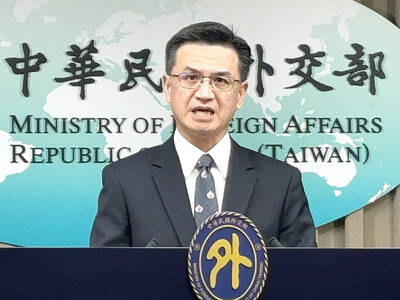
BULLY TACTICS: Beijing has continued its incursions into Taiwan’s airspace even as Xi Jinping talked about Taiwan being part of the Chinese family and nation China should stop its coercion of Taiwan and respect mainstream public opinion in Taiwan about sovereignty if its expression of goodwill is genuine, the Ministry of Foreign Affairs (MOFA) said yesterday. Ministry spokesman Jeff Liu (劉永健) made the comment in response to media queries about a meeting between former president Ma Ying-jeou (馬英九) and Chinese President Xi Jinping (習近平) the previous day. Ma voiced support for the so-called “1992 consensus,” while Xi said that although the two sides of the Taiwan Strait have “different systems,” this does not change the fact that they are “part of the same country,” and that “external
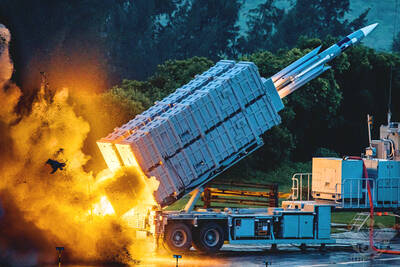
UNDER DISCUSSION: The combatant command would integrate fast attack boat and anti-ship missile groups to defend waters closest to the coastline, a source said The military could establish a new combatant command as early as 2026, which would be tasked with defending Taiwan’s territorial waters 24 nautical miles (44.4km) from the nation’s coastline, a source familiar with the matter said yesterday. The new command, which would fall under the Naval Command Headquarters, would be led by a vice admiral and integrate existing fast attack boat and anti-ship missile groups, along with the Naval Maritime Surveillance and Reconnaissance Command, said the source, who asked to remain anonymous. It could be launched by 2026, but details are being discussed and no final timetable has been announced, the source


 RSS
RSS